
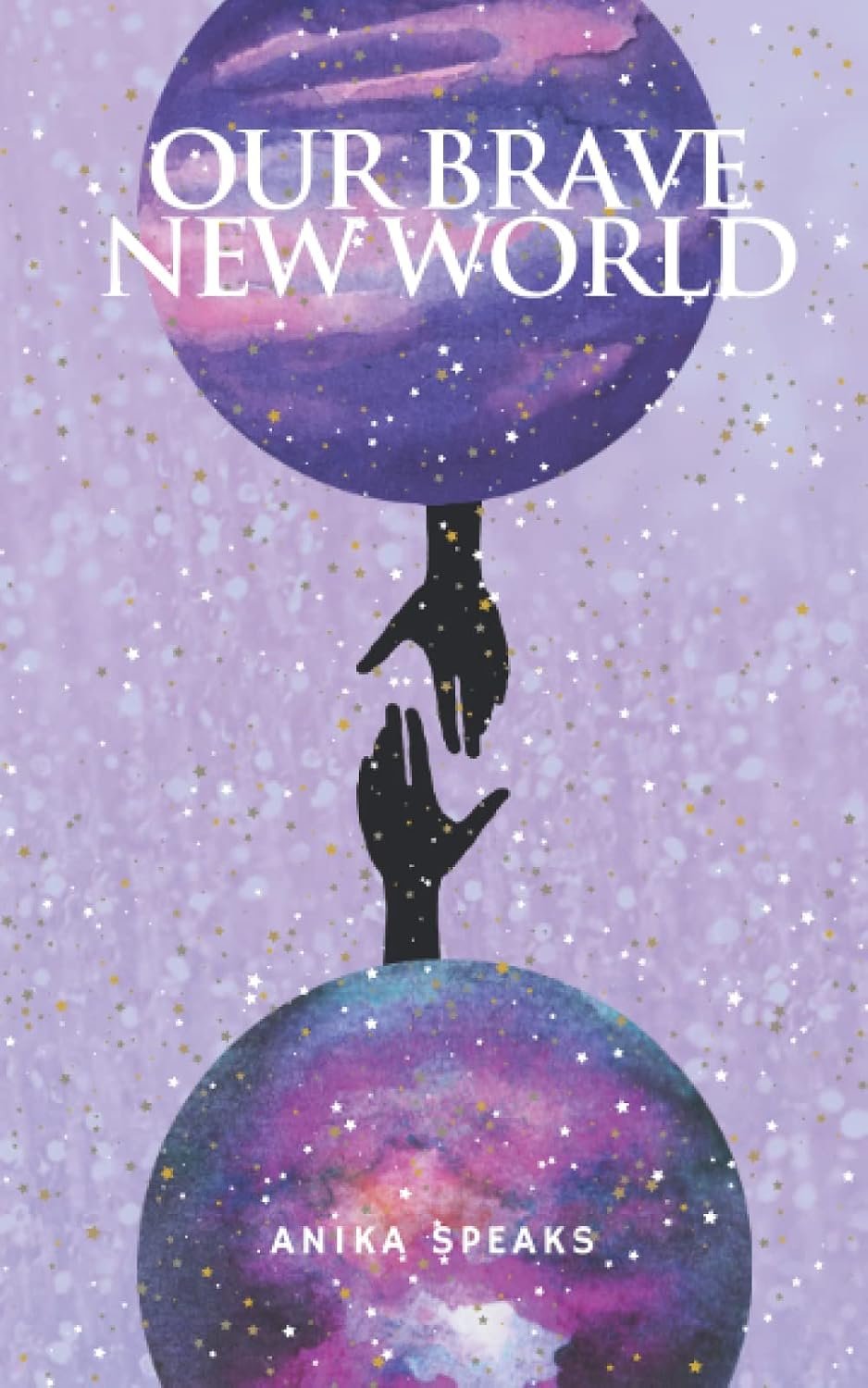
Our Brave New World
A poetry collection written around the pandemic years offers encouragement without reducing difficult times to easy answers.
Books worth discovering. Authors worth knowing.
Anika Speaks wrote toward the difficult days, hoping a poem could make them feel less solitary.
S.
Poetry for Days That Feel Too Heavy
Our Brave New World comes from a period when familiar routines, shared spaces and ordinary reassurances were suddenly unsettled. Anika Speaks explains on her website that she wrote the collection during the COVID years, with the intention of encouraging people facing difficult days. Importantly, she also says relatively few poems directly discuss the pandemic. That distinction guides an accurate reading of the book’s purpose. Its origin belongs to a particular era, but the writer’s stated hope is that its words might travel beyond that immediate situation.
The title sounds expansive, almost like a declaration that everything has changed. Yet the author’s description turns the emphasis toward the individual reader who may be discouraged, lonely or uncertain. Poetry can address those experiences without demanding a long continuous narrative. A brief piece may offer a rhythm, image or thought that a reader carries into the rest of the day. The public material does not establish the exact wording or sequence of all poems, so any discussion of their particular stanzas would be speculative. The meaningful verified starting point is the author’s intention to uplift.
An encouraging collection is not necessarily one that denies pain. If language about hope becomes too neat, it can feel distant from the situations in which people most need comfort. Speaks’s stated commitment to difficult days gives readers reason to look for a gentler relationship between acknowledgment and possibility. A poem can make room for exhaustion and still suggest that the next hour is worth meeting. That is an interpretive framework supported by the book’s public mission, not a claim that one named poem delivers these precise lines or conclusions.
The Difference Between Hope and Optimism
Optimism sometimes describes an expectation that events will work out well. Hope can be more modest: a willingness to keep acting or caring even when the result remains uncertain. Poetry suited to a difficult period may be especially useful when it gives readers permission to inhabit that uncertainty. Anika Speaks does not market the collection as a system for solving problems. She describes a book that might help someone through a dark stretch. That limited promise is both humane and more credible than guaranteed emotional transformation.
People bring different circumstances to encouraging writing. A reader grieving a death, one recovering from a strained relationship and another exhausted by public crises may respond to the same poem in very different ways. That flexibility can be a strength. A small volume of reflective language allows people to return to passages at a pace that suits them, rather than following a prescribed route to improvement. Nothing in the available description suggests that the collection should replace professional care for serious distress; it is a literary companion, not treatment.
The pandemic context makes the word brave in the title especially resonant. Many people learned that resilience did not always look dramatic. It might involve making one more phone call, checking on someone vulnerable or coping with a day of uncertainty. The author’s aim to encourage can be read against that backdrop without insisting that every poem narrates lockdown or illness. This distinction honors the text’s stated reach: born in a hard time, the writing seeks to speak to difficulties that long predate that moment and will outlast it.
A Small Form With Room for Big Feelings
Poetry differs from advice in the work it asks of the reader. An instruction tells someone what to do. A poem may present an image or change the cadence of a feeling, leaving its implications open. In a collection offered as encouragement, this openness matters. Readers are allowed to discover what resonates, to set aside what does not, and to return when circumstances make an earlier line feel different. The experience depends partly on the reader’s participation, not solely on the writer’s message.
A poem also has the capacity to slow attention. In an anxious period, information can arrive faster than people can process it. Condensed language offers a different rhythm: a moment to notice what is being felt before choosing how to respond. We cannot responsibly describe the collection’s exact meter, voice or imagery without verified text excerpts, but the author’s decision to use poetry rather than a conventional self-help manual is meaningful in itself. It places expression and reflection ahead of a checklist of solutions.
Written During Crisis, Not Trapped Within It
The author’s explanation that only a small number of poems directly reference COVID is important to the collection’s identity. Works written during major public events are often categorized so narrowly that readers assume they will be interested only if they want to revisit the event itself. Here the stated goal is broader. Circumstances of composition may have sharpened Speaks’s attention to vulnerability, but the themes of perseverance and encouragement are not exclusive to one historical moment.
A reader encountering the book years later can understand that distinction. The conditions that gave rise to the writing may recede, while questions about fear, patience and connection remain. This is one reason poetry from crisis periods sometimes finds new audiences. Its value may not rest on recording precise news events, but on noticing responses to uncertainty that continue to make emotional sense. Such a claim should be understood as a reading possibility rather than a documented reception history for this specific volume.
The title Our Brave New World can also be heard as a collective statement. Our suggests that readers are not isolated in their difficulties; brave emphasizes that living through change asks something of people. Yet solidarity is not the same as assuming everyone experiences hardship alike. Some face extraordinary burdens of illness, poverty or exclusion. Responsible encouragement needs room for those differences. The author’s modest description of helping others through dark days makes it possible to approach the title as an invitation to companionship, not a demand for relentless positivity.
Anika Speaks and the Purpose of an Author’s Note
The strongest source for understanding Our Brave New World is the author’s own brief explanation on her website. Speaks identifies the period of writing, the relatively small number of poems directly about the pandemic and the intention to uplift others. Those are the book-specific facts that support this feature. They also define a limit. Without a verified table of contents or complete poem texts, one cannot honestly identify recurring characters, claim that a particular poem resolves an emotional conflict or describe artistic devices unique to a particular page.
A book spotlight can still be useful within those limits. Readers may want to know whether a collection is satirical, confessional, political or offered as support. Speaks makes the broad emotional purpose clear. The title, author and listing provide the bibliographic frame; her explanation gives a reason the collection may matter to someone looking for encouraging verse. More precise judgments about craft, imagery or individual poems should come from reading the volume itself, not from extrapolating beyond a brief publicity description.
This transparency distinguishes informed introduction from fabricated criticism. A feature need not pretend to have sampled unseen poems in order to discuss the value of an author making space for hope. It can instead direct attention toward the questions a reader might bring: What does encouragement sound like when it acknowledges pain? Which kinds of language feel supportive rather than prescriptive? How might writing shaped by a public crisis meet the needs of a person facing a private one?
Who Might Reach for This Collection
Our Brave New World is an appropriate title to consider for readers interested in contemporary poetry with an encouraging intention, or for those who like sharing small literary gifts during difficult times. It may also appeal to people studying how artists responded creatively to a period of major social disruption without producing literal records of it. The author’s description supports those audiences. Readers seeking a detailed chronicle of pandemic policy or a scientifically tested resilience method should choose a different kind of book.
The best way to encounter such a collection may be without asking it to repair an entire life. A poem can offer a useful phrase, a sense of company or a reason to pause; it cannot guarantee that grief ends or that circumstances improve. Speaks’s project, as she describes it, is an act of encouragement. That is enough to give it a clear identity while respecting what literature can and cannot responsibly promise.
The collection’s lasting possibility lies in its refusal to confine hope to a single historical episode. Written during the pandemic but aimed at a wider range of difficult days, Our Brave New World suggests that an act of expression can cross time and find another reader when needed. Its title imagines shared bravery, while its form leaves each person free to decide which words offer comfort. The invitation is simple and humane: when the world feels unfamiliar, a little language made with care may help someone feel less alone.
About the book.
Anika Speaks describes this collection as writing produced during the COVID period to uplift others, while noting that relatively few poems explicitly discuss the pandemic.
Editorial book feature, not paid sponsorship. Research-based original commentary from public author, publisher, retailer and bibliographic sources; not a first-hand complete-book review. A cover placeholder will be resolved by the owner’s publishing automation.
Found a book worth opening?
Books worth discovering. Authors worth knowing.
Return to the Journal →