
The Cider Maker’s Secret
In 1763 Herefordshire, a widow fights a punitive cider tax while a secretive newcomer complicates her plans and her heart.
Books worth discovering. Authors worth knowing.
An orchard may look peaceful, but a new tax turns Elizabeth Whitcombe’s livelihood into a political battleground.
S.
An Orchard Under Threat
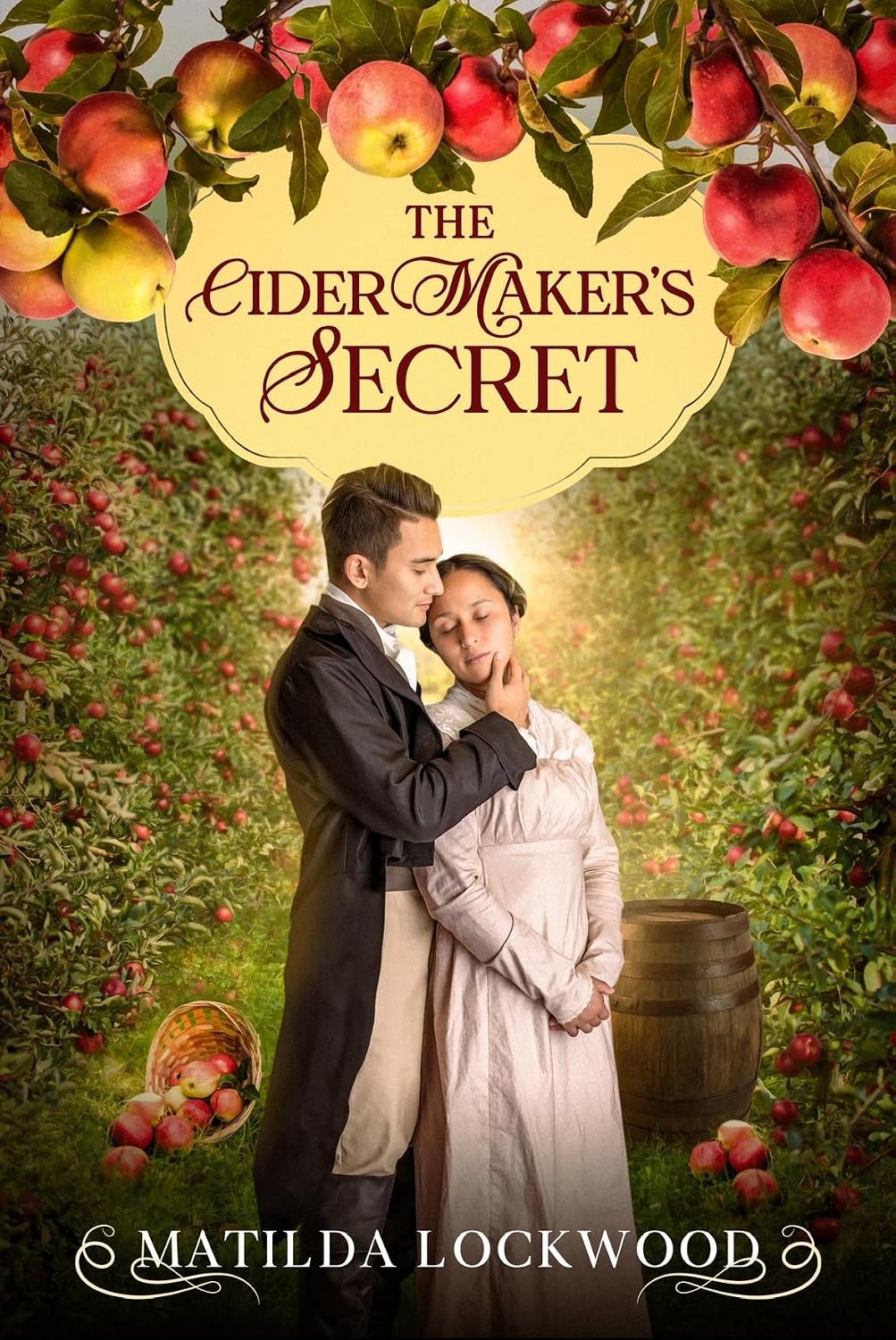
Matilda Lockwood’s The Cider Maker’s Secret brings romance into a historical dispute with immediate consequences for one woman’s livelihood. The story is set in Herefordshire in 1763, when a new tax on cider threatens growers already vulnerable to weather and debt. Elizabeth Whitcombe has managed her orchard through frost, financial strain and the dismissive assumptions of men who believe a widow should surrender control. A Crown assessor’s arrival turns those pressures into an urgent fight over whether the place she has worked to preserve can remain hers.
Historical romance often uses political events as an attractive backdrop while concentrating on private affection. Lockwood’s premise makes the politics central. The orchard represents income, skill, family continuity and Elizabeth’s ability to choose her future. Threatening it with an unpopular levy gives the developing relationship a concrete obstacle that cannot be solved by declaring love. The reader is asked to consider what affection means when the people involved must first confront conditions that make ordinary survival precarious.
Elizabeth’s characterization is anchored in her work. The public synopsis emphasizes her stillroom craft, experience and stubborn determination. She is not simply a woman waiting for rescue. Her knowledge of the orchard is a form of authority, even when the surrounding culture refuses to recognize it as such. The romance becomes more interesting because another person’s arrival need not erase that expertise. A satisfying partnership, if it is to emerge, must reckon with the life Elizabeth has already built and refuses to abandon.
Nathaniel Carter Arrives With Secrets
Nathaniel Carter crosses the Atlantic carrying a history he is reluctant to disclose. The published description does not establish every detail of that past, and readers should have the pleasure of discovering those revelations in the novel. What is clear is that he becomes drawn to the Whitcombe orchard and to the woman fighting for its survival. His attraction places him near practical and political risks that are not exclusively his own, raising the question of how trustworthy he can be when significant parts of his story remain hidden.
The newcomer and the established orchard keeper bring different kinds of experience into the same landscape. Elizabeth understands the demands of land, harvests and business conducted under restrictive expectations. Nathaniel knows something of travel and a wider transatlantic world. Their contrast gives a slow-burn romance room to explore what each person initially misunderstands about the other. Rather than assume that proximity produces trust, the premise suggests trust must be developed through decisions made under pressure.
Secrets are a familiar romance device, but their moral weight depends on context. Nathaniel may have reasons to guard his past, yet Elizabeth has good reasons to be cautious with anyone whose choices could endanger her home. The book’s framing around scars, obligation and redemption invites readers to think about whether love can make truth safer to tell. It would be premature to announce how the characters resolve those tensions. The emotional promise lies in watching guarded people decide what honesty requires.
The Cider Tax and the Cost of Resistance
A distinctive feature of the story is its use of the 1763 cider tax as a source of plot momentum. A tax may sound dry beside the language of romance, but taxes reach directly into everyday work. Growers must calculate costs, protect stock and decide whether rules leave them enough resources to continue. Lockwood turns that economic pressure into narrative urgency. Elizabeth’s orchard is not an abstract symbol of freedom: it is a working enterprise with vulnerable trees, records, products and relationships that depend on its survival.
The synopsis identifies a forged folio that briefly buys the characters three days of grace. That detail condenses their dilemma into a narrow window. They need more time than the legal machinery appears willing to allow, and improvisation creates its own dangers. The forgery is a fictional plot device, not advice on evading taxes or altering records. Its dramatic importance lies in showing how desperate people may act when ordinary channels seem insufficient to protect what matters to them.
The novel’s historical setting also invites attention to who has the right to own, work and defend property. A widow’s capacity to act independently could be shaped by family expectations and social norms as well as legislation. The precise legal details of Elizabeth’s fictional situation belong to Lockwood’s narrative and should not be generalized without historical verification. Still, the published premise clearly connects gendered condescension with fiscal danger. Elizabeth has to resist both a public demand on her business and private pressure to step aside.
When Work Becomes a Love Language
Many romances build attraction around physical proximity or sparkling conversation. The Cider Maker’s Secret offers another possibility: two people can begin to understand one another through shared attention to difficult work. Caring for an orchard requires seasons of observation, patience and a willingness to prepare for outcomes that cannot be guaranteed. Those qualities resemble the demands of a slowly developing relationship. The connection is interpretive, but it arises naturally from the book’s verified setting and emphasis on resilience.
Elizabeth’s knowledge of cider-making and orchard management gives her a grounded identity that should remain visible alongside the romantic plot. Nathaniel’s arrival becomes consequential only because the enterprise already has a history worth protecting. This arrangement resists the fantasy that a heroine’s previous life exists simply to be replaced by a new partner. A more compelling romance asks whether affection can help preserve and change that life without erasing the person’s previous commitments or achievements.
The author has publicly described an interest in historical characters who are strong, creative and deeply human. That statement provides useful context for Elizabeth’s position. Strength here need not mean absolute independence or immunity to fear. A woman facing tax collectors, debt and uncertain allies may be brave because she continues making difficult choices while fully aware of the risk. A relationship that recognizes such vulnerability can be richer than one built solely on admiration for heroic competence.
Winter, Spring and the Shape of Hope
The book’s publicity links the movement of the seasons to its emotional arc. Winter grafts give way toward spring, suggesting that patient work may eventually generate new growth. In an orchard, renewal is neither instantaneous nor guaranteed. Trees need attention, favorable conditions and sometimes difficult pruning. As a metaphor for trust, the seasonal cycle suits a slow-burn romance in which past wounds and present obligations cannot be resolved by one declaration.
The synopsis also alludes to a fragile family the characters are building. Readers can regard that as an important emotional dimension without inventing the identity or actions of family members whose full stories remain to be discovered. Lockwood’s published author interview mentions a disabled girl who perceives more than the adults around her, adding another possible perspective within the setting. This information should be attributed carefully to the author’s description rather than expanded into imaginary scenes or a detailed account of the girl’s circumstances.
Historical details can enrich this emotional landscape by reminding readers that every generation improvises within limits it did not choose. Elizabeth cannot remove the tax by force of personality, just as Nathaniel cannot erase his earlier choices by wishing them away. Their potential growth depends on deciding which risks are worth taking now. That creates a resonance between the orchard’s future and the relationship’s future: both require practical action as well as faith that change is possible.
A Romance Rooted in Particular Soil
The Cider Maker’s Secret is most likely to appeal to readers who prefer historical romance with working livelihoods, political pressures and characters whose vulnerabilities are established before the courtship begins. Its named setting, Herefordshire in 1763, differentiates it from vaguely old-fashioned love stories. The cider levy and Elizabeth’s business provide stakes beyond whether the couple admits an attraction. The Atlantic crossing adds distance and unanswered questions to Nathaniel’s role without requiring the feature to reveal what the book holds back.
Readers should also understand the tonal promise. Lockwood describes a slow-burn romance of resilience and redemption. This points toward patient emotional development rather than an immediate, uncomplicated romance. Historical context matters, but the book is fiction, not a textbook about the 1763 tax. A reader curious about that policy can enjoy the novel while verifying its broader history independently; a reader seeking the characters’ intimate choices can follow their story without having to master every detail of eighteenth-century taxation.
At its heart, the premise centers two people who must decide whether to risk what they already have for a possibility they cannot yet fully trust. Elizabeth’s orchard anchors the novel in labor, memory and responsibility. Nathaniel’s secretive arrival makes love another kind of uncertainty. Lockwood brings them together under a political deadline, turning fruit trees, ledgers and the coming spring into more than picturesque scenery. In this story, hope must prove that it can survive both the tax collector and the difficult work of growing something together.
About the book.
A slow-burn historical romance follows widowed orchard owner Elizabeth Whitcombe and transatlantic newcomer Nathaniel Carter amid the 1763 English cider tax.
Sponsored book feature. Research-based original commentary from public author, publisher, retailer and bibliographic sources; not a first-hand complete-book review. A cover placeholder will be resolved by the owner’s publishing automation.
Found a book worth opening?
Books worth discovering. Authors worth knowing.
Return to the Journal →