
Curtains of Rain
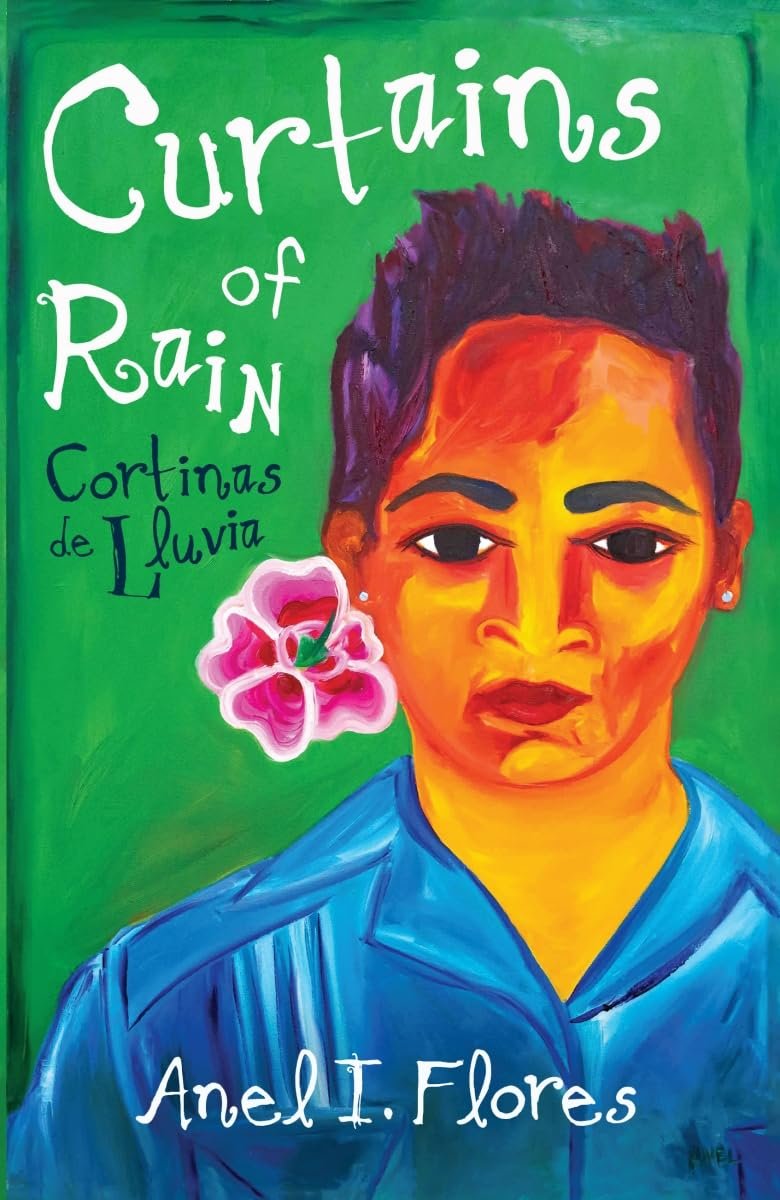
Solitaria returns to her border-town past after fifteen years, confronting family, faith, belonging and queer survival.
Books worth discovering. Authors worth knowing.
A return home can reopen a wound—and make possible a kind of belonging that departure could not secure.
S.
Returning to a Town That Tried to Exile You
Anel I. Flores’s Curtains of Rain: Cortinas De Lluvia follows Solitaria Gaviota-Alaniz as she confronts a place she left fifteen years earlier. The library catalogue’s description identifies an exorcism as the event preceding her flight from her hometown. That disturbing history gives the return a charge beyond ordinary nostalgia. Solitaria is not simply revisiting childhood streets. She is facing a community and a history in which her identity was treated as something to be expelled or corrected. The book’s stakes begin with survival and move toward the possibility of reclaiming a life on different terms.
The novel brings together intergenerational queer and genderqueer lives from a border-town setting, with San Antonio playing an important part in the network of relationships. Family here cannot be understood only through descent or conventional household arrangements. The public synopsis identifies Solitaria’s gay uncles, her nonbinary friend Toni and a wider community of workers and performers who become part of her support. These connections suggest a rich social world in which care can be offered beyond institutions that once caused harm.
Flores’s title is bilingual, and the library record notes movement between English and Spanish in the text. That language choice belongs to the book’s representation of borderland identity. A code-switching novel does not merely decorate its setting with occasional foreign words. It can make visible the way speakers move between communities, histories and emotional registers. Without quoting unseen passages, one can still recognize that language itself is part of the work’s stated cultural form and should be approached with attention rather than treated as an obstacle to be removed.
Solitaria and the Search for a Lost Self
The synopsis describes Solitaria’s return as a search-and-rescue mission for the self she lost. That metaphor changes the meaning of homecoming. She is not travelling back to be judged by the old community’s standards. She is searching for parts of her own history that fear and rejection have made difficult to hold together. The distinction matters because narratives of reconciliation sometimes assume that the wounded person must forgive or accommodate every source of harm in order to heal. This premise instead gives agency to the person returning.
Fifteen years is long enough for memory to become complicated. A place once experienced primarily as dangerous can contain moments of affection, cultural belonging and unresolved grief. A survivor may want to reconnect with some relationships and maintain distance from others. The book’s public description indicates that Solitaria negotiates both personal trauma and family complexity. It does not establish a neat final settlement, and a responsible feature should not announce one. The emotional tension lies in the act of approaching what was once unbearable.
The name Solitaria itself suggests an intriguing tension between solitude and community, though any linguistic resonance should be considered an interpretation rather than a documented authorial explanation. Her path appears populated by people who can challenge isolation without making all suffering disappear. A chosen family may provide safety, humor, criticism and the ordinary duties of belonging. That is different from a fantasy in which one supportive conversation instantly repairs years of exclusion. The novel’s emphasis on a network rather than a lone rescuer makes the possibilities more complex.
Queer Familia as a Living Social World
The publisher-supplied synopsis names gay tíos, Toni, panaderas and drag queens as participants in the story’s social fabric. Their presence signals a cultural world with work, performance, kinship and shared history, not simply a list of identity labels. Readers can expect questions about who gets to define family and how communities preserve a sense of belonging when dominant institutions treat certain forms of love or self-expression as unacceptable. The names and roles are grounded in public material; their particular scenes and conversations remain for the novel to reveal.
The term familia can carry both warmth and tension. Blood relatives may be loving, rejecting or divided; chosen relationships can provide deep care but also require effort and accountability. Flores’s intergenerational focus suggests that no single generation has an exclusive claim on understanding queerness or survival. Younger people may inherit strategies of resistance from elders while questioning customs that no longer serve them. Older people may learn new language from those coming after. Such exchanges offer a richer concept of continuity than any uncomplicated story of progress.
San Antonio is more than an interchangeable urban backdrop within the description. It connects borderland history with contemporary queer community, art and labor. A person returning from exclusion may encounter forms of solidarity that were once invisible or inaccessible. The city’s particular cultural setting can shape that possibility. The reader should nevertheless resist treating any community as uniformly accepting; the story’s interest in survival presupposes conflict and uneven access to safety. Belonging is made and defended, not automatically provided by geography.
Exorcism, Shame and Religious Harm
The event that drove Solitaria away involved an exorcism, a word with intense religious and cultural implications. In this context it is presented as part of a history of homophobia, not as evidence that queer identity is a condition requiring spiritual correction. The distinction is fundamental. The novel’s synopsis situates the action within coercive rejection and the protagonist’s long-term effort to live fully afterward. The event should be discussed as narrative harm, not sensationalized into supernatural spectacle or treated as legitimate care.
Fiction can give readers language to understand how shame is produced when authority figures claim the right to define another person’s identity. The resulting wounds may be social as well as emotional: separation from family, loss of home, fear of return and uncertainty about which traditions remain open to someone who has been rejected. The catalogue summary explicitly links Solitaria’s history to homophobia. Beyond that, the specific words and actions of individual characters should remain with the text itself rather than be fabricated for dramatic effect.
The novel’s possible power lies in recognizing survival as something other than silence. To live openly may involve rebuilding trust, choosing new boundaries and discovering communities willing to affirm what was previously condemned. That process does not require the story to dismiss religion or tradition in every form. It invites questions about whose needs religious authority serves and how cultural belonging might be reimagined without demanding conformity. The book’s emphasis on redefining tradition suggests a search for transformation rather than mere escape.
Environment, Place and Unequal Burdens
The public synopsis also identifies environmental racism among the novel’s concerns. This expands the story beyond personal reconciliation into questions about whose neighborhoods bear harm and whose voices matter when decisions about place are made. The connection to family and community is not incidental. A landscape includes schools, workplaces, homes and the routes through which people support one another. Damage to that landscape can make already vulnerable lives more precarious and complicate any attempt to return.
A novel can place environmental injustice beside the experience of exclusion because both concern power over a person’s place in the world. Who has the authority to decide where people live, what risks are acceptable, and which traditions deserve protection? Solitaria’s history of being pushed away by homophobia may shape how she perceives other forms of unequal treatment. That is a thematic reading of the synopsis, not a claim that the book contains any particular protest, legal case or environmental incident not established by sources.
A Story of Survival Without Simplification
Curtains of Rain may appeal to readers of queer Latinx fiction, bilingual narratives, family stories and novels about return after exclusion. The book’s catalogue places it within contemporary queer fiction and notes its intergenerational scope. Those descriptors are more helpful than reducing it to a single issue novel. It addresses identity through relationships, cultural memory, work, place and collective imagination. Readers who value literary works that allow communities to be lively and contradictory may find its premise especially compelling.
The subject matter is also significant for readers who want fiction to acknowledge difficult forms of harm without turning survivors into passive symbols. Solitaria’s story is framed around the desire to thrive and love fully. That language places agency at the center. The available synopsis promises confrontation with the past and a rich network of companions; it does not authorize a summary of an ending or an invented account of reconciliation. Leaving those discoveries to the book is part of respecting its complexity.
Flores’s Curtains of Rain: Cortinas De Lluvia appears to ask what home can become when the version one inherited has proved unsafe. The novel’s answer, as presented in public material, is not simply to return or to remain away. It is to make connections, revisit cultural forms and insist that life can include love, dignity and chosen belonging. The journey is grounded in Solitaria’s particular borderland history, but its central question is widely recognizable: how do people reclaim a place in the world without surrendering the self they fought to preserve?
About the book.
This bilingual, code-switching work follows Solitaria Gaviota-Alaniz after an exorcism drove her away from her hometown, and explores queer familia, San Antonio community and environmental racism.
Editorial book feature, not paid sponsorship. Research-based original commentary from public author, publisher, retailer and bibliographic sources; not a first-hand complete-book review. A cover placeholder will be resolved by the owner’s publishing automation.
Found a book worth opening?
Books worth discovering. Authors worth knowing.
Return to the Journal →