
Sacrificial Lambs
A Vatican-centred supernatural thriller about a celestial experiment and a desperate defence.
Books worth discovering. Authors worth knowing.
A Vatican-centred supernatural thriller about a celestial experiment and a desperate defence.
Research-based literary perspective on a verified edition.
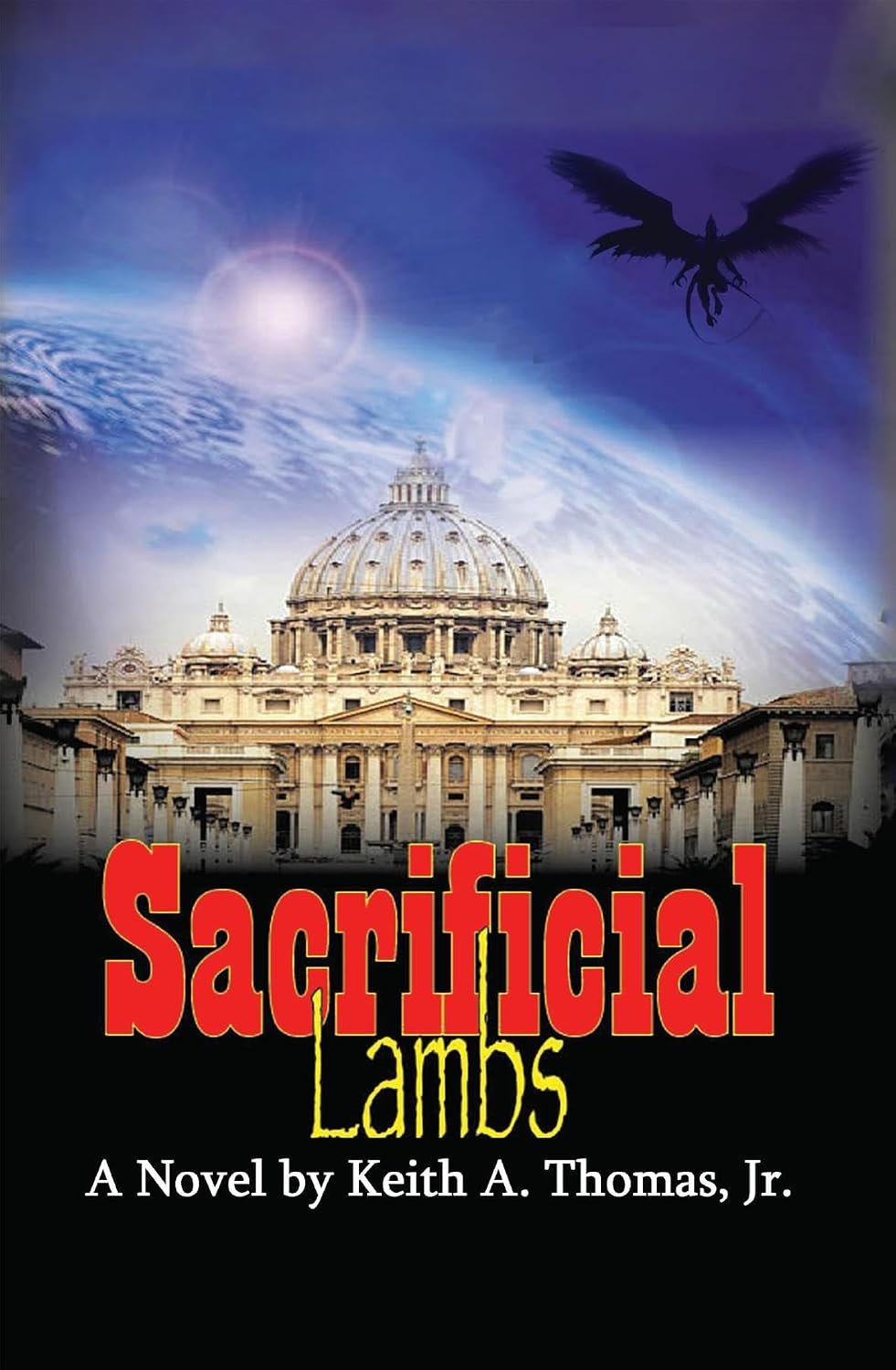
Keith A. Thomas Jr.’s Sacrificial Lambs takes an audacious supernatural premise into one of the world’s most recognizably symbolic settings. According to the published description, a forbidden experiment mixing reptilian and angelic DNA predates Genesis; its escaped result, Natas Christopher, threatens the Vatican with a cloned army and catastrophic destruction. A young angel named Darr, a heavily armed pope and a group of cardinals with secrets must unite to stop a disaster. That unusual cast promises a narrative willing to mix theology-shaped mythology with science-fictional invention and action-thriller urgency. The question is not whether this is ordinary historical realism. It is how a deliberately extravagant world uses familiar moral symbols to dramatize the struggle between responsibility and the desire for power.
When origin stories turn dangerous
Placing the story’s experiment before Genesis immediately expands its imaginative time frame. The idea should be understood as fictional mythology, not as a factual claim about religious history or genetics. Within that invented framework, an ancient technological or celestial mistake returns to threaten the present. This is a durable narrative pattern: a civilization discovers that an effort to control nature has left an obligation it cannot escape. The striking choice here is that the experiment invokes both an angel and a reptilian humanoid, collapsing categories often kept apart in religious fantasy and science fiction.
Hybrid creation stories invite questions about the ethics of making life for a purpose. Who authorized the experiment? Who bears responsibility for the creature’s suffering or violence? Does an origin considered unnatural determine a being’s moral destiny? The public synopsis establishes the catastrophic result and an escaped antagonist, not the detailed answers to those questions. Still, the premise becomes richer when readers look beyond spectacle to the relationship between creation and accountability. A terrible consequence can be feared without pretending that every character understands how it began.
The Vatican as both place and symbol
Choosing Vatican City concentrates the conflict inside a location associated with spiritual authority, ritual and centuries of institutional history. A fantastical siege of such a site carries more than architectural stakes. It can challenge the difference between an institution’s visible power and the moral obligations its leaders claim to represent. A pope with a gun is a vivid reversal of conventional expectations. It turns a figure associated with spiritual guidance into an active defender, raising questions about the relationship between faith, physical force and the protection of vulnerable people.
Such imagery is best approached as creative exaggeration, not commentary that must be translated into real institutional behavior. Fantasy frequently works by forcing familiar symbols into extreme situations. When sacred authority is placed in a story about armies, monsters and old secrets, a reader can ask what survives the collision: courage, humility, solidarity or merely the structures of command. The publisher description does not identify specific historical figures or factual church events; its world should remain understood as the novel’s speculative invention.
An unlikely coalition of defenders
The protagonists are advertised as a ragtag combination of an apprentice angel, a gun-carrying pope and cardinals with baggage of their own. Rather than assembling uniformly idealized champions, this setup emphasizes uneven abilities and imperfect backgrounds. Stories about unlikely coalitions can become moving when they recognize that shared danger does not erase individual flaws. Cooperation must be built under pressure, sometimes by people who would not otherwise choose each other. The result can be an action sequence with genuine moral stakes: saving others requires the characters to act together before they have resolved everything that divides them.
Darr’s description as a young or apprentice angel is especially suggestive. An apprentice exists at the boundary between responsibility and preparation. The role invites a familiar coming-of-age question in an unfamiliar cosmology: how does someone learn to exercise judgement when catastrophe makes gradual learning impossible? The synopsis does not allow a detailed character study, but it clearly positions Darr within the defensive effort. Readers may want to attend to the difference between instinctive bravery and the more difficult patience needed to work with imperfect allies.
Cloning, armies and the multiplication of harm
The antagonist is described as threatening to produce a hybrid army. Cloning in science-fiction fantasy often functions as a metaphor for the multiplication of power: one dangerous act can become a system capable of repeating itself. That idea is frightening not just because many opponents are harder to defeat, but because it turns individuality into something apparently disposable. An army built around replication can be imagined as threatening to overwhelm both bodies and ethical distinctions. The novelist’s imaginative use of cloning should not be mistaken for a realistic scientific proposal. Its dramatic role is to intensify the consequences of an ancient fictional transgression.
This raises a useful way to read action scenes. Is the threat merely numerical, or does the possibility of an expanding army expose a deeper fear that no single victory will be enough? A confrontation with one villain might have a clear end. Stopping a process that keeps reproducing danger requires understanding the source. The synopsis mentions sealing an ancient gateway, indicating that containment rather than mere confrontation may be central to the mission. A reader who notices that distinction can find conceptual interest beneath the book’s promised battles.
Righteousness as a shared test
The available description unites the defenders under a banner of righteousness. That word is powerful and potentially uncomfortable because it suggests moral certainty during a crisis. A compelling supernatural thriller can test whether a shared declaration of virtue is enough, or whether those who make it must demonstrate restraint and care in their actions. The cardinals’ concealed histories, briefly noted in the synopsis, make this issue especially pertinent. People may rally to a good cause while still carrying unresolved failures. The challenge is to act constructively without confusing a righteous mission with personal infallibility.
Thomas’s genre combination offers readers a way to explore this tension without demanding that the fiction operate as a theological argument. Angels, forbidden experiments and supernatural gateways are the materials of an invented dramatic world. They can suggest moral conflicts, but the editorial feature should not claim any religious doctrine has been proved or disproved by the story. The most responsible approach is to enjoy the work’s imaginative energy while recognizing the difference between fantasy cosmology and lived belief.
Who may want to read it
Sacrificial Lambs is most clearly suited to readers who enjoy supernatural horror, apocalyptic fantasy and high-action plots that combine religious iconography with speculative invention. Those drawn to unlikely teams may appreciate the contrast between the youthful angel, the pope and the secretive cardinals. Readers who prefer understated literary realism or careful scientific plausibility are not the obvious audience; the description advertises a consciously extravagant blend. Its premise also involves threatening creatures, large-scale violence and catastrophic peril, so a sample may help readers gauge their comfort with the tone. The novel’s title and imagery invite reflection on sacrifice, but the publicly verified description does not support claims about particular sacrifices in the ending.
Bibliographic listings credit Keith A. Thomas Jr. as author and describe a novel that crosses fantasy, the paranormal and apocalyptic science fiction. This feature draws on those descriptions rather than firsthand reading. The central appeal is the grand collision of scales: an ancient secret, the fate of a city steeped in spiritual meaning, and a small group whose willingness to stand together may matter more than their apparent suitability for the task.
About the book.
A Vatican-centred supernatural thriller about a celestial experiment and a desperate defence. The purchase link preserves the original listing in the queue.
This is an independent research-based editorial introduction, not a claim to firsthand reading or a personal review of the full book. Sources comprise publicly available publisher, retailer or bibliographic descriptions and the verified queue and cover; detailed interior content has not been independently examined.
Found a book worth opening?
Books worth discovering. Authors worth knowing.
Return to the Journal →