
The 100 Most Common Entrepreneur Mistakes
A business guide focused on preventable mistakes, customer needs and adaptive judgement.
Books worth discovering. Authors worth knowing.
A business guide focused on preventable mistakes, customer needs and adaptive judgement.
Research-based literary perspective on a verified edition.
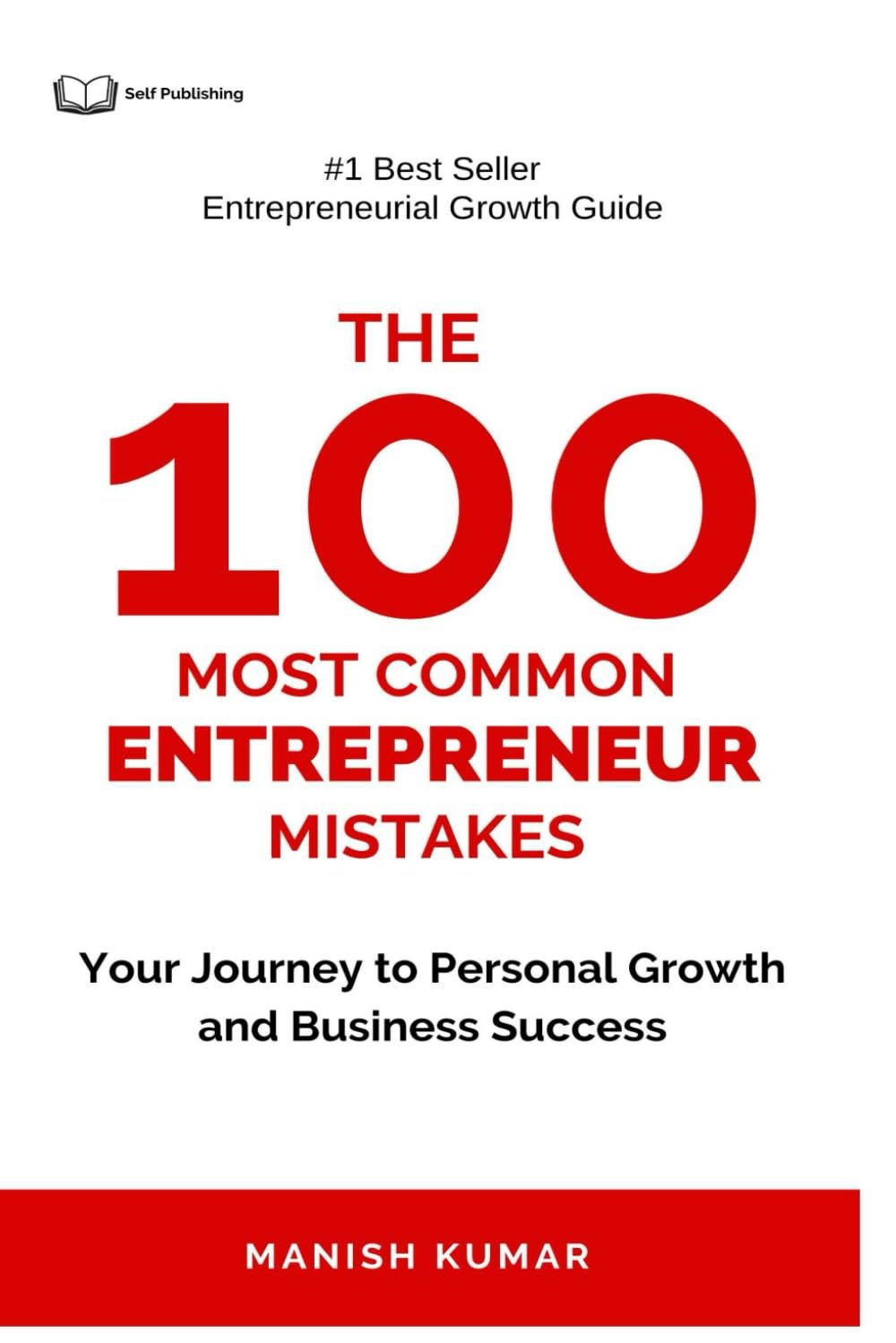
A great business idea is not the same as a viable business. Manish Kumar’s The 100 Most Common Entrepreneur Mistakes takes that difficult distinction as its organising promise. The public publisher description identifies familiar but costly areas of failure: ignoring customers, neglecting legal protections, misreading changing conditions and failing to build trust. It presents real-life examples and actionable strategies as a way to help entrepreneurs recognize trouble before it becomes irreversible. The value of a book with a numbered list of mistakes depends not merely on how many items it includes, but on whether it encourages readers to replace vague confidence with careful observation, honest feedback and decisions that can be revised.
Why lists of mistakes can be more useful than success stories
Entrepreneurship is often marketed through exceptional outcomes: the founder who saw an opportunity nobody else recognized, took a dramatic risk and built a remarkable company. These stories can be inspiring, but they are vulnerable to hindsight. Once we know a venture succeeded, earlier decisions appear more logical than they may have felt at the time. A catalogue of recurring errors can correct that bias by turning attention toward the ordinary decisions that rarely receive celebratory headlines. It asks not only what an excellent founder did, but what a careful founder might have avoided.
Of course, no list can remove uncertainty from business. A decision that proves unwise in one market may be sensible in another, and an outcome can be influenced by timing, resources and luck. The most productive way to use a mistakes guide is therefore as a series of diagnostic questions rather than a set of universal prohibitions. Where are the assumptions? What has been tested? Which costs are still hidden? The published description suggests Kumar wants readers to address blind spots, an aim that works best when the material is used to improve judgement rather than to punish every past failure.
Customer needs are not a decorative detail
The book’s available description explicitly mentions neglecting customer needs. That error reaches the heart of entrepreneurship because businesses survive by delivering something that other people value. A founder may be fascinated by an elegant technical solution or a clever brand, but enthusiasm is not evidence of demand. Customers can reveal problems that were not visible in the original plan, and they can also challenge assumptions about price, convenience, timing and trust. Listening to them is not a sign of weakness; it is a way of acknowledging that the venture exists in a relationship with people outside its founding team.
Yet “listen to customers” is too simple when treated as a slogan. Different customers may want contradictory things, and vocal feedback does not always represent the broader market. The useful discipline is to distinguish anecdotes from patterns and requests from demonstrated behaviour. A reader approaching Kumar’s book can ask which mistakes arise because founders failed to gather information, and which arise because they gathered it but were unwilling to change course. That distinction turns customer focus into a method rather than a marketing phrase.
The unglamorous architecture of protection
Another identified theme is the neglect of legal protections. Legal paperwork rarely appears in romantic accounts of founding a company, but agreements, ownership arrangements, compliance obligations and records influence how a venture survives conflict. The specifics vary by jurisdiction and business model, so a general entrepreneurship book should not be mistaken for individualized legal advice. What matters at the editorial level is the principle of treating foreseeable risks as part of the business design, not as an afterthought to be addressed only when a dispute occurs.
Entrepreneurs sometimes postpone this work because it appears to slow momentum. That creates a paradox: the desire to move faster can produce future constraints that are far more expensive than early consultation would have been. A good mistakes guide can make such trade-offs visible without turning caution into paralysis. Preparation is not the opposite of boldness. It gives a business clearer knowledge of what it can responsibly promise, how responsibilities are shared and what action is possible when circumstances change.
Adaptation is not failure of conviction
Kumar’s description also emphasizes adapting to market change. That subject is especially important because founding stories often celebrate persistence, while actual markets reward responsiveness to evidence. There is a difference between abandoning a meaningful goal and revising the method by which one hopes to achieve it. A product may serve a real need but reach customers through the wrong channel. A service may be useful but priced in a way that cannot sustain delivery. The task is to identify what is essential in the mission and what is only an initial assumption.
Adaptation also requires emotional discipline. Founders can become attached to a particular approach because it embodies months of work or a cherished sense of identity. Changing course then feels like admitting defeat even when it would preserve the underlying opportunity. A book about common mistakes can provide a vocabulary for separating pride from evidence. The reader should not seek a single formula for when to pivot; instead, they can look for indicators that distinguish a difficult but promising path from one that is no longer supported by what the venture has learned.
Trust as a business asset
The published synopsis identifies building trust and loyalty as important themes. That language is sometimes reduced to customer retention metrics, but trust is a broader promise about behaviour. Customers need reasonable confidence that a seller will describe a product honestly, deliver what is offered, protect relevant information and respond constructively when something goes wrong. Employees and partners need clarity about expectations and commitments. These relationships become especially visible during setbacks, when a venture must decide whether to acknowledge a problem or protect its image.
Trust is difficult to build through slogans because it emerges from repeated experience. A founder who wants loyalty has to consider the systems that make dependable behaviour possible. Are customer-service commitments realistic? Does the organisation have enough capacity to deliver at its advertised standard? Can complaints travel to someone empowered to act? These questions place ethics alongside operations. They also help explain why some mistakes compound: a missed deadline can become a greater problem if the response to it erodes confidence.
A practical way to read one hundred warnings
Rather than reading a list of one hundred potential errors as a forecast of inevitable disaster, readers can turn it into a structured review. Select the few areas most relevant to the current stage of a venture, compare them with actual evidence, and record what action would reduce the uncertainty. The number in the title encourages comprehensiveness, but attempting to fix everything at once may generate more anxiety than progress. Prioritization can be more valuable than exhaustive vigilance. A problem that threatens a company’s legal existence deserves a different response from a minor inefficiency in its branding.
This approach also makes the book useful to people who are not entrepreneurs yet. Someone considering a first project can examine assumptions before investing scarce resources. A team leader inside an established organisation may recognize equivalent errors in product development, communication or client relationships. The book’s subject is entrepreneurship, but the underlying habits of testing, listening and protecting trust are not confined to founders.
Who may want to read it
The 100 Most Common Entrepreneur Mistakes is most directly relevant to founders, small-business owners and aspiring entrepreneurs who prefer a systematic discussion of risks to a purely inspirational account of success. Its coverage of customers, legal safeguards, trust and adaptation may also interest mentors and early-stage team leaders. Readers should approach the material as a learning framework, not a guarantee that following it will make a venture profitable. Business outcomes depend on the industry, economy, resources and execution, and general advice should be supplemented by appropriate professional guidance when money or legal obligations are at stake. The publisher offers a practical guide; the complete text should be judged by how specific and applicable its examples are.
The verified bookseller listing credits Manish Kumar and identifies the work as an entrepreneurship guide. This article has not independently audited every example or business claim in its chapters. Its governing insight is a worthy one nonetheless: entrepreneurial skill is not measured solely by the courage to start, but by a willingness to see preventable mistakes before they become a company’s defining story.
About the book.
A business guide focused on preventable mistakes, customer needs and adaptive judgement. The purchase link preserves the original listing in the queue.
This is an independent research-based editorial introduction, not a claim to firsthand reading or a personal review of the full book. Sources comprise publicly available publisher, retailer or bibliographic descriptions and the verified queue and cover; detailed interior content has not been independently examined.
Found a book worth opening?
Books worth discovering. Authors worth knowing.
Return to the Journal →