
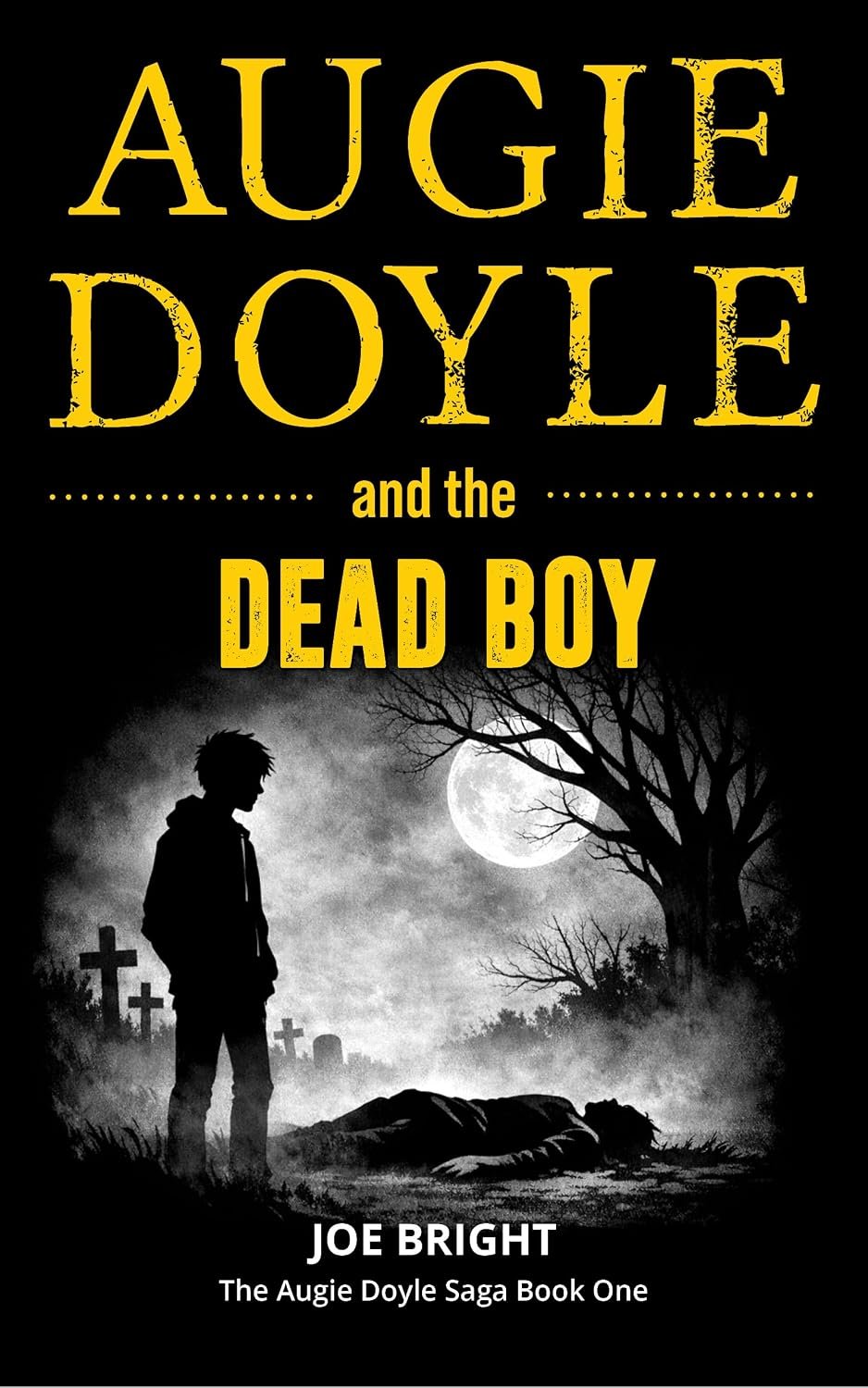
Augie Doyle and the Dead Boy
A boy who should be dead returns to school, and Augie Doyle suspects the sinister pattern behind his friends’ worsening health.
Books worth discovering. Authors worth knowing.
A boy who should be dead returns to school, and Augie Doyle suspects the sinister pattern behind his friends’ worsening health.
Original editorial perspective, grounded in the identified book and edition.
Oliver has died, and everyone knows it. He fell from Old Mill Bridge; then, five days later, he returns to school. Joe Bright gives Augie Doyle and the Dead Boy a premise that turns an ordinary teenage social setting into a place where the most obvious fact can no longer be trusted. The publicly available description makes the mystery more unsettling still: while Oliver seems to recover, people around him become ill or disappear. Augie, inclined to suspect a zombie apocalypse, must confront a pattern that resists an easy explanation. It is a sharp starting point for young-adult horror because the supernatural question emerges inside a familiar world of peers, loyalty and fear.
The nightmare of someone coming back wrong
Many ghost and zombie tales begin by asking what happens when the dead return. Bright’s synopsis gives that old question a focused social dimension. Oliver is not merely a nameless figure on a deserted road; he is someone Augie and the town already know. Recognition intensifies the dread. A stranger can be kept at a distance, but a familiar face creates pressure to acknowledge a relationship even when something in the face or behaviour feels profoundly altered. The return becomes a challenge to common knowledge as well as a source of immediate danger.
The five-day interval is an especially effective piece of premise-building. It is long enough for the community to have accepted Oliver’s death, yet brief enough for memories to be painfully fresh. Readers do not need an invented account of a funeral, a police report or the boy’s family to grasp the emotional disturbance that such a reappearance could create. The advertised details are sufficient: the school sees a person it should not see, and the categories through which everyone understands their world begin to fail.
Friendship as a test of competing explanations
The description contrasts Augie’s apocalyptic interpretation with a best friend who expects a rational explanation. This familiar pairing gives the mystery more than one way to move forward. A protagonist who immediately leaps toward the supernatural can be entertainingly alert to genre conventions, while a sceptical companion may keep the investigation anchored in practical questions. Neither approach is automatically correct. A horror story gains tension when the reader can feel the appeal of both explanations without knowing which will survive the next clue.
More importantly, disagreement between friends can dramatise how people respond to fear. Some prepare for the worst before they have evidence; others hesitate to believe even when evidence accumulates. In everyday life those differences might cause arguments about something trivial. In Bright’s premise, they may affect who notices a warning sign and who dismisses it. The synopsis does not specify exactly how Augie and his friend resolve their differences, so it would be wrong to assign them actions or outcomes. The tension itself is real in the advertised setup.
A pattern that makes the horror personal
Oliver’s friends are reportedly the ones becoming sick, and the description links their worsening health with his apparent improvement. That correlation is more disturbing than a sequence of unrelated attacks. It suggests that a threat might move through relationships, drawing the boundaries of danger according to social proximity. For a young-adult narrative, those boundaries matter. School friendships can define a person’s daily life with the force of a second family, and harm inside that circle can be impossible to ignore. The premise converts an existing web of attachments into a field of suspicion.
The available blurb mentions disappearing and hospitalised friends, offering concrete stakes without laying out the mystery’s full mechanism. A sound editorial introduction should stop there. It cannot claim to know the supernatural rules or reveal motives that public sources do not establish. The interesting critical question is how a storyteller makes a pattern feel purposeful before its explanation is known. Each incident can seem like confirmation of the worst theory, yet a mystery also requires space for revision. Readers who enjoy gathering clues are likely to watch closely for what the pattern includes and what it leaves unexplained.
When a small town becomes the whole world
The scale of this danger is deliberately intimate. The published pitch is not about armies of monsters spanning continents; it concentrates on the immediate environment of a school community and those connected to one boy. Limited geography can make horror feel more urgent than spectacle. There may be nowhere psychologically safe to put the problem. The setting that once offered predictable routines now returns every day with a fresh possibility of threat. Even ordinary conversations acquire an undertone because the reader knows something is badly wrong.
Small-town mystery also allows public certainty to clash with private knowledge. A community can develop a version of events that seems settled, while one observant teenager recognises contradictions. That dynamic is familiar from detective stories, but here the evidence includes the apparent violation of death itself. We should not invent what local authorities believe or how adults behave in this particular novel. It is enough to notice that the synopsis positions Augie’s attention as essential when the situation grows more dangerous, placing youthful perception at the centre of the mystery.
A clever boundary between horror and mystery
The book is marketed as paranormal teen horror with a mystery dimension. Those labels promise different kinds of satisfaction. Horror works by producing uncertainty and dread; mystery promises that attentive reading may lead toward understanding. Bright’s setup lets the genres reinforce each other. The more questions Augie asks, the more frightening the answers could become. Conversely, fear makes small details significant. A changed expression, an absence at school or the timing of illness can serve both as an atmospheric signal and a potential clue.
That blend also shapes the reading experience. Someone seeking relentlessly graphic violence may find the investigative aspect more important than they expect; someone who wants a conventional detective puzzle should be prepared for an explicitly uncanny premise. The available descriptions mention bodies and illness, but this feature has not independently verified the book’s intensity, age suitability or specific content warnings. Those judgements should follow a fuller look at the published edition. Genre labels are a guide to expectations, not a substitute for checking the text.
Oliver, Augie and the problem of moral distance
There is an intriguing complication in the way Oliver is introduced. He was unpleasant in life, according to one public description, but the story does not become less troubling because its central figure was difficult. Horror sometimes invites readers to decide too quickly that a victim or antagonist deserves whatever happens. A stronger moral perspective resists that simplification. The mystery can ask what makes a person responsible for a frightening outcome while also recognising that being feared, disliked or changed is not the same thing as being understood.
Augie’s role matters here. He is not described as a trained investigator, and that makes his curiosity feel more exposed. He must interpret unusual information while negotiating friendships and the ordinary pressures of adolescence. Whether he proves brave, misguided or both is a matter for the book itself. What the premise clearly supplies is an invitation to watch a young observer test convictions in an increasingly unsafe environment. The best paranormal mysteries unsettle not only a character’s sense of physical danger but their confidence in what counts as evidence.
Who may want to read it
This is a promising choice for readers who like teen-led paranormal mysteries, unsettling small-town settings and a horror premise built around a specific pattern rather than an anonymous evil. Readers attracted to the collision of friendship and fear may enjoy the contrast between Augie’s alarm and his companion’s scepticism. Those expecting a tightly contained single mystery should note the series framing: the queue identifies this as the first Augie Doyle book. Prospective readers sensitive to depictions of death, severe illness or threats to teenagers should consult fuller content information before choosing it. The available descriptions establish the premise, not the exact level of on-page intensity.
Joe Bright is credited as the author, and bibliographic listings identify this as a young-adult horror entry in the Augie Doyle saga. The feature does not claim a firsthand reading or reveal the central explanation. Instead, it preserves what makes the setup attractive: a dead classmate has returned, friendships are implicated, and a teenager’s instinct that something impossible is happening may be the beginning of a very necessary investigation.
About the book.
A boy who should be dead returns to school, and Augie Doyle suspects the sinister pattern behind his friends’ worsening health. The original queue purchase URL points to the intended edition.
Independent editorial feature: this is an original research-based introduction, not a firsthand review of the complete book. The supplied purchase URL is preserved, while the WordPress cover image will be supplied later by the owner’s publisher. Details unavailable in the cited sources have not been invented.
Found a book worth opening?
Books worth discovering. Authors worth knowing.
Return to the Journal →