
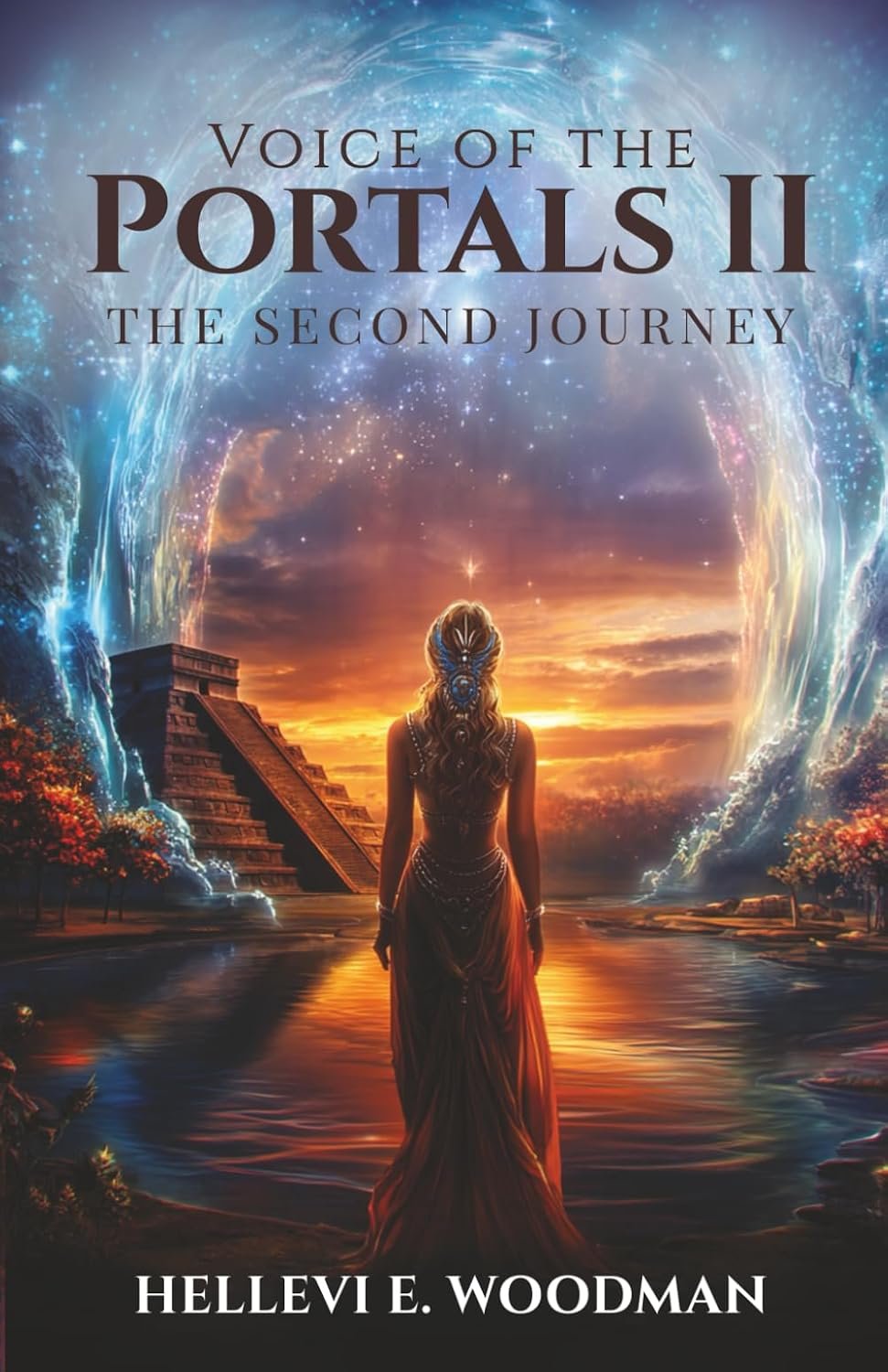
Voice of The Portals II: The Second Journey
Hellevi E. Woodman moves across landscapes and inward reflection in a contemplative account of travel, memory and attentive silence.
Books worth discovering. Authors worth knowing.
Hellevi E. Woodman moves across landscapes and inward reflection in a contemplative account of travel, memory and attentive silence.
Original editorial perspective, grounded in the identified book and edition.
A journey can be measured in distances, but it can also be measured by what becomes newly visible to the person travelling. Hellevi E. Woodman’s Voice of the Portals II: The Second Journey is presented as a reflective travel-and-spirituality work that crosses remarkable landscapes while looking inward. Its published description names Spirit Mountain in Nevada, Baobab Alley in Madagascar, the old streets of Zanzibar, Lake Titicaca and the Serengeti. Yet the organising idea is not a guidebook’s route map. The author treats places as occasions for memory, silence and reconsideration. That makes this volume appealing to readers interested in reflective prose and the encounter between external landscape and internal experience.
A second journey that changes direction
The publisher and bookseller descriptions characterise the book as a continuation of Voice of the Portals I: The First Gateway, but they emphasise deepening rather than repetition. This distinction matters. A conventional sequel might promise a fresh set of destinations and a greater number of dramatic incidents. A contemplative continuation can instead return to familiar questions with a different capacity to listen. The change is less about increasing the scale of the itinerary than about altering the traveller’s relationship to experience. It invites readers to consider how an earlier exploration might prepare someone to notice the same world more carefully.
Woodman’s author note, available in a public preview, describes a period of withdrawal from constant seeking and external voices. Rather than taking that statement as a universal prescription, it is more helpful to read it as context for the book’s stated sensibility. Silence is not presented merely as an empty pause between discoveries; it is among the experiences that shape the account. That focus provides a counterpoint to travel writing concerned mainly with movement, novelty and collecting destinations. The author seems interested in what happens when arrival becomes an opportunity for attentiveness.
Place as encounter, not trophy
The locations named in the description span different continents and cultural contexts. They are not interchangeable backdrops, and responsible reading must remember that real communities, histories and stewardship exist beyond any traveller’s private interpretation. Woodman’s public author note acknowledges the limits of her knowledge of the cultures and cosmologies she encounters. That acknowledgement is important in a genre where a visitor’s transformative feeling can too easily become a claim to understand someone else’s tradition. A landscape can provoke genuine reflection without giving a person authority to explain all that the place means.
For a reader, the most useful question may therefore be how the book balances poetic response with humility. The preview explicitly frames the writing as impressions and experiences rather than historical or scientific conclusions. That stance gives the prose space to use metaphor while reminding us not to mistake metaphor for documentation. A place may be described as a threshold or mirror in the author’s personal language; such a description tells us about an encounter, not about a measurable property of the geography. Keeping those categories separate makes room for wonder without surrendering critical thought.
Why the threshold is such a powerful image
A portal suggests a boundary between ordinary sight and another way of understanding. In fantasy, stepping through one often changes the world physically. In reflective writing, the change can be in perception: what felt commonplace becomes charged with attention. Woodman’s presentation uses the language of unseen thresholds and remembrance, but it does not require readers to accept that literal supernatural mechanisms have been established. A generous literary reading can appreciate the metaphor as a way of expressing transition, uncertainty and the desire for meaning in experiences that resist easy explanation.
Thresholds can also be uncomfortable. They imply leaving behind a familiar account of oneself without knowing what will replace it. The published preview speaks of disorientation and the loss of previously stable structures. Those are the author’s stated experiences, not a formula that readers must imitate. Their literary interest lies in a change of emphasis: discovery is not always the accumulation of facts. Sometimes the sense of progress depends on questioning inherited assumptions, recognising an unfinished emotion or sitting with uncertainty longer than one would prefer.
A travel narrative shaped by attention
Specific places give the book its physical vocabulary. Zanzibar’s streets, Madagascar’s baobabs and Bolivia’s high-altitude lake invite different images and associations. Their presence suggests a work that develops through contact with varied settings rather than remaining an abstract meditation from beginning to end. The public preview also lists locations in Mexico, Tanzania, Peru and Florida. This geographical breadth gives the account more texture than its spiritual language alone might imply, while the book’s internal organisation appears designed around thematic thresholds rather than a simple chronological itinerary.
What binds such a varied set of locations together is not necessarily a claim that they share one universal cultural meaning. It may be the author’s continuing act of reflection. Travel writing at its best can acknowledge that a traveller arrives with questions, privileges, blind spots and changing expectations. The published material gives readers reasons to examine whether Woodman does that successfully, while leaving critical assessment of the complete prose for an actual reading. We should not pretend to have witnessed ceremonies, conversations or events that the accessible synopsis does not describe in detail.
Silence, memory and the appeal of the unfinished
The book’s language of remembrance invites a striking paradox. Memory seems to face the past, while journeys usually point toward somewhere not yet visited. Bringing them together suggests that an unfamiliar environment can reveal an older feeling, fear or longing. Whether Woodman uses this pattern consistently throughout the volume cannot be determined from the preview alone. It is nonetheless a fruitful way to approach the advertised themes: the traveller does not merely learn facts about a destination but notices what the destination stirs in the traveller.
The role of silence is equally interesting. Contemporary travel can be heavily narrated before, during and after an experience, with photographs and public commentary arriving almost automatically. A text that places pauses at its centre asks what an experience might be before it becomes a story for other people. Silence can be restorative, difficult or simply ordinary. This essay makes no therapeutic claim for it. The literary possibility is subtler: a pause might allow an impression to remain unresolved instead of forcing it immediately into a lesson.
The ethics of reading spiritual travel
The available preview contains a particularly clear disclaimer: the writing should not be treated as historical, medical, spiritual or scientific proof. It is an account of personal perceptions, dreams and inner listening. That precision should travel with any editorial recommendation. Readers may respond strongly to the author’s metaphors while disagreeing with her interpretations. They need not adopt an entire worldview in order to value a lyrical moment, a sense of place or a question about belonging. Conversely, readers looking for authoritative histories of the named communities will need sources written for that purpose.
The work’s advertised commitment to donating profits to animal rescue organisations is another detail worth recording as an author or bookseller claim, not as an independently audited financial fact. It aligns a stated purpose with a concern outside the self, though readers should consult the publisher for current fulfilment details. Sponsorship is also disclosed for this MarketAnyBook feature. Neither commercial framing nor charitable intentions determine a book’s literary worth; both are relevant contexts for reading its public presentation honestly.
Who may want to read it
The Second Journey may suit contemplative readers who enjoy travel writing woven with personal essay, symbolism and spiritual inquiry. It is likely to be less satisfying for someone expecting a conventional travel guide with logistics, exhaustive history or verified archaeological explanation. Readers familiar with The First Gateway may appreciate the continuity, but the publisher presents the second volume as an inward deepening rather than a simple repeat performance. People interested in reflective language, questions of belonging and the practice of noticing may find an inviting starting point here. Those looking for factual accounts of the places should supplement it with scholarship and local voices.
Hellevi E. Woodman is the credited author, and the public edition material identifies her as the writer and publisher of this personal work. The lasting question behind the journey is not whether an invisible portal can be proved to exist. It is whether a reader can carry curiosity into unfamiliar places without turning curiosity into certainty, and can treat a moment of silence as something more than time spent waiting for the next attraction.
About the book.
Hellevi E. Woodman moves across landscapes and inward reflection in a contemplative account of travel, memory and attentive silence. The original queue purchase URL points to the intended edition.
Sponsored book feature: the MarketAnyBook queue lists this title as sponsored. This original editorial article is based on public book descriptions and available bibliographic data, not a firsthand reading or a commercial endorsement. The supplied purchase URL is preserved, while the WordPress cover image will be supplied later by the owner’s publisher. Details unavailable in the cited sources have not been invented. The book’s personal and spiritual interpretations are not presented as scientific, historical or medical facts.
Found a book worth opening?
Books worth discovering. Authors worth knowing.
Return to the Journal →