
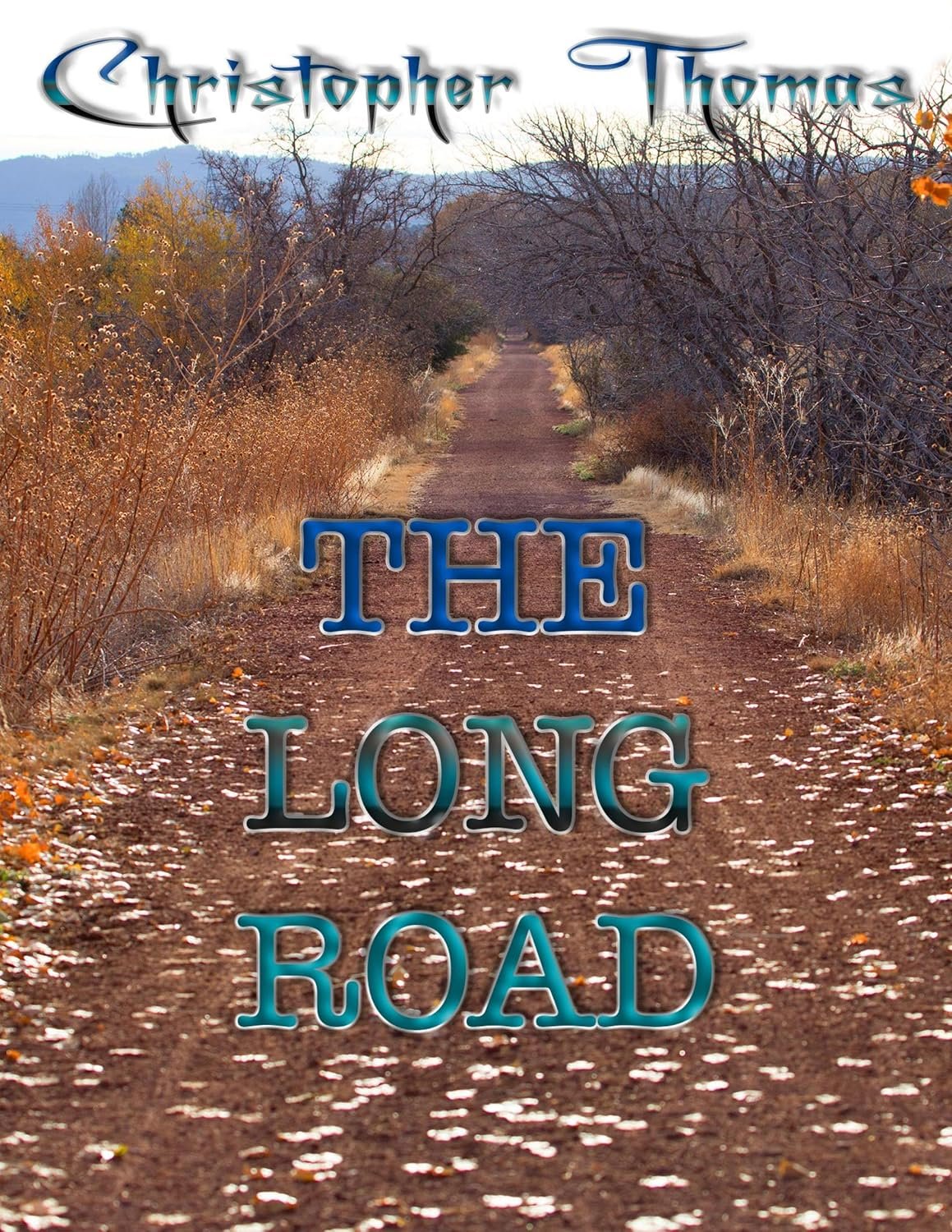
The Long Road
Christopher Thomas gathers futuristic and dystopian short fiction into a collection shaped by many years of imaginative exploration.
Books worth discovering. Authors worth knowing.
Christopher Thomas gathers futuristic and dystopian short fiction into a collection shaped by many years of imaginative exploration.
Original editorial perspective, grounded in the identified book and edition.
A road suggests continuity: one route, one destination, a succession of miles that gradually adds up to an arrival. Christopher Thomas’s The Long Road takes that image in a different direction. The author’s public description identifies the book as a collection of futuristic and dystopian short stories developed over roughly a decade. It names pieces including The Space Disaster, American Zombie and The Queen’s Assassin. Rather than a single plot in which each episode follows directly from the last, the volume offers distinct imagined situations. The connection is an authorial journey through speculative possibilities and an invitation to see what different stories can do within a compact form.
Why the anthology form matters
Short fiction asks a writer to choose carefully where a reader enters the world. There may be no room for pages of explanation before something changes. A disturbing situation, an unfamiliar rule or a single decisive relationship can bear much of the imaginative weight. The available description does not provide complete plots for the named stories, so this feature does not invent their characters or endings. It does, however, establish the collection’s interest in futurist and dystopian settings. That genre positioning matters because short forms can explore one unsettling possibility intensely without needing to build an entire fictional civilisation around it.
A collection can also give readers a chance to compare the author with himself. One story may attract attention through pace; another through a difficult idea; another through atmosphere. Such variation is part of the pleasure of reading short fiction, even if the exact differences between these pieces require the book itself to assess. The publisher’s description calls the work an introduction to Thomas’s larger fictional interests. That is a useful way to approach it: not necessarily as a definitive portrait, but as a series of entry points into the kinds of future, danger and choice that interest its author.
The meanings packed into dystopia
The word “dystopian” has become broad enough to cover social control, environmental crisis, technological dependence and collapse. It can imply disaster on a planetary scale or a more local situation in which a supposedly reasonable system makes ordinary life unbearable. The public listing does not specify which of those possibilities the collection addresses in detail. A responsible editorial discussion therefore treats dystopia as a reading frame, not a plot summary. The key question becomes what forms of power or fragility the stories might invite us to consider, and how the compressed form changes their effect.
Speculative fiction often magnifies an aspect of present life to make it strange enough for renewed attention. The reader knows the invented conditions are not a direct record of the world, yet can recognise the emotional shape of a fear: being trapped by institutions, losing control of a tool, or discovering that assumptions about safety are unreliable. A short story has the advantage of stopping at the precise point where such a question becomes most memorable. What an individual story achieves, however, must be judged through its actual sentences rather than through the genre label alone.
Three titles, three invitations
The named story titles provide a small but useful glimpse of range. The Space Disaster points toward the technological and physical hazards commonly associated with science fiction. American Zombie connects an established horror image to a national qualifier, which could indicate satire, social critique or simply setting. The Queen’s Assassin suggests power, secrecy and potential betrayal. These are readerly expectations prompted by titles, not claims about specific events in the stories. The distinction matters, because a title can promise an atmosphere while the full work delivers something surprising.
Even those limited signals demonstrate why a collection can feel more varied than a tightly unified novel. Space, zombies and royalty do not automatically belong to one fictional system. Their coexistence creates opportunities for shifts in scale, tone and moral concern. A reader can move from apparent technological catastrophe to a potentially political problem without needing to follow the same protagonist across every piece. The editorial question is whether the movement between imaginative territories produces a coherent voice. The available synopsis asserts range; it does not allow a final verdict on the execution.
Written over time, read in one sitting
The publisher’s description says the stories were written over a ten-year period. That span invites a particular mode of reading. Writers change. So do the technologies, anxieties and debates that surround them. A story conceived years earlier may appear newly relevant for reasons its author did not foresee. It can also bear the marks of an earlier moment’s assumptions. Reading a collection assembled across time is therefore not quite the same as reading a set of pieces produced for one immediate theme. Continuities and changes may become part of the experience.
Readers should avoid presuming that every story reflects Thomas’s current opinions or that fictional settings amount to an autobiographical statement. The ten-year composition period is documented in a public description, but the available material does not supply a story-by-story writing timeline. It would be misleading to assign specific pieces to specific years. The stronger observation is structural: gathering work across time permits an author to bring previously separate thought experiments into conversation, and it invites readers to notice recurring questions without forcing a single answer.
What science fiction can do at small scale
Large speculative novels often establish vast systems of technology, politics and geography. A short story may choose the opposite route: begin with one consequence and let the reader infer the larger world. That discipline can make a scenario feel immediate, because the unfamiliar conditions are revealed through action or a decisive choice. It can also leave productive gaps. In a dystopian story, not knowing everything about the wider society may contribute to discomfort. The danger is that a striking premise does not always become a satisfying narrative. A reader has to decide how much emotional and intellectual development a particular piece needs.
Thomas’s collection is promoted to readers who enjoy thinking beyond the present. That description is broad, but it helps position the book against purely escapist expectations. Speculative stories can entertain while carrying arguments, doubts or warnings about human behaviour. They are most interesting when those ideas emerge through credible narrative pressure instead of arriving as detached instructions. Nothing in the verified public synopsis supports a claim that all stories achieve that balance. It does establish that this collection belongs in the conversation about how imaginative fiction tests possible futures.
Reading for connections without forcing them
Anthologies often tempt us to invent a master theme that explains every inclusion. Sometimes that is illuminating; sometimes it flattens differences that give a collection its energy. The Long Road has a unifying title and a dystopian or futuristic description, yet those facts need not mean every story shares one political message or one kind of ending. An attentive reader can look for echoes of uncertainty, survival or authority while allowing each piece its separate shape. The decision to place the stories together already offers an invitation to compare; it does not demand uniformity.
There is a practical advantage to that openness. A reader who does not respond to the first speculative premise may find the next one more engaging. Short fiction permits exploration without the commitment of a long series. It can also provoke rereading, because an ending can change the significance of a small earlier detail. These are qualities of the form rather than certified outcomes of every contribution here. Their relevance is that they suggest how to meet Thomas’s book: with curiosity about varied experiments rather than with an expectation of a single continuous adventure.
Who may want to read it
Readers who enjoy compact speculative fiction, future-oriented thought experiments and a mixture of dystopian and genre-inflected scenarios may find this collection worth exploring. It could appeal to someone who likes dipping into one complete narrative at a time, or to a reader interested in discovering an author’s recurring concerns across shorter works. Anyone seeking a continuous novel should note the anthology format before buying. Those hoping for a detailed guide to the contents should also be aware that the publicly available descriptions name only selected pieces and do not establish every story’s themes or tone. An actual reading remains necessary before offering a critical rating.
Christopher Thomas is credited as the author, and the bibliographic listings present The Long Road as a collection of science-fiction and dystopian stories. Some catalogues show differing edition or release information; the original Amazon Italy link remains the exact intended purchase URL, and this feature makes no unsupported claim that all editions are identical. The road in the title may ultimately belong as much to the writer’s sustained curiosity as to the futures imagined along the way.
About the book.
Christopher Thomas gathers futuristic and dystopian short fiction into a collection shaped by many years of imaginative exploration. The original queue purchase URL points to the intended edition.
Independent editorial feature: this is an original research-based introduction, not a firsthand review of the complete book. The supplied purchase URL is preserved, while the WordPress cover image will be supplied later by the owner’s publisher. Details unavailable in the cited sources have not been invented.
Found a book worth opening?
Books worth discovering. Authors worth knowing.
Return to the Journal →