
Your Job Bites!
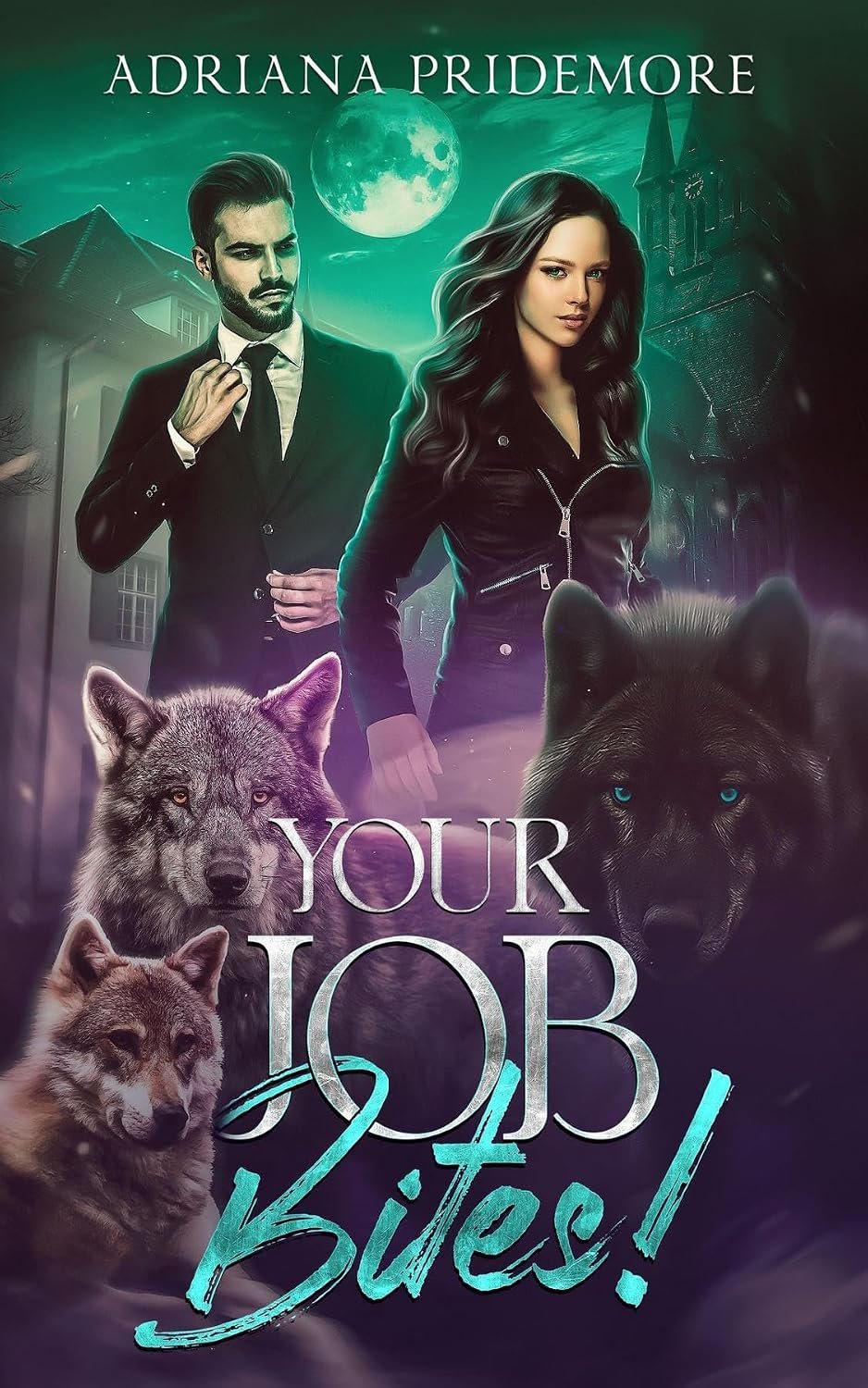
Whitney and Madraeus face a vampire adversary, fraying trust and an ancient enemy’s troubling bargain in Book Two of Council of Races.
Books worth discovering. Authors worth knowing.
Whitney and Madraeus face a vampire adversary, fraying trust and an ancient enemy’s troubling bargain in Book Two of Council of Races.
Original editorial introduction, grounded in the verified book edition and public descriptions.
Your Job Bites! returns to the Council of Races universe at a moment when recovery is hardly possible. The publisher's summary places Whitney Martindale less than a day after rescue from the vampire Cecelia, while Cecelia herself remains at large. Whitney's life is in ruins, her vampire boss Madraeus is wrestling with his own darkness, and the werewolves who might help her are caught in widening danger. The title's workplace joke survives, but its setting has become much more threatening than an awkward office. Adriana Pridemore's sequel is presented as a paranormal fantasy in which the aftermath of one crisis becomes the starting gun for another.
A sequel that refuses a clean reset
The phrase “less than 24 hours” is an unusually direct statement of narrative continuity. It tells a returning reader that the characters' difficulties will not be neatly filed away between volumes. A predecessor's consequences matter immediately. This is one reason the book is best approached as the second Council of Races story rather than as an isolated supernatural adventure. The first title, This Job Sucks!, introduces Whitney's unexpectedly dangerous employment at InfiniCorp and the realization that her boss and former partner belong to a world she had not anticipated. The sequel's public description assumes that history and continues it under greater pressure.
For a series reader, the appeal of such continuity is emotional as much as logistical. Betrayal can have a delayed cost; a rescue does not restore an ordinary life in a morning. Whitney's uncertainty about Madraeus is especially consequential because the summary explicitly says her faith in him has been shaken. It is one thing to fear a villain. It is another to wonder whether an ally's history and choices could make that ally dangerous. Without inventing a confrontation or a reconciliation, the premise gives readers a reason to track trust as closely as action.
A world held together by uneasy alliances
Pridemore's fantasy includes vampires, werewolves and a group called the Races. The villain Cecelia has escaped and is described as leaving traps for Whitney and her allies; authorities are also closing in while Cecelia's army hunts opponents. That means conflict comes from different directions. A supernatural community may see itself as besieged by an internal enemy while also facing human investigation. The description does not specify what police know or how their inquiries unfold, but it does establish the pressure of being pursued and misunderstood at the same time.
The appearance of the Three Hares increases the uncertainty. The synopsis calls them an ancient enemy of the Races and says they offer a deal. Readers are therefore asked to evaluate help from a source already labeled hostile. In fantasy, bargains often reveal the boundaries of a community's principles: what may be surrendered to avert a greater disaster, and who gets to approve the bargain? The text available publicly does not disclose whether the offer is sincere or what it costs. The important editorial observation is the question itself. It places the characters in a problem that cannot simply be solved by identifying the strongest creature in the room.
The personal costs inside the spectacle
Whitney's situation offers a human scale against the book's larger supernatural stakes. The public description says she has been rescued, her life is damaged and her trust has become unstable. These are different aspects of vulnerability. Physical safety may return before a sense of security does. The fact that the series grew out of a seemingly ordinary office job gives these problems a wry backdrop: employment can already blur the boundaries between what a person owes a workplace and what it demands in return. Here that exaggeration becomes literal, as an employer's past may endanger the employee.
Madraeus is not simply introduced as a protector. His struggle with darkness is part of the sequel's stated conflict, and it complicates any easy distinction between a frightening creature and a trustworthy person. This could be fruitful material for readers who like paranormal romance with moral unease. Still, the published summary is not evidence for the couple's final relationship, the degree of romantic focus or the handling of consent in individual scenes. It is more precise to say that duty and love are explicitly presented as competing pressures. The reader is invited to watch how characters justify their choices, not to assume those choices have a comfortable resolution.
Suspense built from consequences
Cecelia's escape gives the sequel an engine that is independent of Whitney's personal decisions. The description identifies betrayal, impending disaster, police attention and an army enforcing allegiance. Such a plot can be read as a tightening set of options rather than one monster being chased through a fantasy setting. Each faction may have different information, incentives and limits. In stories like this, suspense often depends on whether the characters can tell a necessary compromise from a fatal concession. The Three Hares' proposal brings that distinction into sharper focus.
The published preview of the ebook confirms that tunnels, pursuing police and strategic disagreement appear in an available excerpt, but this Journal introduction does not need to retell those scenes or reproduce protected dialogue. What matters here is the description's consistent emphasis on constriction: less time, fewer allies, less trust and growing pressure. Readers entering Book Two can reasonably expect a story concerned with how people act under such conditions. They should not expect a verified scene-by-scene recap from a research-based feature.
The series rhythm and the promised tone
The title continues the comic language of This Job Sucks!, replacing one workplace complaint with another. That choice keeps the series' identity even as the premise darkens. The author has described the second book on her own website as a continuation of Whitney and Madraeus's attempt to prevent Cecelia from ruining their lives. That endorsement of continuity matters because an outside description may sometimes flatten a hybrid novel into only its romance or only its peril. Here the joke, the relationships and the supernatural danger are meant to share the same space.
A useful reading question is how the book balances those registers. Does humor appear as defense, affection, or genuine lightness? When the stakes involve an ancient threat, do personal loyalties remain meaningful? And does the plot treat Whitney as an active participant in the decisions that affect her? The sources give reasons to ask these questions but not license to announce the answers. That distinction protects the reader's sense of discovery.
Who may want to read it
Your Job Bites! is suited to readers who enjoy fast-moving paranormal fantasy with romantic tension, shifting alliances and series-level consequences. Returning fans of This Job Sucks! have the clearest point of entry because the second installment begins almost immediately after earlier events. Readers attracted to vampires and werewolves will find those elements in the confirmed premise, while those who like morally uncertain bargains may be interested in the offer from the Three Hares. The advertised mix of peril and workplace wit should appeal to readers comfortable with a story that can make a joke while characters face serious threats. Anyone seeking a standalone novel or a low-conflict paranormal romance may want to start with Book One and check whether the series' intensity suits them. This research-based introduction cannot verify individual content warnings or the final outcomes.
A sequel that asks who can be trusted
Adriana Pridemore identifies herself as a fantasy and speculative-fiction writer, and her author site places this book squarely within the Council of Races series. Her own publication notes reinforce that Whitney and Madraeus's story continues beyond its original office setup. The distinctive question raised by this installment is not merely whether its characters can defeat Cecelia. It is whether they can decide whose help to accept while fear, affection and history pull them in different directions. That is a richer invitation than a list of supernatural species. The old rules of Whitney's working life have vanished; what replaces them depends on the trust she can build and the choices the story ultimately reveals.
About the book.
Whitney and Madraeus face a vampire adversary, fraying trust and an ancient enemy’s troubling bargain in Book Two of Council of Races. Public bibliographic details have been distinguished from editorial interpretation.
Independent editorial feature: this is a source-based introduction, not a firsthand review of the complete book. Bibliographic descriptions and author or publisher statements are interpreted with clear source limits. The original purchase URL remains unchanged; WordPress cover media is added later by the owner’s publisher.
Found a book worth opening?
Books worth discovering. Authors worth knowing.
Return to the Journal →