
A Kingdom of Hoarfrost and Ichor
A mission against a tyrannical ruler becomes entangled with a crowned princess’s hidden identity in Corissa M. Duggar’s dark fantasy.
Books worth discovering. Authors worth knowing.
A mission against a tyrannical ruler becomes entangled with a crowned princess’s hidden identity in Corissa M. Duggar’s dark fantasy.
Original editorial introduction, grounded in the verified book edition and public descriptions.
A Kingdom of Hoarfrost and Ichor announces its fantasy ambitions in a title full of coldness, blood and contradiction. The publicly available description identifies Illyrian Harkness as a figure attempting to mend a broken kingdom and end wars that have outlasted any simple solution. Her first declared move is to kill the tyrannical king of the Human Kingdom. Yet a second strand changes that apparently direct mission: her destiny becomes bound to the Crowned Princess, whose identity is itself part of the mystery. Corissa M. Duggar's premise therefore holds two impulses in tension—the decisive wish to end a reign, and the more uncertain need to understand what that reign has concealed.
A mission to end a war
Epic fantasy often begins with a threat that seems large enough to organize a world: armies gather, monarchs rule, and magic alters what ordinary strategy can accomplish. The publisher-facing synopsis for this novel gives that framework in compressed form. It names warring kingdoms, arcane magic, darkness and a broken political order. It also offers an agent of change, Illyrian, whose intention is to bring peace. Such a goal immediately creates a question of means. If killing a ruler is presented as the necessary first step, what is the relationship between ending a person’s rule and rebuilding the institutions that supported it?
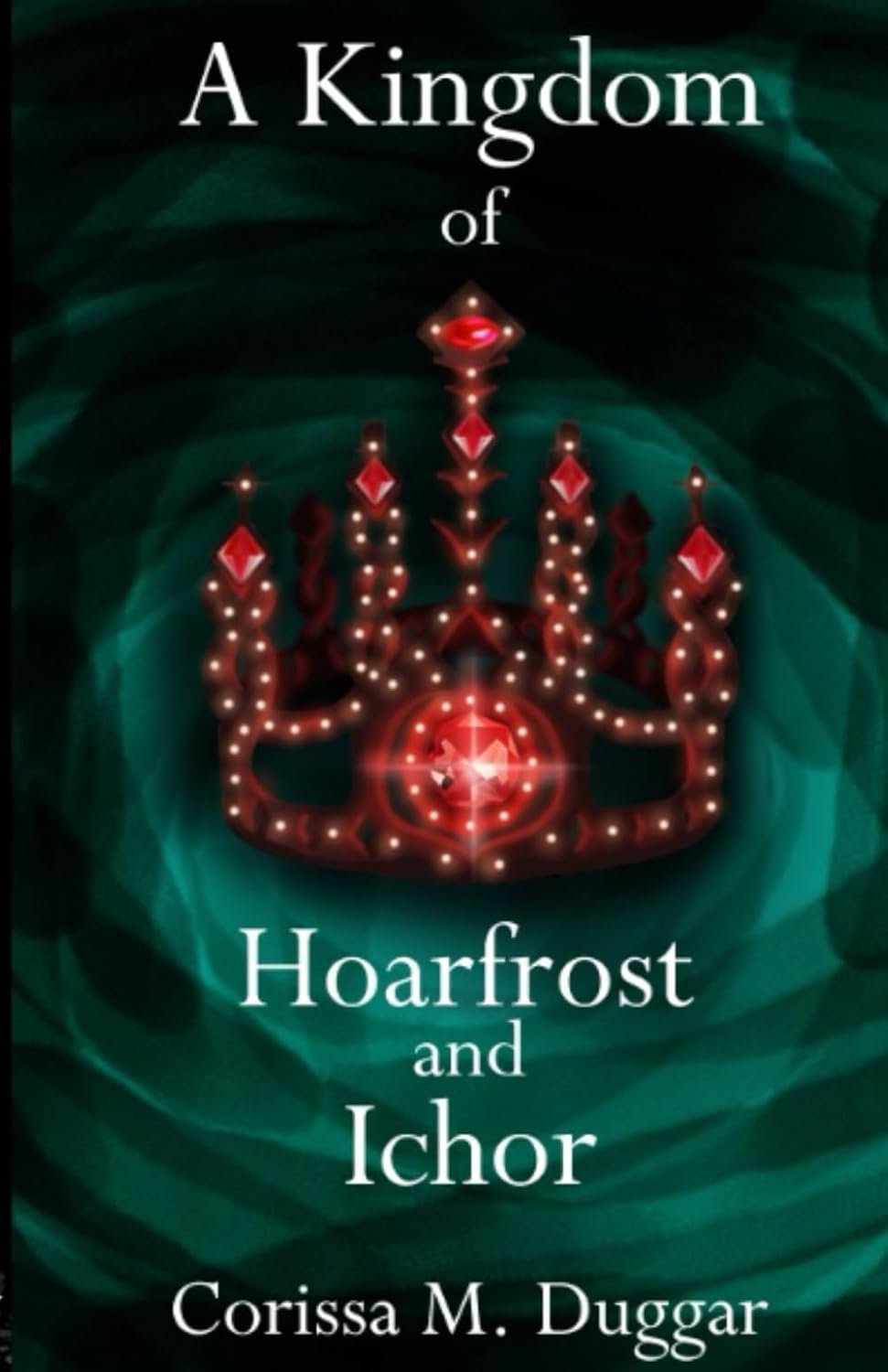
A title that combines hoarfrost and ichor fits a world where preservation and injury are hard to separate. That is an interpretation of the imagery, not evidence that particular winter landscapes or divine creatures appear in the text. The cover's crown and jewels visually emphasize sovereignty, while the plot summary establishes that the Human Kingdom is ruled by a tyrant. The most promising approach to this setup is to see political power and personal identity as linked mysteries, without assuming detailed histories or secret powers that have not been documented.
The Crowned Princess changes the question
The central twist disclosed in the synopsis is that Illyrian's fate becomes entangled with that of the Crowned Princess. Her identity, according to the description, is more complicated than the king's version of events would suggest. This moves the story beyond a single assassination mission. A conventional revenge or rebellion narrative can build tension around whether a target will be defeated. A fantasy of concealed identity asks a second question: whether the people trying to change a kingdom understand the history on which their plans depend.
The precise nature of the princess's secret remains undisclosed in the available source. Rather than filling the gap with an imagined bloodline, prophecy or relationship, readers can pay attention to the kind of pressure the premise creates. If the king has told lies about who the princess is, truth itself becomes a political resource. Who controls official memory? Who is believed when they speak? And what happens when a person recognized by a title is asked to inhabit a different account of herself? Those questions are grounded in the disclosed identity mystery, even though the answers belong to the book.
Two destinies, unequal starting positions
Illyrian is introduced through action: she wants to end conflict and makes a dangerous choice about how to begin. The princess is introduced through position: she carries a crown-related identity that may prove misleading. That difference offers an interesting structure. One character appears to have an objective and faces new knowledge; the other is associated with inherited authority and may face the instability of discovery. The synopsis states that their fates become one and that the journey involves sacrifice, but it does not say what sort of relationship develops or which sacrifices are made. A responsible feature can consider the promise of a shared journey without assigning it an invented emotional trajectory.
There is a classic fantasy tension between private purpose and collective duty. Illyrian's intention to end a tyrant's reign could be morally forceful, yet any lasting peace demands attention to people who did not choose the war. A crowned figure may have obligations she never asked for. In a story about discovering truth behind lies, the central tension may lie in deciding what leadership ought to mean once old claims to legitimacy become doubtful. Again, these are reading questions invited by the plot summary, not claims about scenes the article has not examined.
The political imagination of secondary worlds
Secondary-world fantasy allows authors to make familiar moral disputes look strange. In this case, the distinction between the Human Kingdom and other kingdoms is explicit, but the public description provides no reliable map or inventory of species and factions. The best way to approach the book before reading is therefore through its confirmed conflict: kingdoms at war and an individual whose proposed intervention may reorder them. Why does the existence of magic not already resolve the fighting? What kind of authority does a throne provide? How do competing versions of a country's history make peace more difficult?
These issues matter because a broken kingdom is not simply a broken ruler. Even after a tyrant is gone, people may disagree about justice, memory and restitution. A story that connects a would-be liberator to a princess whose history is uncertain has an opportunity to consider both change from outside the throne and accountability within it. The synopsis is too brief to say how fully the novel pursues these themes, but it names enough elements to place these questions at the center of an attentive reading.
Atmosphere without fabricated details
The novel's title and cover suggest dark fantasy in mood, while the summary confirms arcane magic and danger. It would be misleading, however, to describe specific spells, monsters, court intrigues or battles without a source. Instead, the compelling atmosphere lies in the declared combination of uncertainty and high stakes. Illyrian intends an irreversible political act; the princess's true identity is uncertain; and two kingdoms' futures may depend on what they discover together. That is already substantial dramatic material, because each new answer could change the meaning of the original plan.
Readers of fantasy know that a journey can be geographic and interpretive at once. Characters travel toward a destination while the reader's understanding of earlier events changes. The disclosed mission and identity mystery suggest this sort of double movement, though the author has not provided enough public detail to specify the route or sequence of discoveries. The distinction is useful: it allows an editorial introduction to describe the book's intellectual invitation without pretending to know the full plot.
Who may want to read it
A Kingdom of Hoarfrost and Ichor may appeal to readers of high-stakes, kingdom-centered fantasy who prefer complicated motives to a simple contest of armies. Its public premise contains a determined protagonist, a tyrannical king, arcane magic, a crowned princess and a mystery about identity. Readers interested in the ethics of rebellion, hidden histories and sacrifices made for political peace will find recognizable hooks here. It is also a candidate for those who enjoy stories that set an apparently clear mission against discoveries that could change its meaning. Readers seeking detailed assurances about world-building, romantic subplots, magical rules or the level of on-page violence should consult a preview or the book itself, because the publicly accessible summary does not establish those details. This is a source-limited introduction, not a claim to a complete reading.
What remains to be discovered
The book is credited in the queue and external listings to Corissa M. Duggar. Beyond that attribution, the available sources do not justify an invented personal biography or a definitive account of the intended fantasy influences. What is clear is the premise's central reversal: a plan to correct a kingdom by removing its ruler becomes a journey in which understanding the princess may be just as important as confronting the king. That combination is a promising foundation for reflection on force, legitimacy and the stories people inherit. Whether the novel resolves its conflicts through victory, sacrifice, reconciliation or something less tidy is the reader's discovery. The invitation is to enter a dangerous political world and ask not only who should rule it, but who has the authority to tell the truth about it.
About the book.
A mission against a tyrannical ruler becomes entangled with a crowned princess’s hidden identity in Corissa M. Duggar’s dark fantasy. Public bibliographic details have been distinguished from editorial interpretation.
Independent editorial feature: this is a source-based introduction, not a firsthand review of the complete book. Bibliographic descriptions and author or publisher statements are interpreted with clear source limits. The original purchase URL remains unchanged; WordPress cover media is added later by the owner’s publisher.
Found a book worth opening?
Books worth discovering. Authors worth knowing.
Return to the Journal →