
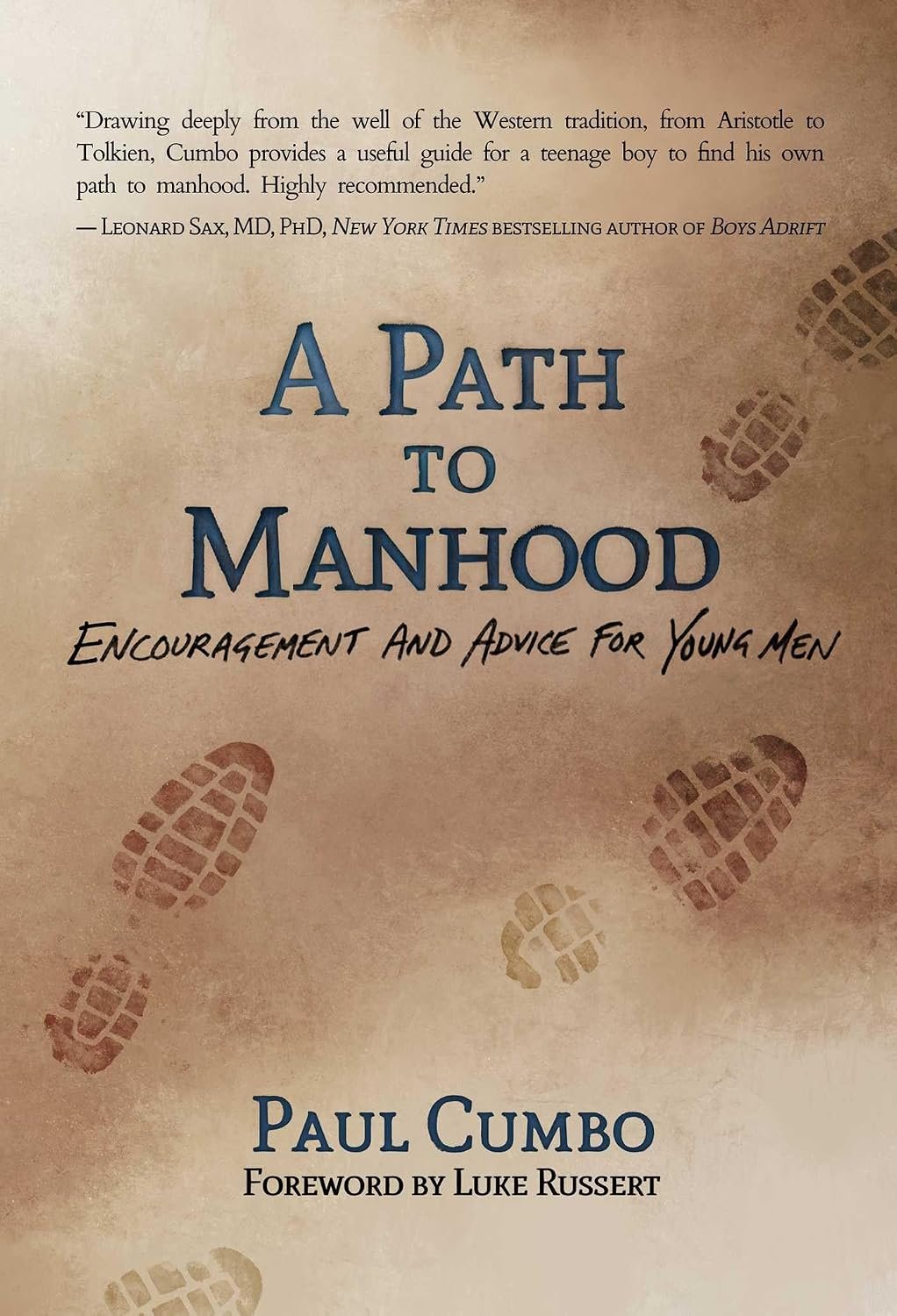
A Path to Manhood: Encouragement and Advice for Young Men
Educator Paul Cumbo combines practical advice with questions of friendship, virtue and personal growth for young men.
Books worth discovering. Authors worth knowing.
Educator Paul Cumbo combines practical advice with questions of friendship, virtue and personal growth for young men.
Original editorial introduction, grounded in the verified book edition and public descriptions.
A Path to Manhood: Encouragement and Advice for Young Men treats growing up as a process of learning what to value rather than merely reaching a particular age. Paul Cumbo's official description draws on more than two decades spent teaching, coaching and mentoring boys and young men. The book addresses self-knowledge, friendship, education, money, work, health, habits, relationships, faith and fatherhood in concise, conversational chapters. It is explicitly directed toward young male readers but also offered to parents, coaches, teachers and mentors. Its central wager is that guidance can combine warmth with challenge without reducing a complicated human being to a stereotype.
Beyond a single definition of maturity
Advice books about young men can narrow quickly into slogans: be strong, be successful, be independent. Cumbo's published explanation argues for a more layered picture. Boys and young men, he suggests, need affirmation as well as demands placed upon them. This is a useful tension to examine, because support without expectations can feel aimless while expectations without care can become punitive. A reader approaching the book can watch for how the author negotiates that balance rather than assume any one formula can define manhood for everyone.
The chapter topics point toward a broad conception of adulthood. Self-knowledge sits beside practical financial decisions; friendship appears with vocation and health. These are not separate checkboxes so much as interdependent parts of a life. For example, the capacity to choose work may be related to an understanding of one's abilities, while durable friendships depend on habits and emotional judgment. The public synopsis gives the subject areas but not each recommendation in full, so a responsible introduction should discuss the intended scope without pretending to have audited every piece of advice.
The credibility of experience—and its limits
Cumbo's own website describes his work as an educator and former rowing coach in boys' schools. He has spoken about developing the manuscript from lessons gathered through mentoring and teaching. Those experiences offer a credible basis for the book's conversational voice, but they do not make every proposal automatically correct for every reader. A teacher's advice comes from particular settings, generations and relationships. Readers may profit most by asking which principles feel broadly applicable and which depend on circumstances different from their own.
This distinction is especially important in books about identity. A useful guide makes room for young people whose families, cultures, health, abilities, beliefs and aspirations differ. The author describes an inclusive attitude and practical spirituality as part of the work. That is his stated intent; judging how fully the chapters realize it requires reading them. An editorial introduction can take the intention seriously while leaving room for readers to test individual passages against their experience.
Friendship and emotional complexity
The published material emphasizes that young men are emotionally complicated. This challenges an old habit of treating male development as chiefly a matter of performance or self-control. Friendship, the ability to ask for support and an understanding of one's own reactions all deserve attention. A path toward maturity may involve learning when to persist and when to seek help, when to speak and when to listen. These are readings of the book's advertised themes rather than quotations from unavailable chapters.
The author's decision to address readers directly is itself significant. A book written only about boys can turn them into problems for adults to manage. A book that speaks to boys and young men asks them to become participants in their own growth. That does not erase the role of parents or coaches. It changes the nature of the relationship: guidance is something received, questioned, practiced and eventually made one's own. The public description's emphasis on self-knowledge fits this approach, even though the exact exercises and anecdotes cannot be established from the summary alone.
Practical responsibilities and inner commitments
Money, work, health and habits are concrete matters. They generate consequences, routines and trade-offs that are easier to observe than broad claims about character. By including them, the book signals that moral aspiration ought to touch daily behavior. Readers can usefully ask how the author relates a virtuous life to what someone does on an ordinary Tuesday: keeping an obligation, learning from a mistake, respecting another person's time, or deciding how to spend limited resources. Those examples are general editorial applications, not asserted scenes or chapter exercises.
The book also includes love, marriage, faith and fatherhood among its subjects. These carry different meanings for readers at different life stages. A teenager may not be contemplating marriage or children, but may be learning to treat other people with respect and to understand commitment. A young adult may be assessing which ideals inherited from family remain important. The range of topics suggests that the book invites thinking ahead without promising that everyone must follow one predetermined sequence. Readers should inspect the actual chapters to understand the author's more specific positions.
Encouragement that leaves room for disagreement
The subtitle pairs encouragement with advice, an important difference. Encouragement tells a reader that change is possible; advice asks that reader to consider a course of action. Good mentoring requires both, and it also requires room to disagree. An author can offer clear convictions without turning reflection into obedience. Cumbo's public materials position the project outside immediate partisan argument and inside questions of values and everyday formation. That framing may appeal to readers tired of culture-war shouting, although the work's religious and philosophical perspective remains relevant to understanding its recommendations.
The author’s published reflections on the writing process are revealing. He explains that the early project became unwieldy as he tried to cover everything, then needed a more coherent focus. That is a familiar challenge of life advice: every topic touches another, so the boundary of a useful book is hard to draw. The final chapter list is broad, but its emphasis on navigating the path rather than arriving at a final definition of adulthood may help readers approach it as a set of conversations, not an exam with one correct answer.
Who may want to read it
A Path to Manhood is aimed first at teenage boys and young men looking for practical and ethical guidance across friendships, education, habits, relationships and work. Its conversational structure may be helpful to readers who prefer short discussions over a dense theory of masculinity. Parents, teachers, coaches and mentors may also find it a starting point for conversations, especially when the goal is to offer both care and challenge. Readers interested in the intersection of personal responsibility and faith will recognize the book's stated emphasis on virtue and spirituality. Those seeking a purely secular, clinical or research-systematic account of male development should understand that this is an experience-informed guide with the author's own perspective. It should not be mistaken for individualized medical, psychological or financial advice, nor is it an endorsement of one model of adulthood for everyone.
Guidance as an ongoing relationship
Paul Cumbo's book includes a foreword by Luke Russert, a credit preserved in the source queue and publisher listing. That contribution does not change the fact that the book's principal guidance comes from Cumbo's years in education. What makes the project potentially valuable is its attempt to respect young men as complicated people while still asking them to take responsibility for their choices. A reader may not agree with every value the author emphasizes and still find productive questions: What do I owe others? What habits shape my days? Which mentors help me grow without deciding my identity for me? Such questions continue beyond any single volume, which is appropriate for a book that understands maturity as a path rather than a certificate received at the end.
About the book.
Educator Paul Cumbo combines practical advice with questions of friendship, virtue and personal growth for young men. Public bibliographic details have been distinguished from editorial interpretation.
Sponsored book feature: the MarketAnyBook queue lists this book as sponsored. This original research-based editorial article is not a firsthand reading or an independent endorsement. Bibliographic descriptions and author or publisher statements are interpreted with clear source limits. The original purchase URL remains unchanged; WordPress cover media is added later by the owner’s publisher. Advice in the book reflects the author’s perspective and is not individual medical or financial advice.
Found a book worth opening?
Books worth discovering. Authors worth knowing.
Return to the Journal →