
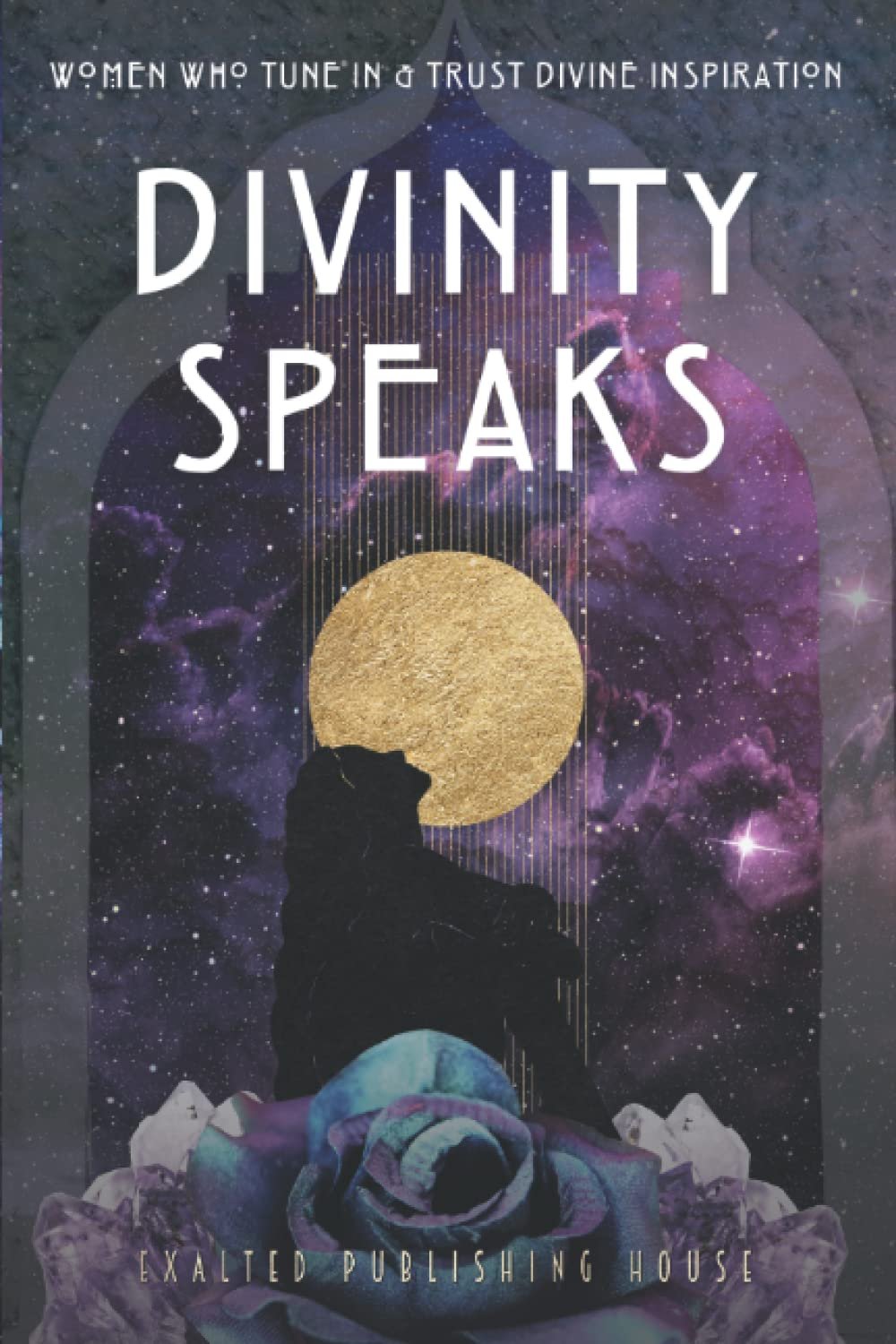
Divinity Speaks
Women describe intuition and perceived spiritual guidance in a many-voiced anthology of personal testimonies and reflection.
Books worth discovering. Authors worth knowing.
Women describe intuition and perceived spiritual guidance in a many-voiced anthology of personal testimonies and reflection.
Original editorial introduction, grounded in the verified book edition and public descriptions.
Divinity Speaks: Women Who Tune In & Trust Divine Inspiration is presented as a collective work about how women recognize meaning, guidance and inward conviction in their lives. The public description names a range of possible languages for this experience—God, Source, the Universe, Spirit—rather than requiring a single formal vocabulary. It also makes an unusual reading suggestion: approach the collection somewhat like an oracle deck, finding a message that resonates at a particular moment. This is not evidence that a book provides supernatural knowledge. It is a statement of the contributors' spiritual framework, and an invitation to read personal stories with an ear for what they mean to the people telling them.
Many voices, a shared invitation
An anthology is not simply a long essay divided among many names. Its appeal often lies in contrasts among personal histories, belief systems and styles of reflection. The bibliographic record credits Bridget Aileen Sicsko, AlyseMarie Gallagher Warren and Amanda Rumore, while additional contributors are named in public listings. The exact order of each essay or its contents is not established by the available descriptions, so it would be misleading to invent chapter summaries. What is documented is the project's organizing premise: women sharing accounts of perceived divine or spiritual connection as they navigate their lives.
That collective structure changes the reader's task. Rather than following a single argument toward one conclusion, an anthology of testimony invites consideration of what different people mean by similar words. For one person, intuition might be bound to a religious tradition; another might speak of cosmic connection in a more personal language. The book's description acknowledges these differences with its deliberately broad vocabulary. Readers need not collapse them into an identical belief to notice the common desire to be heard, to make sense of uncertainty, or to feel less isolated during change.
The difference between testimony and proof
The source description characterizes the contents as true stories of how spiritual feelings appear in women's lives. A responsible editorial introduction can respect that self-description while remaining precise about evidence. A person's experience of guidance is real as an experience, but it does not independently establish a supernatural mechanism or universal truth. The anthology is best approached as a set of accounts and interpretations, not as a scientific study. That distinction need not diminish its literary interest. Personal writing is often compelling because it shows how individuals organize memory, fear, hope and conviction into a meaningful story.
A useful reading question is what each storyteller asks of an audience. Is the reader being invited to believe an event happened exactly as recounted, to reflect on a feeling, to draw a parallel with their own life, or to consider a practice? These are different kinds of invitation. The publisher’s description suggests the collection prioritizes resonance and recognition, but the individual chapters must be read before assigning a particular claim to a particular contributor. The value of careful reading is not to pronounce on anyone's faith, but to understand what the narrative is trying to communicate.
From the abstract to the intimate
Spiritual language can seem remote when it stays at the level of large metaphysical claims. The published summary says this book intends to make the esoteric relatable through lived experiences. It mentions subjects such as womb healing, feelings of unworthiness and shame, spirit guides, and connection with God or another name for a perceived higher power. These topics are reported as parts of the anthology’s spiritual frame, not verified treatments or objective descriptions of invisible forces. In particular, healing language should not be mistaken for a medical promise.
There is an important literary strategy in moving from the cosmic to the domestic. Big ideas acquire texture when attached to everyday choices, relationships and emotions. The public materials suggest that the book uses this movement to make its contributors' ideas approachable. Without the full text, it is impossible to judge how effectively every essay performs that task. Still, the intention matters. The collection is asking readers to look for the felt significance of experiences rather than only for a doctrinal proposition stated in abstract terms.
What an open-ended reading method offers
The oracle-deck analogy is striking. A conventional book is expected to be read from first page to last, each section building on earlier material. An oracle deck instead often invites a moment of selection and reflection. The description's comparison therefore suggests a less linear relationship to the anthology: a reader might pause at a story that speaks to a present concern, return later, or reconsider the same passage in a different season. This is an editorial inference from the book's own framing rather than a claim about formal instructions or chapter organization.
Such a practice can be rewarding even for readers who do not share the contributors' metaphysical assumptions. Memoiristic essays are mirrors of other lives; their value may reside in the questions they prompt. What experience have I interpreted as a turning point? When does a sense of inner certainty help me act, and when should I examine it more closely? How does belonging to a community affect the way a personal story is told? The anthology’s plurality could make those questions richer, provided the voices are allowed to remain distinct.
Care with universal language
One danger in discussing spiritually oriented books is turning individual testimony into a universal assurance. The public blurb uses language of support, guidance and coming home to oneself. Those are the collection's aspirations and beliefs, not outcomes that any reader is guaranteed to experience. Another danger is reducing all spiritual traditions to interchangeable labels simply because the book offers several terms. A careful reader can recognize that the contributors may use similar language while holding different understandings of its meaning. Nothing in the available bibliographic material permits a claim that all faith communities endorse the collection's approach.
The most useful editorial stance is curious rather than credulous or dismissive. What experiences do the storytellers connect to insight? How do they distinguish a wish from a conviction? When they describe change, do they credit chance, personal work, relationships or a perceived spiritual presence? These questions honor the complexity of personal testimony. They also help a reader decide which parts of a text speak to their own convictions and which parts are better understood as another person's distinctive account.
Who may want to read it
Divinity Speaks may interest readers who enjoy women-centered personal essays, spiritual memoir and reflective anthologies that present multiple understandings of intuition and divine connection. It is especially suited to readers who like dipping into a collection for a perspective to consider rather than following one sustained plot. People who appreciate writing about belonging, self-worth, inherited shame and personal transformation may find the advertised themes relevant, regardless of whether they adopt every metaphysical claim. Readers seeking a systematic comparative religion text, independently tested psychological interventions or a single coherent argument should be aware that the work is presented instead as personal testimony. Because this feature is based on public descriptions, it cannot verify the content or representativeness of every contribution, nor does it imply spiritual or health outcomes.
The promise of a collective conversation
The strongest distinction of this book is its many-voiced framework. The credited contributors—including Bridget Aileen Sicsko, AlyseMarie Gallagher Warren and Amanda Rumore—are part of a larger group offering personal narratives under one theme. That is a different undertaking from a solitary guidebook. The reader enters a conversation whose value may lie in the variety of ways people name guidance and describe change. Its central question is not whether a stranger can prove the source of another person's conviction. It is what happens when private experiences are given public language, and whether listening to them helps us ask more careful questions about our own lives. That is an invitation worth keeping distinct from the anthology's faith claims.
About the book.
Women describe intuition and perceived spiritual guidance in a many-voiced anthology of personal testimonies and reflection. Public bibliographic details have been distinguished from editorial interpretation.
Independent editorial feature: this is a source-based introduction, not a firsthand review of the complete book. Bibliographic descriptions and author or publisher statements are interpreted with clear source limits. The original purchase URL remains unchanged; WordPress cover media is added later by the owner’s publisher. Spiritual testimony is described as contributor perspective rather than verified metaphysical or health fact.
Found a book worth opening?
Books worth discovering. Authors worth knowing.
Return to the Journal →