
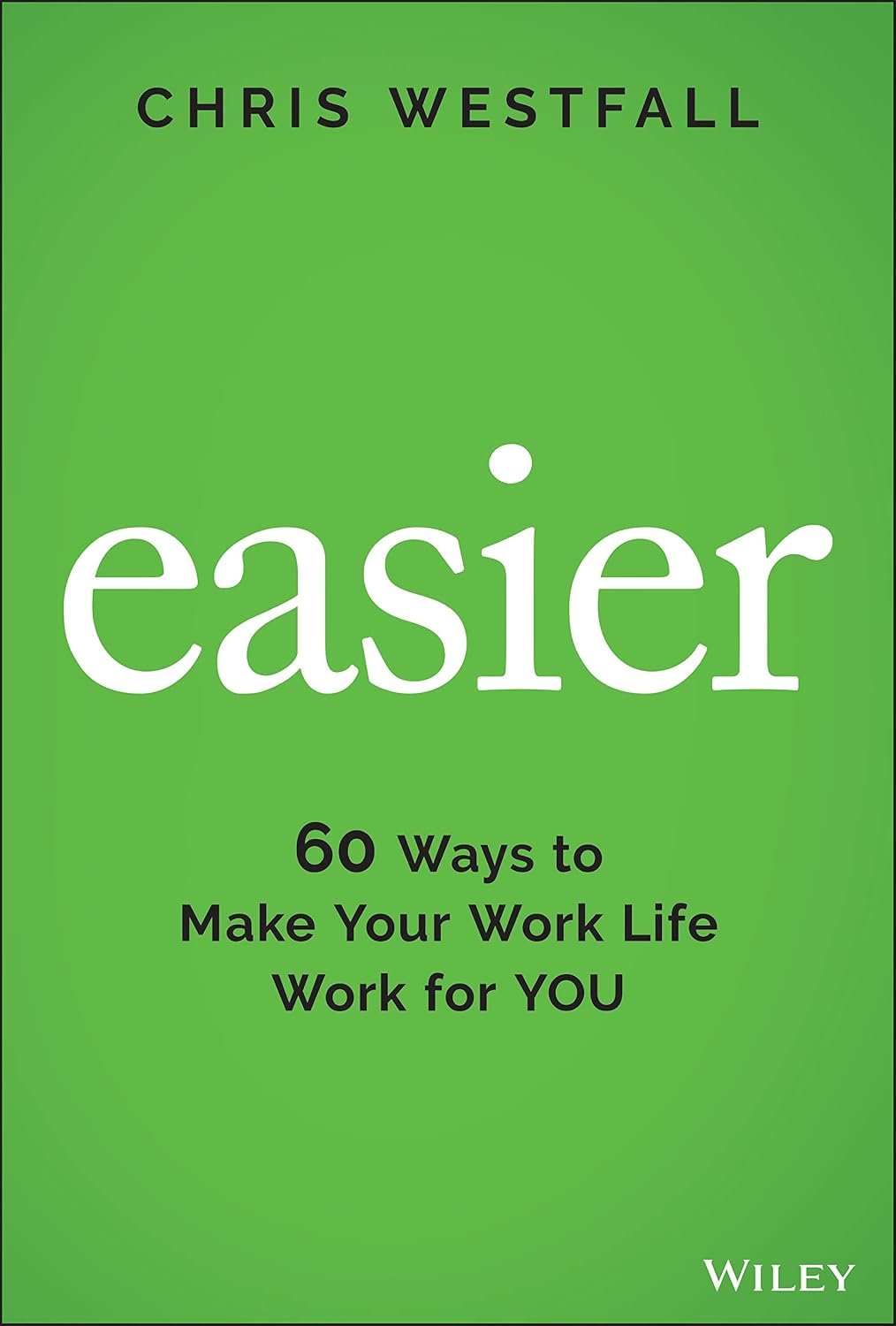
Easier: 60 Ways to Make Your Work Life Work for You
A coaching conversation begins with job frustration and becomes Chris Westfall’s story-led inquiry into work, resilience and possibility.
Books worth discovering. Authors worth knowing.
A coaching conversation begins with job frustration and becomes Chris Westfall’s story-led inquiry into work, resilience and possibility.
Original editorial introduction, grounded in the verified book edition and public descriptions.
An unhappy employee tells a coach that he wants to leave his job, then discovers that the decision may soon be taken out of his hands. That is the documented opening of Chris Westfall's Easier: 60 Ways to Make Your Work Life Work for You, a book published by Wiley that uses a coaching conversation as a vehicle for sixty lessons about work, resilience, and leadership. Its setup offers more dramatic pressure than a conventional checklist: the client seeks greater control just as his workplace future becomes uncertain.
The conversation rather than the commandment
The publisher describes a frustrated client in search of answers, direction, and confidence. He considers leaving his job but does not know whether entrepreneurship would suit him. He is also only days from being fired, a fact that creates urgency in the book's premise. Westfall could have arranged these themes as simple instructions about career planning. Instead, his published description emphasizes the exchange between client and coach. Dialogue allows a question to change shape in response to another person's assumptions, and that may be the book's most distinctive approach to professional guidance.
It is tempting to read every coaching scene as a recipe that will work equally for every reader. The more useful approach is to notice how the questions are framed. Someone who says 'I need to escape this job' may actually be describing a problem with confidence, belonging, expectations, or the value of their own skills. A conversation can help separate those concerns, even if it cannot guarantee the outcome. The public synopsis does not provide a detailed transcript of the coaching session or its resolution, so this feature does not manufacture exchanges or promise that the client finds an ideal career.
The meaning of easier when the stakes are real
The title might suggest avoiding difficult work. The publisher's description makes a subtler claim: a different response to difficulty can make the experience of acting more manageable. Its central proposed pivot asks what a person might gain from a challenge rather than only how to survive it. That is a change in attention, not proof that a firing, financial setback, or organizational problem becomes harmless. In a credible reading, ease is a way of approaching problems with more resources and fewer unnecessary assumptions. It should not become another expectation that stressed people must always feel optimistic.
A pending job loss is a particularly strong test of this idea. A person can adjust their mindset but still need income, legal rights, time to search for work, and support from other people. Westfall's framework is presented as leadership and coaching rather than individualized employment or financial advice. Readers can value its prompts without confusing a useful reframing with a universal solution. A practical question while reading is what remains outside the client's control after the conversation, and which steps become more possible because his interpretation of the situation has changed.
Self-leadership is not solitary leadership
Westfall's book repeatedly connects self-leadership with empathy, innovation, guidance, and relationships. That combination matters because popular workplace advice can overemphasize personal grit. If every problem is cast as an individual's failure to try harder, a reader may leave with more pressure than before. The author's described approach instead asks how someone might find support while rethinking an obstacle. The coach-client format itself illustrates that reaching toward another person can be part of taking responsibility rather than an admission of weakness.
The publisher identifies team members and leaders among the intended audience. That broad readership makes sense if the book's central concern is not merely whether one employee resigns. Managers also confront uncertainty, unclear expectations, and the temptation to make decisions from fear. Teams inherit the emotional tone of their leaders. An approach that invites better questions may change a meeting or a difficult conversation, even when it does not immediately change a policy. These are practical implications of the book's published themes, not claims that Westfall has empirically demonstrated particular workplace outcomes in every setting.
The storyteller's method
The table of contents published through Wiley and bookselling platforms shows a narrative progression rather than a sequence of sixty independently labeled commandments. Chapters such as The Arrival, A Commitment Emerges, A Daring Rescue, and Coming Back Home establish the feeling of a journey. A reader may benefit from noticing how coaching ideas are attached to a story and revisited as circumstances develop. The narrative frame can make advice less abstract because questions arise from the situation of a person who does not know what will happen next.
There is also a limitation in this method. A single fictional or reconstructed encounter cannot establish that every principle will work for everyone. Readers can separate an illustrative story from the evidence they might need before making a consequential personal decision. One person considering entrepreneurship faces a very different risk profile from another managing caregiving responsibilities or an insecure income. The coaching conversation can be illuminating without providing a substitute for specific practical investigation. That distinction is worth carrying into any book that promises numerous ways to improve an aspect of life.
Who should open Easier?
Easier is well suited to readers drawn to narrative business books, professional coaching, leadership development, and workplace reflection. It may be especially timely for someone reassessing a job, preparing for an uncomfortable conversation, or questioning the assumptions that make a problem feel immovable. Managers interested in empathy and team communication may also find the framework worth examining. Anyone seeking a technical labor-law manual, a detailed startup finance guide, or scientifically guaranteed stress treatment should look elsewhere for those specific needs. This book's verified proposition is a story-led approach to work and self-leadership, with sixty ways of thinking and acting positioned as practical possibilities rather than certainties.
A question worth keeping after the book
The strongest invitation in the publisher's summary is to change the question before rushing to an answer. A client on the verge of losing his job can reasonably feel urgency, disappointment, and fear. Asking what might become possible does not erase those feelings. It creates space for decisions that are not made solely by the pressure of the moment. Westfall has built his book around that tension, and readers can test the ideas against their own situations without mistaking them for personal counsel. The work's distinctive combination of career uncertainty, coaching dialogue, and narrative progression makes Easier an introduction to flexibility rather than a promise of painless employment.
About the book.
A coaching conversation begins with job frustration and becomes Chris Westfall’s story-led inquiry into work, resilience and possibility. Public bibliographic details have been distinguished from editorial interpretation.
Independent editorial feature: this is a source-based introduction, not a firsthand review of the complete book. Bibliographic descriptions and author or publisher statements are interpreted with clear source limits. The original purchase URL remains unchanged; WordPress cover media is added later by the owner’s publisher.
Found a book worth opening?
Books worth discovering. Authors worth knowing.
Return to the Journal →