
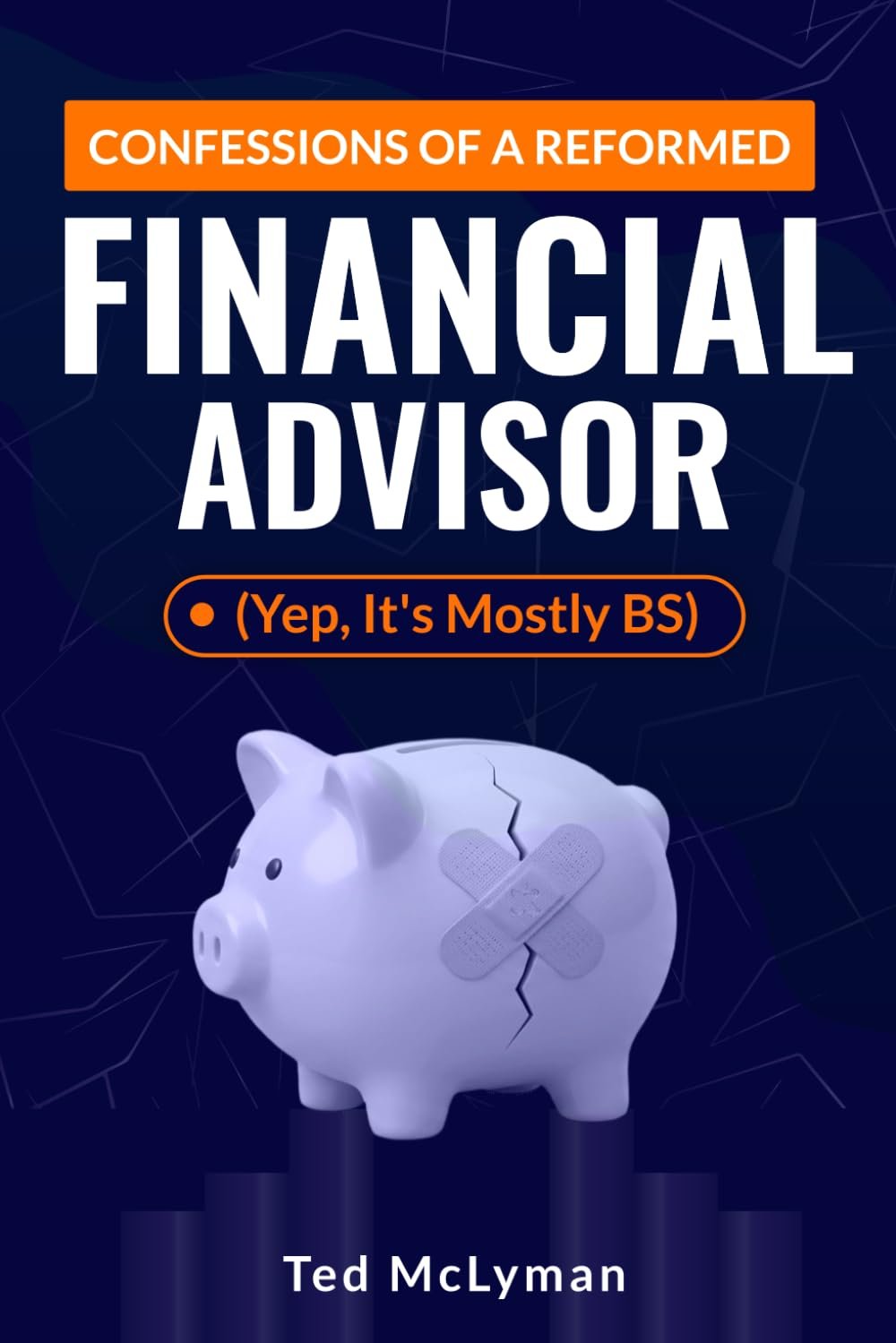
Confessions of a Reformed Financial Advisor
Ted McLyman questions conventional financial advice by asking how habits, personal values and daily choice design affect money behavior.
Books worth discovering. Authors worth knowing.
Ted McLyman questions conventional financial advice by asking how habits, personal values and daily choice design affect money behavior.
Original editorial introduction, grounded in the verified book edition and public descriptions.
Money advice often assumes a simple chain: learn the correct rule, follow it consistently, and arrive at the desired result. Ted McLyman's Confessions of a Reformed Financial Advisor: (Yep, It's Mostly BS) challenges that tidy sequence. On the author's own site, he argues that behavior, temperament, and the design of everyday choices can matter more than possessing another list of technically correct instructions. His provocative title is less a rejection of all financial knowledge than a challenge to advice that overlooks how people actually live.
A confession aimed at the advice industry
McLyman presents himself as a former financial adviser who became dissatisfied with conventional prescriptions. His public materials describe the gap between knowing a sensible financial action and performing it, especially when shopping environments, emotion, and habit make the immediate alternative inviting. This is a recognizable difficulty: a person can understand compound interest and still make an unplanned purchase; another can create a detailed budget but abandon it when life becomes complicated. The book's premise treats these failures of follow-through as a design problem worth examining rather than merely a shortage of arithmetic lessons.
The author's sharp rhetoric is part of the appeal, but it deserves careful framing. His assertion that traditional advice often clashes with human biology is the book's position, not a universally verified statement about every adviser or financial service. Likewise, broad numerical claims about subconscious spending require independent research before appearing as established science. The valuable starting point is narrower and more defensible: financial behavior does not occur in a vacuum. Convenience, stress, marketing, social expectations, and personal priorities can influence decisions alongside formal information. That makes the book relevant to readers tired of assuming a new spreadsheet will solve every repeated difficulty.
Values before rules
The author's published chapter outline describes a Money Behavior System with stages devoted to values, temperament, knowledge, strategy, and plan. That sequence puts the reader's life before the technical instrument. What is the money for? Which trade-offs are acceptable? What habits seem reliable and which situations make judgment harder? Starting with these questions could lead two people with identical incomes toward different practical approaches. Such differences are not necessarily proof that one person is irresponsible. They may reflect different priorities, family structures, financial constraints, or tolerances for uncertainty.
This approach encourages a distinction between personalization and indulgence. Understanding one's tendencies does not mean that every impulse should be accommodated. It may mean deliberately adding a pause between wanting something and purchasing it, arranging automated transfers where appropriate, or reducing exposure to tempting retail environments. Those are examples of behavioral design for readers to consider, not a report that the book prescribes each technique in precisely that form. The published framework suggests that effective plans should account for the person operating them. The broader critical question is whether personalized systems can remain honest about external constraints such as low wages, emergencies, debt costs, and unequal opportunities.
The role of friction
McLyman's public essays criticize technology that makes spending almost effortless. One-click payments, saved card details, and constant offers can remove the small moments in which a person might reconsider a decision. Financial tools that simplify useful actions can therefore also simplify unhelpful ones. The author's language of friction directs attention to the environment surrounding a habit. Instead of demanding extraordinary willpower every day, an individual may ask which defaults make desired behavior more likely and which encourage decisions they later regret.
There is a trade-off here that makes the discussion more interesting than a simple warning against apps. Easier access to financial services can also be beneficial, particularly for people facing distance, disability, irregular hours, or limited banking options. Friction is not inherently good or bad. A sensible reader can distinguish obstacles that protect deliberation from obstacles that exclude people. The book's challenge to modern financial convenience invites that debate. Does a tool support the user's stated long-term goals, or merely shorten the journey from impulse to transaction? Answering well requires both attention to design and an understanding of one's own circumstances.
An argument about self-knowledge
The chapter themes include money beliefs and values. These terms can sound abstract until a conflict appears. Someone may sincerely claim to value security while treating every bonus as an invitation to spend. Another may say that generosity matters but never make room for giving in their plan. Such tensions need not be moral failures; they can indicate that stated ideals and actual habits are operating in separate systems. McLyman's focus on what he calls money temperament invites readers to make those differences visible and consider whether their financial routines match what they say is important.
The challenge is not to turn temperament into destiny. A behavioral label should not imply that someone is biologically incapable of learning, changing, or seeking sound financial advice. Evidence-based research about decision-making is more complex than a single personality category. Readers may find the book most useful when they treat a framework as a prompt for self-observation rather than a diagnostic test. It can help organize questions about spending and saving while still leaving room for professional guidance, changing circumstances, and independent scrutiny of any product or strategy offered alongside the author's system.
Who is likely to benefit from this reading?
Confessions of a Reformed Financial Advisor may appeal to readers who have repeatedly tried conventional budget resolutions and wonder why knowing what to do has not produced sustainable habits. People interested in behavioral finance, consumer psychology, choice architecture, and values-based planning will recognize its central questions. Its confrontational style may also suit readers who enjoy critical accounts of professional industries. But the book should not replace licensed, personalized advice about investments, debt restructuring, tax law, or retirement planning. The publisher and author present a perspective on behavior and planning; the specific effectiveness of its framework for an individual is not guaranteed. The best use is to evaluate its ideas against one's own records, constraints, and independent sources.
The real test of a reformed approach
The book's title invites a dramatic break from familiar financial authority. A careful reader need not accept an equally sweeping replacement theory. The more durable lesson is to insist that advice be tested against real decisions. Does the system reduce regret? Can it be sustained when income changes? Does it make important costs and trade-offs clearer, rather than simply more comfortable to ignore? McLyman's contribution, as described in his public material, is the insistence that knowledge and behavior cannot be separated. That tension offers plenty to think about even for readers who remain skeptical of his strongest claims. The result is a financial book worth approaching as a provocative set of questions about human choice, not a prescription guaranteed to build wealth.
About the book.
Ted McLyman questions conventional financial advice by asking how habits, personal values and daily choice design affect money behavior. Public bibliographic details have been distinguished from editorial interpretation.
Independent editorial feature: this is a source-based introduction, not a firsthand review of the complete book. Bibliographic descriptions and author or publisher statements are interpreted with clear source limits. The original purchase URL remains unchanged; WordPress cover media is added later by the owner’s publisher.
Found a book worth opening?
Books worth discovering. Authors worth knowing.
Return to the Journal →