
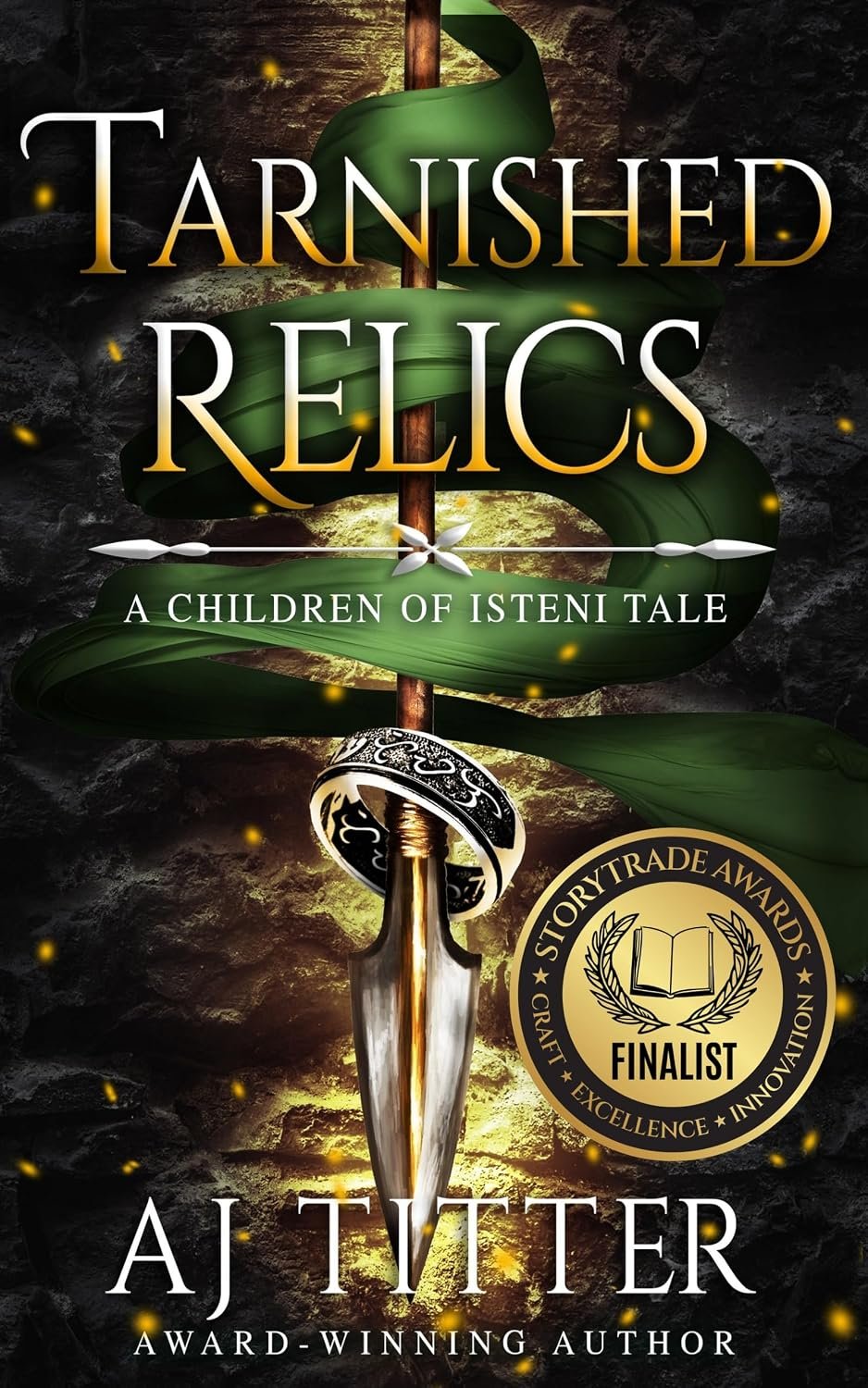
Tarnished Relics: A Children of Isteni Tale (English Edition)
Prophecy, a dream-seer and a demand for revenge converge in a world governed by divine power.
Books worth discovering. Authors worth knowing.
Revenge can feel like justice when the people who should protect a family have failed it. Prophecy can make a personal grievance seem inevitable on a much larger scale. In AJ Titter's Tarnished Relics: A Children of Isteni Tale, those two forces meet around Attoria, a woman whose dreams reveal the future, and Amiir, an ancient being who seeks to remove the creator Isteni from power. The publicly available synopsis provides a richly defined conflict without revealing who will prevail. That combination makes the book a promising subject for a spoiler-conscious fantasy feature.
An editorial introduction to the book and its published premise, not a full-book review.
Two ambitions approaching the same prophecy The publisher description identifies Amiir as one of the first born and the would-be challenger of his father, Isteni, the creator. An ancient prophecy of Ouroby tells of a woman whose arrival may secure Amiir's victory. He has waited for a seer born beneath particular celestial signs: the lorkiss and the swan. These are verifiable elements of the advertised world. Their significance beyond the prophecy remains undisclosed, and an introduction should resist explaining an invented cosmology more fully than the sources allow.
At the other end of the story stands Attoria, who experiences visions of the future through dreams. Her power is described as rare in Halgrond, especially for a woman. That detail immediately makes the gift social as well as supernatural: rarity can attract admiration, suspicion or danger depending on the institutions around it. The synopsis confirms that zealots of Isteni pursue her, hoping to prevent the prophecy by killing its possible subject.
The curse that makes the quest personal Attoria's parents are afflicted with a deadly illness described as a curse. She wants to learn who is responsible and pursue revenge. The emotional logic is direct: an intimate injury drives her toward answers that may connect with conflicts older and larger than her family. This makes her more than an abstract figure chosen by destiny. Her immediate concern has a concrete human scale, even when the prophecy gives it cosmic consequences. Nothing in the public synopsis confirms the curse's origin or whether Attoria identifies the right culprit, so those questions remain part of the book's discovery.
The distinction between a search for truth and a desire for retaliation is useful here. Finding the person responsible could provide knowledge; hurting that person would be a separate decision with separate consequences. The book's promotional line contrasts justice and revenge, inviting a reader to consider whether the two goals reinforce or corrupt each other. That interpretation emerges directly from the blurb's framing.
When fate becomes a threat Many fantasy adventures treat prophecy as a promise of significance. In this story's summary, prophecy is also a target painted on a living person. Zealots who fear its fulfillment try to stop Attoria before they know whether she is the person Amiir has waited for. The uncertainty matters. If a prediction can trigger coercion, its social effects begin before its truth has been established. A character may be forced into danger by what others believe about her rather than by anything she has chosen to do. That is a compelling premise for a fantasy concerned with power.
Attoria's ability to dream the future adds another layer. Does foreknowledge create responsibility, or does it make agency harder to exercise? The published description does not describe the precision of her visions or their limitations, so any detailed magic-system explanation would be invented. Still, the basic premise puts the question of choice in view. Readers can approach the story interested not only in what a prophecy says, but in how people respond to being told that their lives have a predetermined use.
The creator and the rebel Amiir's opposition to Isteni is framed as a desire to dethrone his father. The language of creation and kinship gives this conflict a mythic dimension: an offspring challenges the figure who made the world. That image is recognizable across many storytelling traditions, but one should not assume this fictional mythology precisely reproduces any particular real-world tradition without evidence. The name of the realm, the signs in the sky and the title *Children of Isteni* establish Titter's invented setting on its own terms. Readers can appreciate the scale of the dispute while learning its rules through the narrative.
The promotion leaves Amiir's motives largely open beyond his ambition. An author could make a rebel heroic, self-serving or something in between. The feature has no basis to assign him one of those roles. That uncertainty is productive: Attoria's desire for revenge and Amiir's desire to overthrow an established order might align in action while diverging in purpose. The public question—whether she is the woman he seeks—creates the suspense. It does not provide the answer or the terms of an eventual alliance.
A fantasy world structured by pursuit The advertised action places Attoria between an ongoing search for answers and people intent on killing her. That gives the plot a pursuit structure alongside its mythology. Chases can create momentum, but they also make each temporary refuge or encounter more meaningful. Readers may be interested in the tension between a seer's knowledge of possible futures and her immediate need to survive the present. We do not know from the synopsis which allies appear, which locations she visits or how the pursuit ends, so a feature must avoid naming imaginary episodes.
The story's stated elements support a sword-and-sorcery or epic-fantasy reading, though category labels alone cannot capture its tone. The public listings emphasize revenge, prophecy and divine conflict rather than a comedic quest or purely romantic adventure. Readers who like women with dangerous abilities, invented religious orders and mysteries about fate may find a natural point of entry. Those hoping for an exhaustive lore summary should look to the book itself: a short listing is not a license for an encyclopedia of unverified world-building.
Recognition, editions and expectations Apple Books lists the book as released in December 2024 and includes publisher material mentioning a bronze medal at the 2025 Global Book Awards and a Storytrade finalist distinction. These promotional claims are recorded as listed, not independently audited award results. Edition information and page counts vary across storefronts, so readers should compare the format they intend to buy. The important editorial distinction is between verifiable bibliographic context and a critical judgment: neither an award claim nor a high average rating substitutes for a considered reading of the full work.
What the available description gives Tarnished Relics is a clear set of interlocking questions. Who cursed Attoria's parents? Why does Amiir need a female seer? Can the zealots stop a future they fear by attacking the person who might bring it about? Which decisions remain genuinely hers? A responsible feature can point readers toward those questions without manufacturing revelations. The novel's attraction, at least as publicly presented, lies in the pressure of personal grief inside a much older struggle over creation and control.
About the book.
Amiir seeks to dethrone creator Isteni; Attoria, a dream-seer in Halgrond, seeks the source of a curse on her parents as zealots pursue her.
Sponsored Book Feature: promotional placement is disclosed; this is not an independent full-book review. Interpretive observations are distinguished from the publicly documented synopsis. Verify all copy before publication. Source research: primary reference and second reference.
Found a book worth opening?
Books worth discovering. Authors worth knowing.
Return to the Journal →