
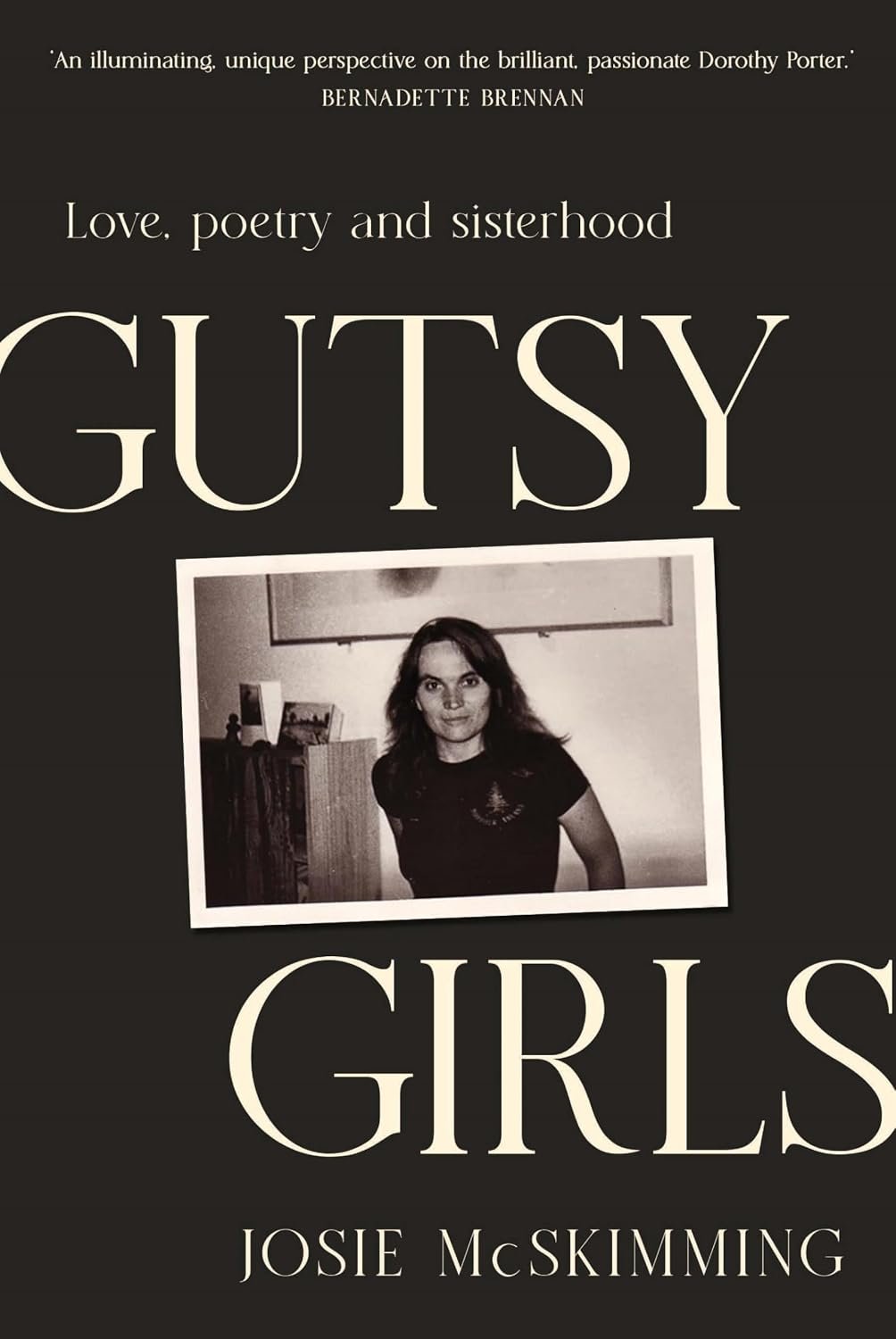
Gutsy Girls: Love, Poetry and Sisterhood
Josie McSkimming writes about her sister, the Australian poet Dorothy Porter, without making Dorothy the only person in the story. Raised alongside their sister Mary in an unpredictable household, the women…
Books worth discovering. Authors worth knowing.
Josie McSkimming writes about her sister, the Australian poet Dorothy Porter, without making Dorothy the only person in the story. Raised alongside their sister Mary in an unpredictable household, the women found markedly different means of surviving and defining themselves. Dorothy moved toward poetry, sexual freedom and public artistic life; Josie spent…
Carefully sourced literary criticism and book-specific interpretation.
Josie McSkimming writes about her sister, the Australian poet Dorothy Porter, without making Dorothy the only person in the story. Raised alongside their sister Mary in an unpredictable household, the women found markedly different means of surviving and defining themselves. Dorothy moved toward poetry, sexual freedom and public artistic life; Josie spent decades in evangelical Christianity before reconstructing her identity. The book draws on private letters, diaries and family memory.
A sister who is also a biographer
What makes this premise unusually rich is its refusal to treat one extraordinary artist as a solitary phenomenon. A sibling can recognise private vulnerabilities that public admirers never see, but that intimacy does not guarantee a complete or impartial account. In making herself visible as a narrator, McSkimming takes responsibility for the angle of her view. The artist is also a sister, and the sister telling the story has her own history of certainty, estrangement and change.
Two lives in one account
The structure matters. Interview material explains that a biography focused on Dorothy grew into a narrative set alongside Josie’s own life and the shifting relationships among all three sisters. That form can confront a dilemma common to family memoir: if one family member becomes famous, do the others become supporting characters? A parallel account insists that apparently quieter lives contain their own risks and reckonings.
When poetry changes its reader
Dorothy Porter’s art is not only a subject of admiration here; it becomes an active force in her sister’s life. For Josie, a poetry that embraced ambiguity and bodily freedom helped loosen the limits of a highly regulated religious identity. This is a powerful critical proposition because literature’s influence is often described abstractly, while here it is placed inside a family relationship shaped by disagreement as well as affection. The memoir asks what it means to learn from someone one has also judged.
A revealing family perspective
For readers interested in Porter’s writing, this book promises a vivid personal perspective, not a replacement for the poems. For readers of family memoir it offers a more difficult subject: love that does not erase ideological distance, and the responsibility of telling a story when some of its subjects can no longer respond. A full review should test how ethically the private archival material is handled. The publisher’s account nevertheless establishes a substantial and original literary project.
Biography without the safety of distance
The biographer of a celebrated artist usually works at some distance from the subject, interpreting records left in archives, public interviews and published work. A sister inhabits a different relationship to evidence. Private memories may be precise yet emotionally entangled; affection may illuminate a trait and excuse another; childhood scenes may retain an intensity that no public account could reproduce. McSkimming’s decision to enter her own narrative is therefore more than a confessional gesture. It acknowledges that her account of Dorothy Porter is inseparable from the person who remembers her. The reader gains access to a view from within the family, but also gains a visible narrator whose perspective can be questioned.
That move offers a refreshing alternative to the idea that the most accurate biographer is the least present. The challenge is not to remove the writer’s perspective but to make its pressures legible. Where Dorothy’s diaries provide one version of feeling, Josie’s recollections may offer another. Where the public persona of a poet appears fearless, the sister might perceive uncertainty, tenderness or contradictions. The published interviews suggest a narrative that regards these differences as material rather than defects. A complete review would examine how clearly memories and archival quotations are distinguished and whether absent family members receive fair treatment.
Two forms of escape
The contrasting paths of Dorothy and Josie are a central structural insight. One sister sought freedom in art, sexuality and experiment; the other found a demanding religious system that initially offered order, identity and belonging. It would be too easy to assign enlightenment to one path and delusion to the other from the opening pages. The meaningful story lies in why each choice might have felt protective at the time, and how those choices shaped the sisters’ ability to understand one another. Josie’s eventual departure from evangelical Christianity does not erase the years when she lived inside its assumptions.
The book is particularly promising as an account of how art can alter a reader who initially rejects much of the artist’s life. Dorothy’s poetry did not merely win Josie’s admiration from a safe distance; her work appears to have pressed on the boundaries of what Josie thought permissible to feel and know. That process invites a more exact conception of literary influence. A poem need not persuade through argument; it can enlarge the emotional range within which a reader is willing to live. The intellectual difference between the sisters becomes part of the intimacy rather than proof that intimacy was impossible.
Who owns a family story?
Writing about the dead does not remove the obligation to think about privacy. A famous sister may have chosen to disclose a great deal in verse and performance without consenting in advance to every detail that later family members might reveal. The same account may involve parents, partners and surviving relatives who understand events differently. McSkimming’s public discussions openly acknowledge the challenge of difficult family history; that candour is a promising basis for a complex memoir, though it cannot substitute for evaluating the finished book’s choices about inclusion and restraint.
This question is not a reason to refuse intimate biography. It is one of the reasons the form matters. Family history has often been polished into a heroic lineage or reduced to damaging revelations. A writer who can show how love persists through conflict, judgment and incompatible convictions may offer something more truthful than either. Gutsy Girls seems to promise a portrait of sisterhood in motion, one that honours the brilliance of Dorothy’s work without treating the other women’s histories as footnotes. That is the most compelling claim the documented materials make for it.
The review’s scope
This assessment is based on the identified bibliographic records and available author, publisher and bookseller descriptions. The interpretive claims above are editorial judgments about the documented premise and genre choices, not testimony to having read every chapter or inspected every illustration. The published text may answer, complicate or contradict the critical questions raised here. A finished review would assess the language, structure and ending directly.
About the book.
The title, author/contributor record, source URL and matching cover file ID come from the current MarketAnyBook Journal Queue and its Drive asset folder. The review considers literary family memoir and biography through verified available descriptions rather than firsthand full-book reading. Sheet Column G only says “English edition” and omits the author; publisher UQP identifies Josie McSkimming. Keep exact source_author_value but require human correction before publishing.
Unsponsored editorial book review based on publicly available bibliographic and descriptive evidence, with critical interpretation distinguished from verified book details. The source spreadsheet author field is incomplete; Josie McSkimming is credited by the publisher.
Found a book worth opening?
Books worth discovering. Authors worth knowing.
Return to the Journal →