
Entrance To Eden
An adventure ending at the gates of Eden brings an ancient theological image into contact with two young friends whose loyalty is repeatedly tested. The public summary of Rick Mercado’s Entrance To Eden…
Books worth discovering. Authors worth knowing.
An adventure ending at the gates of Eden brings an ancient theological image into contact with two young friends whose loyalty is repeatedly tested. The public summary of Rick Mercado’s Entrance To Eden: Never Give Up! follows Will Stilwell and Eddie Lauer toward the close of a long-running Cavern of Time storyline. A corrupted sword threatens Eddie’s…
Book-specific criticism, grounded in what the available sources support.
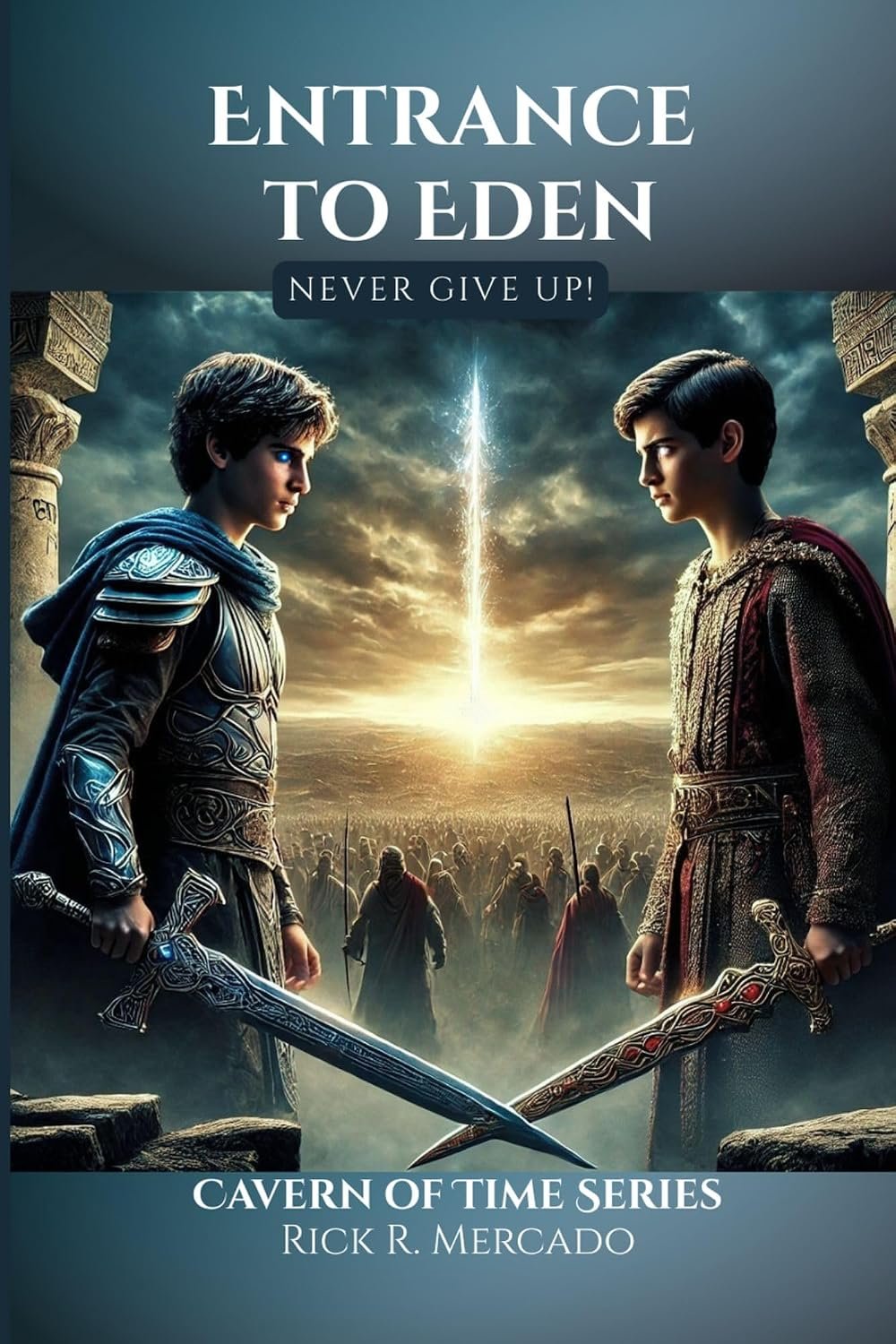
An adventure ending at the gates of Eden brings an ancient theological image into contact with two young friends whose loyalty is repeatedly tested. The public summary of Rick Mercado’s Entrance To Eden: Never Give Up! follows Will Stilwell and Eddie Lauer toward the close of a long-running Cavern of Time storyline. A corrupted sword threatens Eddie’s judgment, while Will confronts the possibility that saving his friend and safeguarding the world may require opposing choices. The Sheet identifies this listing as a second edition.
A moral choice beneath spectacle
The external synopsis supplies giants, skeletal warriors, hidden passages and a prophecy, but those images are secondary to the moral shape of the climax. Will’s dilemma is memorable because it denies him an easy distinction between private love and public duty. The hero of an adventure can often defeat the villain without surrendering anything essential; here the promise is more uncomfortable. To make such a predicament meaningful, the story must show that Eddie remains a person worth saving even when he becomes dangerous. Otherwise the conflict is only a dramatic postponement of an inevitable rescue.
Friendship and the language of corruption
A weapon that influences its bearer is a familiar fantasy device. It allows an author to represent temptation externally, but carries a risk: if every bad choice belongs to the sword, the character’s responsibility disappears. The book’s advertised interest in courage, faith and forgiveness would be better served by allowing Eddie some agency even within pressure. That would make Will’s faithfulness an ethical response to a friend’s complicated predicament rather than a simple obligation to remove a curse. The synopsis alone cannot tell us whether Mercado develops this distinction, but it is the correct measure of the novel’s most interesting tension.
A finale built from earlier debts
The book’s description calls it the finale of a trilogy even though its queue designation mentions Book 6. That mismatch could reflect different marketing structures and deserves edition verification rather than silent correction. What is clear is that the advertised story relies on accumulated events: prior encounters with ancient riddles, guardians and a sentient sword. A reader entering here may understand the immediate stakes but lack the emotional memory that gives a final test its force. Series continuity is not only a matter of recalling lore; it is the weight of decisions made before the climax.
Faith without a shortcut
The promise of Eden and biblical artifacts situates the adventure in religious imagination. It need not require the reader to share every premise to appreciate the structure of moral conflict. The useful question is whether faith becomes a means to face uncertainty or a shortcut through it. An outcome guaranteed by prophecy can flatten suspense unless characters must still choose how to answer the call. The most compelling possibility is that the spiritual imagery expands, rather than simplifies, the cost of loyalty.
What the word Eden promises
Eden is a particularly charged destination because it evokes a place of origin and a story of loss. As an adventure objective, it appears to promise restoration. As a religious symbol, it can also make the desire to return seem suspect: restoration might require confronting the limits of human control rather than possessing another spectacular artifact. The synopsis names a flaming sword among the legendary elements attached to the site. A narrative using these images has a chance to distinguish wonder from conquest. Will and Eddie’s friendship becomes a human-scale version of the same question: when someone wants to recover what has been lost, how far may they go in order to do so?
The corrupted weapon as an external conscience
The sword motif gives the novel a potentially interesting visual shorthand for a slowly altered sense of right and wrong. Unlike a creature that simply attacks, a weapon is used by somebody; danger arises through the relationship between an object’s power and a bearer’s desire. The published description says Eddie’s encounter threatens to consume him, making Will the person required to respond. That formulation invites the reader to look for moments of hesitation, accountability and recognition. A magical explanation for harm can be dramatically satisfying only if it does not erase the person beneath the influence. In a faith-oriented tale, forgiveness should have weight because an actual wrong has been recognised, not because the villainous object has been safely discarded.
Who is the intended young reader?
The advertised age band is broad. A ten-year-old may respond chiefly to the puzzles, subterranean spaces and friendship, while an older teenager may be more interested in sacrifice and questions of moral autonomy. The book’s structure must give both groups a place to stand. Clear action is not inherently shallow, and spiritual seriousness need not imply adult complexity in every conversation. The more practical editorial question is whether the story can carry its central dilemma in images and consequences that younger readers understand without simplifying the older reader’s uncertainty. Its public synopsis lays out a real narrative test; the full edition must show whether that test is met.
An edition question that matters
The queue specifically calls this the second edition. Changes of edition may involve corrections, revisions or merely republication; those possibilities are not equivalent. Without access to both texts, a critic should neither congratulate the author on improvements nor describe new material. This practical reservation is especially relevant for an apparent series finale, where small differences in continuity may matter to a returning reader. The original retail link is preserved, and the edition should be checked against the actual cover and publication record before the article is authorised.
Who will find value here
Readers aged toward the older end of the advertised middle-grade and teen spectrum who enjoy clean, quest-driven fantasy and explicit questions of faith may want to begin with the earlier Cavern of Time books. For a newcomer, the central friendship offers a clear way in, but the second-edition and series-order details should be checked before buying. This critical framing follows the public synopsis, not a full reading.
What this review can establish
This is an independent, research-based editorial assessment of the identified book, informed by the listed publisher, author and bibliographic materials. The analysis identifies documented premises, meaningful genre expectations and open critical questions. It is not a firsthand claim to have read every chapter or inspected the entire illustrated edition; judgments about the quality of prose, plot resolution and any unverified interior material are reserved for a full-text review.
About the book.
A limited-source, independent editorial evaluation of faith-inflected young-adult fantasy adventure. Facts are drawn from the listed book record and separately identified public descriptions; speculative editorial questions are not presented as plot facts. Public series synopsis describes a trilogy conclusion; queue calls this Cavern of Time Series Book 6. Verify exact second edition and volume designation before publication.
This is an unsponsored editorial review based on verified public descriptions and bibliographic materials, not a claim to firsthand reading of the complete book.
Found a book worth opening?
Books worth discovering. Authors worth knowing.
Return to the Journal →