
The Guardians Trilogy: Rise of Vice: 1
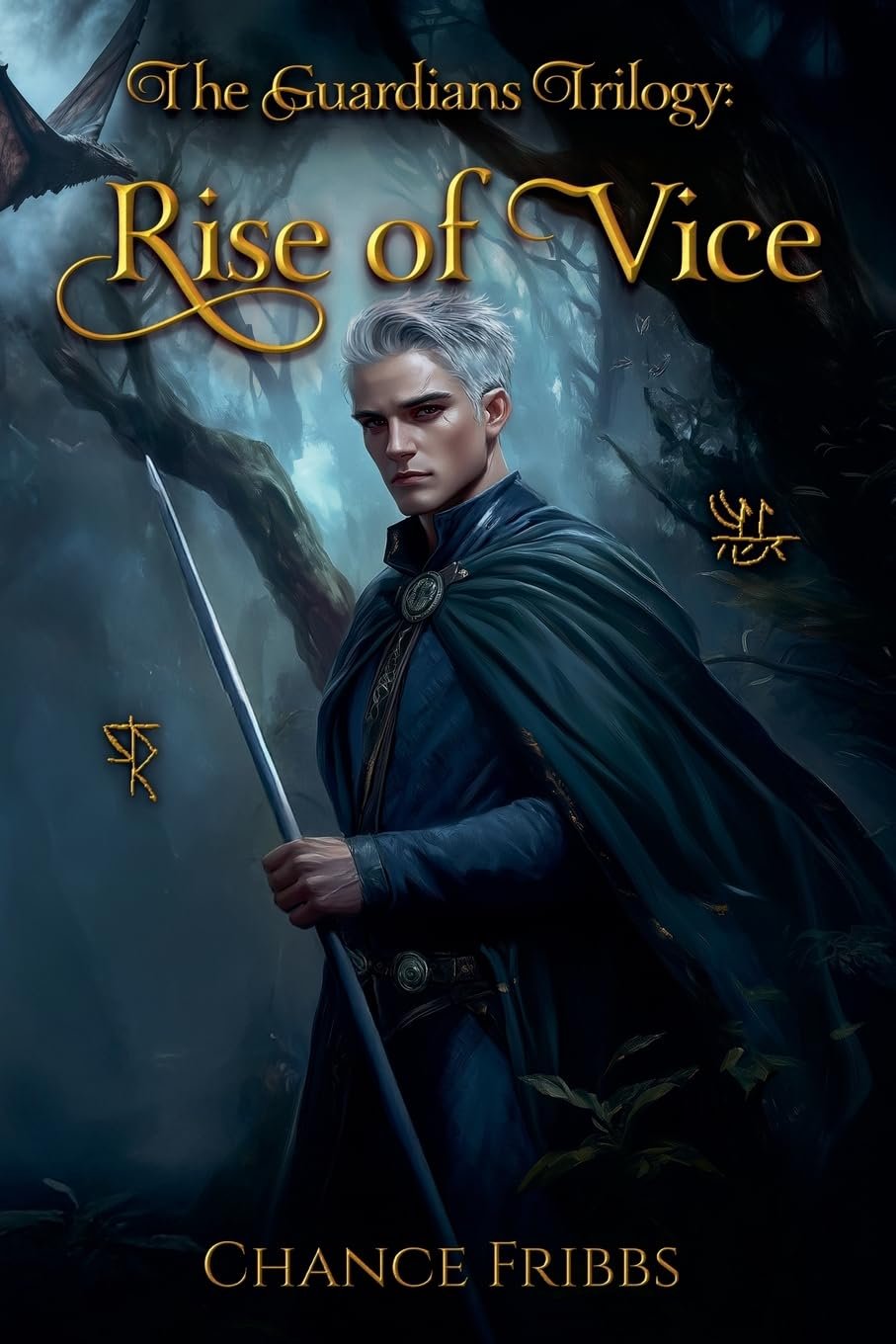
In Chance Fribbs’s Rise of Vice, destiny is not a private revelation but a burden distributed among six people drawn from different worlds. Set in Maeglover, the novel brings Garthen, whose family history is…
Books worth discovering. Authors worth knowing.
In Chance Fribbs’s Rise of Vice, destiny is not a private revelation but a burden distributed among six people drawn from different worlds. Set in Maeglover, the novel brings Garthen, whose family history is marked by tragedy, together with Kriegon and fellow Guardians Ellena, Rei, Saphire and Zenmore. An archangel’s prophecy establishes their task…
Book-specific criticism, grounded in what the available sources support.
In Chance Fribbs’s Rise of Vice, destiny is not a private revelation but a burden distributed among six people drawn from different worlds. Set in Maeglover, the novel brings Garthen, whose family history is marked by tragedy, together with Kriegon and fellow Guardians Ellena, Rei, Saphire and Zenmore. An archangel’s prophecy establishes their task against demonic princes, including Mammon and Beelzebub. The advertised drama therefore depends not only on an escalating war but on strangers learning whether they can carry an obligation in common.
The challenge of six destinies
An ensemble prophecy is capable of creating both scale and intimacy. Six heroes suggest distinct abilities, loyalties and interpretations of what they owe to the world. Yet a crowded chosen-company premise can become a procession of introductions unless every character’s private reasons for fighting are tested by someone else’s presence. The synopsis gives Garthen grief and Kriegon dislocation; those motivations are already different enough to create resistance to a single, official reading of the prophecy. The critical question is whether the other Guardians receive similarly consequential interior lives, or whether the narrative’s demand for escalating conflict reduces them to their combat roles.
Faith, warfare and freedom
The book’s cosmology borrows familiar names from religious traditions and sets them inside a fantasy multiverse. That choice gives its antagonists immediate symbolic power, but it risks making moral complexity a matter of allegiance alone. If the Guardians must fight figures defined as demonic, what remains open to choice? The press description points toward loss, transformation and possible betrayal—potential sources of genuine uncertainty. A prophecy is dramatically interesting when fulfilment does not excuse individuals from answering for their actions. The more the story insists that good is chosen under pressure, the less it needs to rely on the absolute vocabulary of light and darkness.
World-building as an invitation
Fribbs’s publishing project openly imagines a realm that other writers may eventually enter. That collaborative ambition is noteworthy. It turns a fictional map into a shared imaginative proposition, but it also raises a demanding standard for the original book: the world must feel inhabited before it feels expandable. Maeglover’s names, battles and cosmological laws will matter most when they create credible constraints on ordinary desires. A novel whose setting consists chiefly of lore announcements can grow larger without becoming deeper. We cannot resolve that issue from a promotional description, but the ambition itself makes it a central question.
An epic’s genuine stakes
High fantasy can portray colossal armies and still leave readers cold if the personal cost remains abstract. Garthen’s bereavement is thus a promising anchor; fighting evil may be easier than deciding what grief authorises. Kriegon’s arrival from another world provides an outsider’s perspective on laws that everyone else has accepted. The dramatic value of the Guardians’ alliance depends on the space between those viewpoints. A strong opening volume should leave one or more emotional decisions complete even as the wider struggle continues.
An army of the chosen is still an army
The Guardians’ divine mandate might seem to settle the legitimacy of their campaign, yet large-scale fantasy is rarely more interesting than when it questions how an army treats those outside its ranks. A prophecy names the threat, but it cannot answer every question of strategy, sacrifice or collateral damage. The six heroes must presumably act within a world containing people who have not been chosen and may not even believe in the foretold conflict. Their treatment of those people would help decide whether they are guardians in the ethical sense or only warriors bearing a sacred title. The published summary does not give the relevant decisions, so the question remains a measure by which to read the novel rather than a judgment already reached.
The usefulness of separate worlds
Because the protagonists originate in different realms, the series can make unfamiliarity more than decorative world-building. A newcomer may misunderstand customs that a native regards as natural, and conflicting cultures may carry distinct ideas about duty, faith and leadership. That friction would be more fruitful than treating difference as a set of costumes and combat styles. Kriegon’s apparent displacement is therefore a promising component of the premise. It could provide the critical distance required to question Maeglover’s established explanations of its own war. In a genuinely plural epic, the alliance is formed through negotiation among worldviews; in a thinner one, all viewpoints quickly dissolve into obedience to the same prophecy. The available description promises the former possibility without settling the comparison.
Scale demands narrative restraint
A first volume whose world contains archangels, demonic princes and an entire multiverse risks giving too many explanations before the reader has learned to care. It is the classic epic-fantasy difficulty: every new name can broaden the fictional world while delaying a decision that matters emotionally. Garthen’s private tragedy could serve as an anchor, but only if it remains a cause of particular choices rather than a shorthand for seriousness. The use of multiple heroes offers opportunities for contrasting grief, ambition and humility. The challenge is one of selection. A good epic does not show everything about its world; it chooses which details make a conflict impossible to forget. This is the most useful critical question to carry into a complete reading of Rise of Vice.
Who will find value here
Rise of Vice will be of interest to readers who enjoy group quests, angelic and demonic cosmology and multi-world fantasy. Its strongest documented promise is a large-scale conflict shaped by different forms of personal loss. Because the available evidence is descriptive and partly promotional, no claim is made here about the success of its battle scenes, prose or ending. Those require reading the novel itself.
What this review can establish
This is an independent, research-based editorial assessment of the identified book, informed by the listed publisher, author and bibliographic materials. The analysis identifies documented premises, meaningful genre expectations and open critical questions. It is not a firsthand claim to have read every chapter or inspected the entire illustrated edition; judgments about the quality of prose, plot resolution and any unverified interior material are reserved for a full-text review.
About the book.
A limited-source, independent editorial evaluation of epic fantasy with religious cosmology. Facts are drawn from the listed book record and separately identified public descriptions; speculative editorial questions are not presented as plot facts.
This book is marked sponsored in the MarketAnyBook source queue. Sponsorship is disclosed; the analysis is research-based and does not claim a full firsthand reading.
Found a book worth opening?
Books worth discovering. Authors worth knowing.
Return to the Journal →