
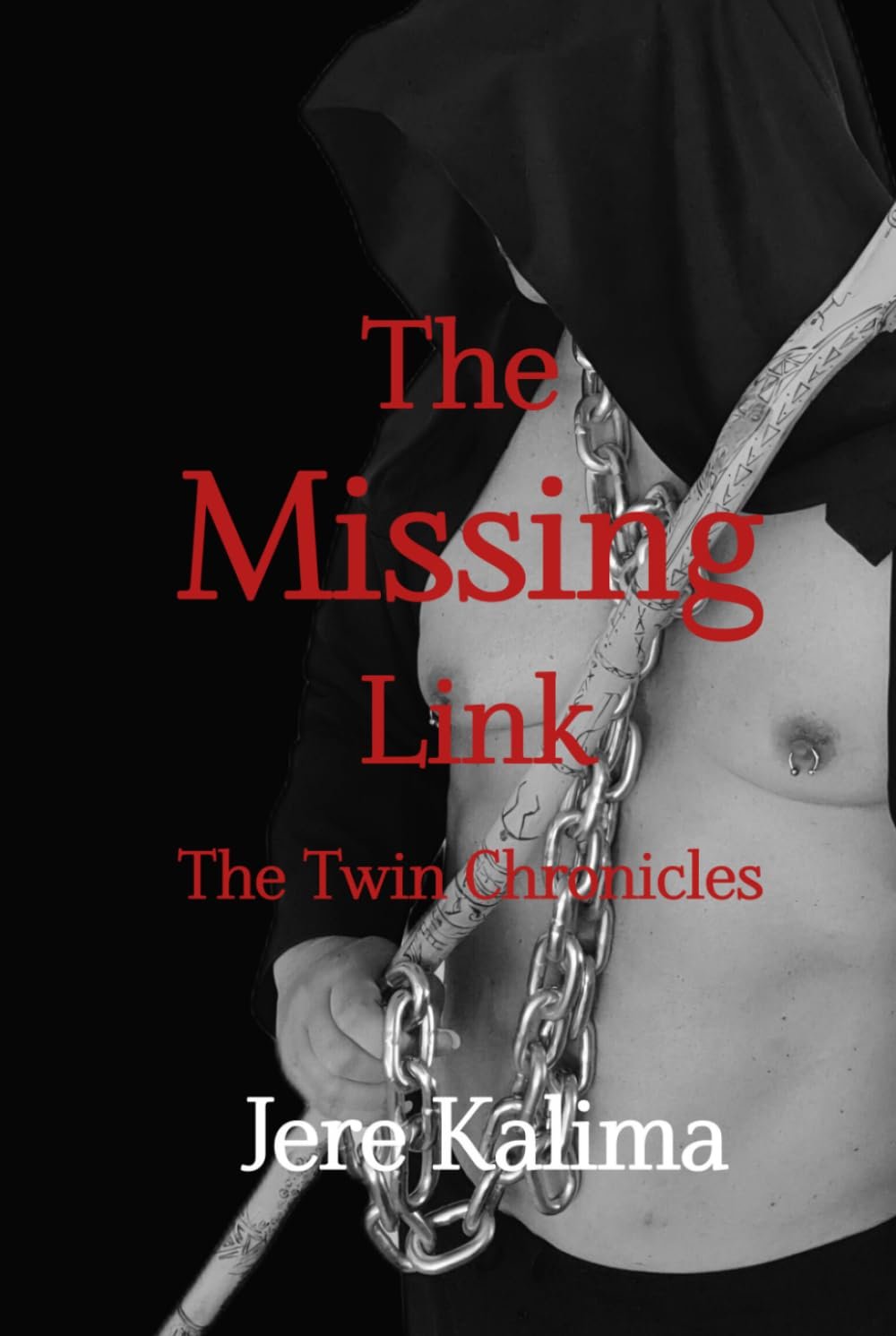
The Missing Link: The Twin Chronicles
The Missing Link: The Twin Chronicles announces its central imaginative interest in two phrases: something absent, and a relationship understood through twinning. Public cataloguing identifies Jere Kalima as…
Books worth discovering. Authors worth knowing.
The Missing Link: The Twin Chronicles announces its central imaginative interest in two phrases: something absent, and a relationship understood through twinning. Public cataloguing identifies Jere Kalima as the author and places the work among a series of linked mysteries. Available reader descriptions refer to Elijah Paul, questions of identity…
Book-specific criticism, grounded in what the available sources support.
The Missing Link: The Twin Chronicles announces its central imaginative interest in two phrases: something absent, and a relationship understood through twinning. Public cataloguing identifies Jere Kalima as the author and places the work among a series of linked mysteries. Available reader descriptions refer to Elijah Paul, questions of identity, family secrecy and the meeting of past and present. They are less dependable than an official synopsis for precise incidents, so this review treats them as a guide to the work’s apparent concerns, not verified chapter-level evidence.
Identity as a puzzle
Mysteries about family history can derive suspense from an unsettling possibility: a person who believes they know their own story discovers that important decisions were made before they were able to ask questions. The title suggests an absent connection rather than a straightforward missing object. That enables a richer kind of puzzle if the solution also alters an existing relationship. A “link” is not simply information recovered from the past; it can be the obligation to someone whose experiences complicate a settled account of the self. Whether this novel earns such complexity cannot be determined from the presently accessible catalogue entry.
The meaning of twins
Twins in fiction are especially susceptible to being used as clever machinery: interchangeable faces, secret lineage and reversible identities. Their deeper potential lies in the conflict between resemblance and individuality. A tale called The Twin Chronicles invites readers to ask who gets to define a family bond and whose account receives authority. An ethical mystery must permit its characters to exist beyond the eventual surprise. Even a dazzling revelation becomes smaller if it has merely turned people into clues. This is a standard for assessment, not an assertion about an unread plot.
Managing time and disclosure
Independent comments describe collisions among past, present and future. Such claims support cautious discussion of temporal design but not a detailed account of a device or timeline. A multi-period mystery must decide how much the reader should know at each stage. Withholding a fact can create anticipation; withholding the grounds for understanding can simply create confusion. When family secrets are involved, the most satisfying discoveries alter the meaning of earlier scenes instead of mechanically negating them. The book’s full structure remains unavailable in verified excerpt form, so the narrative’s handling of that balance is still an open question.
A critical reservation
A significant part of the readily accessible discussion consists of reader ratings and comments rather than author or publisher exposition. These do not constitute reliable proof of particular plot turns or of literary excellence. The novel deserves to be judged on what it actually does with its premise, especially because suspense writing is unusually vulnerable to praise that tells us only that the ending was unexpected. The relevant critical questions are sharper: did the mystery make sense in retrospect, and did its discoveries change our concern for its characters?
Who will find value here
Readers who enjoy family mysteries, layered identities and potentially nonlinear suspense may wish to investigate The Missing Link. It would be premature to promise a certain twist or psychological sophistication from the catalogue alone. This editorial spotlight identifies the novel’s apparent thematic possibilities and the evidence still needed before a definitive review.
What this review can establish
This is an independent, research-based editorial assessment of the identified book, informed by the listed publisher, author and bibliographic materials. The analysis identifies documented premises, meaningful genre expectations and open critical questions. It is not a firsthand claim to have read every chapter or inspected the entire illustrated edition; judgments about the quality of prose, plot resolution and any unverified interior material are reserved for a full-text review.
About the book.
A limited-source, independent editorial evaluation of intergenerational suspense and psychological mystery. Facts are drawn from the listed book record and separately identified public descriptions; speculative editorial questions are not presented as plot facts. Reliable official plot synopsis for exact edition not found; reader comments are not sufficient to assert specific narrative turns.
This is an unsponsored editorial review based on verified public descriptions and bibliographic materials, not a claim to firsthand reading of the complete book.
Found a book worth opening?
Books worth discovering. Authors worth knowing.
Return to the Journal →