
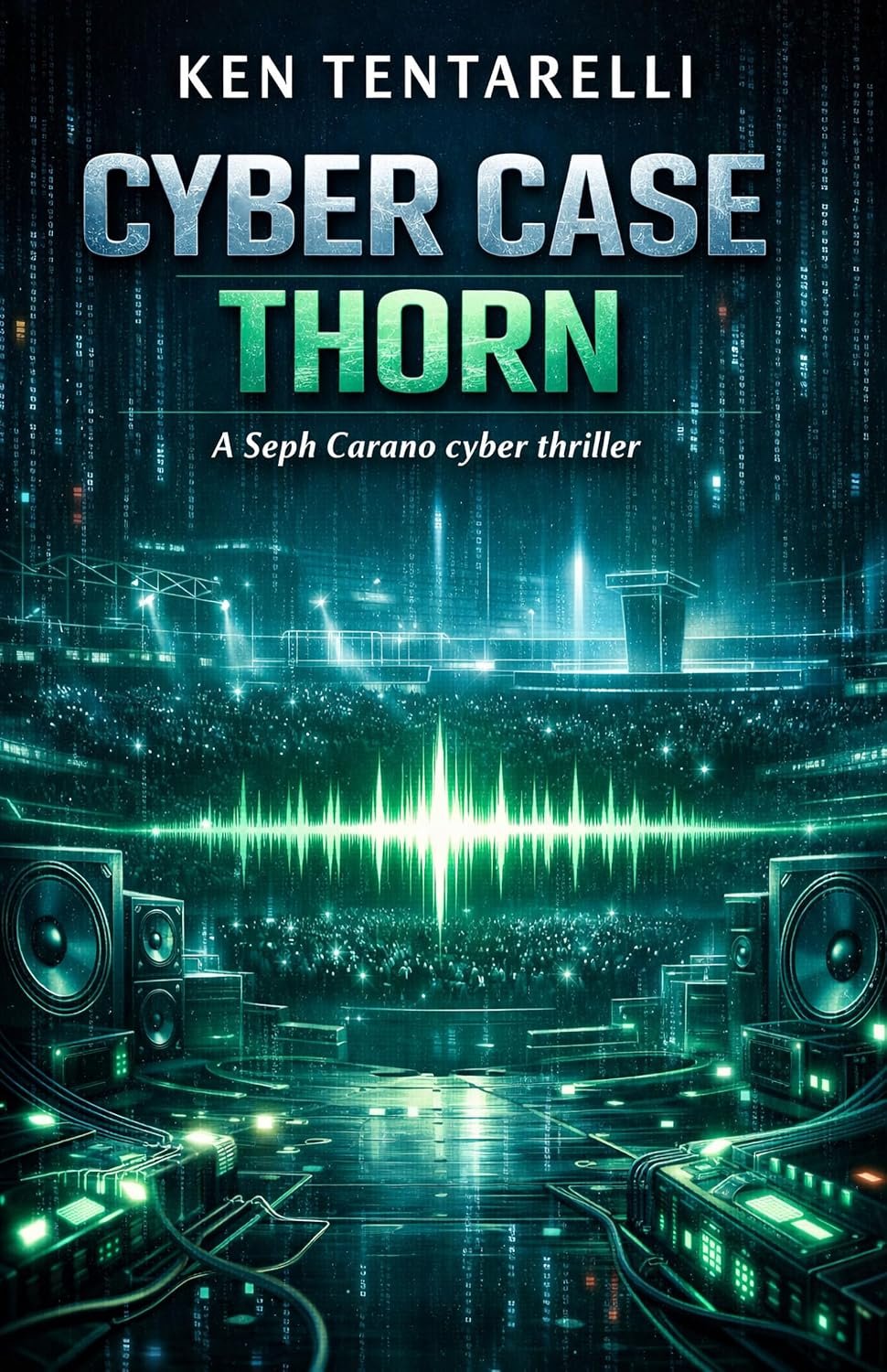
Cyber Case Thorn (The Cyber Case series Book 1)
The danger in Ken Tentarelli’s Cyber Case Thorn begins with a young hacker who appears to mistake public disruption for entertainment. The published description escalates from minor attacks to a riot and a…
Books worth discovering. Authors worth knowing.
The danger in Ken Tentarelli’s Cyber Case Thorn begins with a young hacker who appears to mistake public disruption for entertainment. The published description escalates from minor attacks to a riot and a seriously injured college dean. Agent Seph Carano recognises the pattern before the wider FBI apparatus accepts her warning. The resulting pursuit…
Book-specific criticism, grounded in what the available sources support.
The danger in Ken Tentarelli’s Cyber Case Thorn begins with a young hacker who appears to mistake public disruption for entertainment. The published description escalates from minor attacks to a riot and a seriously injured college dean. Agent Seph Carano recognises the pattern before the wider FBI apparatus accepts her warning. The resulting pursuit is a technological thriller, but its most interesting conflict concerns the time lost when institutions dismiss a credible, inconvenient perception.
Attention as a motive for harm
A hacker seeking admiration or notoriety presents a different problem from a criminal pursuing money or state power. The desired reward is partly the response itself: each successful breach supplies the audience that encourages the next act. The synopsis’s move from online disruption to physical injury is therefore not a random raising of stakes. It proposes that seemingly abstract acts can become harm to people who never consented to participate. A serious thriller must represent that chain of consequence without presenting technical prowess as moral sophistication. The adversary may be clever, but ingenuity is not an excuse for indifference.
The investigator against her institution
Seph’s position matters because her main obstacle is not merely a hidden opponent. She must persuade colleagues who view her alarm as excessive. This gives the thriller two clocks: the hacker’s accelerating skill and the bureaucratic delay before the warning is treated as actionable. The second may be less cinematic but more revealing. Institutions are designed to protect judgment against panic; they can also turn caution into inertia. To make Seph credible, the story needs a method of inference the reader can evaluate, not merely an investigator who is always correct because the plot declares her exceptional.
Making the invisible visible
Cybercrime creates a particular problem for narrative suspense. Much of the meaningful action occurs in logs, systems and code, while readers need bodies, locations and consequences to understand what is endangered. The description’s threatened public venues and underground clubs are attempts to reconnect digital intrusion with tangible social space. There is a risk in relying on an ever-larger casualty forecast to substitute for persuasive process. The strongest technological thrillers offer readers enough of the investigative logic to make a discovery satisfying while avoiding the dense explanation that stops a story in its tracks.
A promising first case
As the initial title in a named series, Cyber Case Thorn must establish whether Seph Carano is interesting as a recurring intelligence, not just as the person who catches this antagonist. Her resistance to official complacency is a useful starting position, but later books would need to complicate it. If the FBI is always shortsighted and Seph always prescient, conflict becomes ritual. More convincing drama would allow her own assumptions to face testing. The synopsis gives no basis for judging whether that happens here; the available material chiefly establishes the premise and its dramatic escalation.
Forensic intelligence and the reader
Seph’s job suggests a form of suspense in which the audience should be able to understand, at least partially, how a correct suspicion is formed. The pleasure of an investigation is not identical to the pleasure of surprise. When evidence is withheld until the protagonist delivers a solution, the reader can admire her but cannot follow her thinking. A richer thriller allows the reader to notice a detail and then discover why it matters, perhaps too late. Cyber Case Thorn’s advertised pattern of scattered targets invites exactly this kind of construction. It could make digital traces the equivalent of fingerprints in a detective story while keeping the actual workings sufficiently intelligible to a general audience. The listing itself does not prove such fairness, and no technical accuracy is endorsed here.
The geography of cyber harm
It is telling that the synopsis moves from online exploits to compromised clubs and public gatherings. An abstract network attack becomes a story with vulnerable bodies occupying common space. This movement also protects the book against one of the dangers of cyber-thriller writing: giving the impression that the virtual world is somehow separate from ordinary social life. Disruption can affect trust, panic, mobility and institutional response before any large technical failure occurs. If Tentarelli makes that connection plausible, he has access to suspense that is more unsettling than a screen displaying ominous code. The novel’s effectiveness depends on whether those consequences are specific enough to matter to identifiable people rather than serving as anonymous numbers in an escalating catastrophe.
A dangerous hunger for recognition
The apparent antagonist’s longing for notoriety also invites criticism of the audience around him. A criminal who treats harm as a game can only win the game if other people pay attention. This provides an opportunity to examine the complicity of institutions, media and spectators without requiring the thriller to leave its chosen genre. The FBI’s initial failure to take Seph seriously is part of that surrounding system of attention: the wrong signals are rewarded or dismissed at the wrong time. A satisfying resolution would require more than the physical capture of an individual. It would also make the pattern of error visible. This is an interpretive criterion drawn from the synopsis, not a promise of the novel’s eventual answer.
Caution about technical authenticity
The advertised emphasis on authentic hacking is a promise of method, not something that a synopsis can prove. A reader who works in information security may judge the novel by details others overlook: the speed of an exploit, the response of an organisation or the limits of forensic certainty. The more responsible recommendation is therefore about its described dramatic design rather than certified realism. Its combination of investigative intuition and public risk is intriguing precisely because it leaves the technical execution open to scrutiny.
Who will find value here
Readers seeking investigative suspense tied to contemporary digital vulnerability may find this case promising. It seems better suited to those who like procedural pattern recognition and institutional friction than to readers expecting a purely technical manual. The precise realism of the cyber methods, pacing and final resolution must remain unjudged without the full book.
What this review can establish
This is an independent, research-based editorial assessment of the identified book, informed by the listed publisher, author and bibliographic materials. The analysis identifies documented premises, meaningful genre expectations and open critical questions. It is not a firsthand claim to have read every chapter or inspected the entire illustrated edition; judgments about the quality of prose, plot resolution and any unverified interior material are reserved for a full-text review.
About the book.
A limited-source, independent editorial evaluation of technological thriller. Facts are drawn from the listed book record and separately identified public descriptions; speculative editorial questions are not presented as plot facts.
This is an unsponsored editorial review based on verified public descriptions and bibliographic materials, not a claim to firsthand reading of the complete book.
Found a book worth opening?
Books worth discovering. Authors worth knowing.
Return to the Journal →