
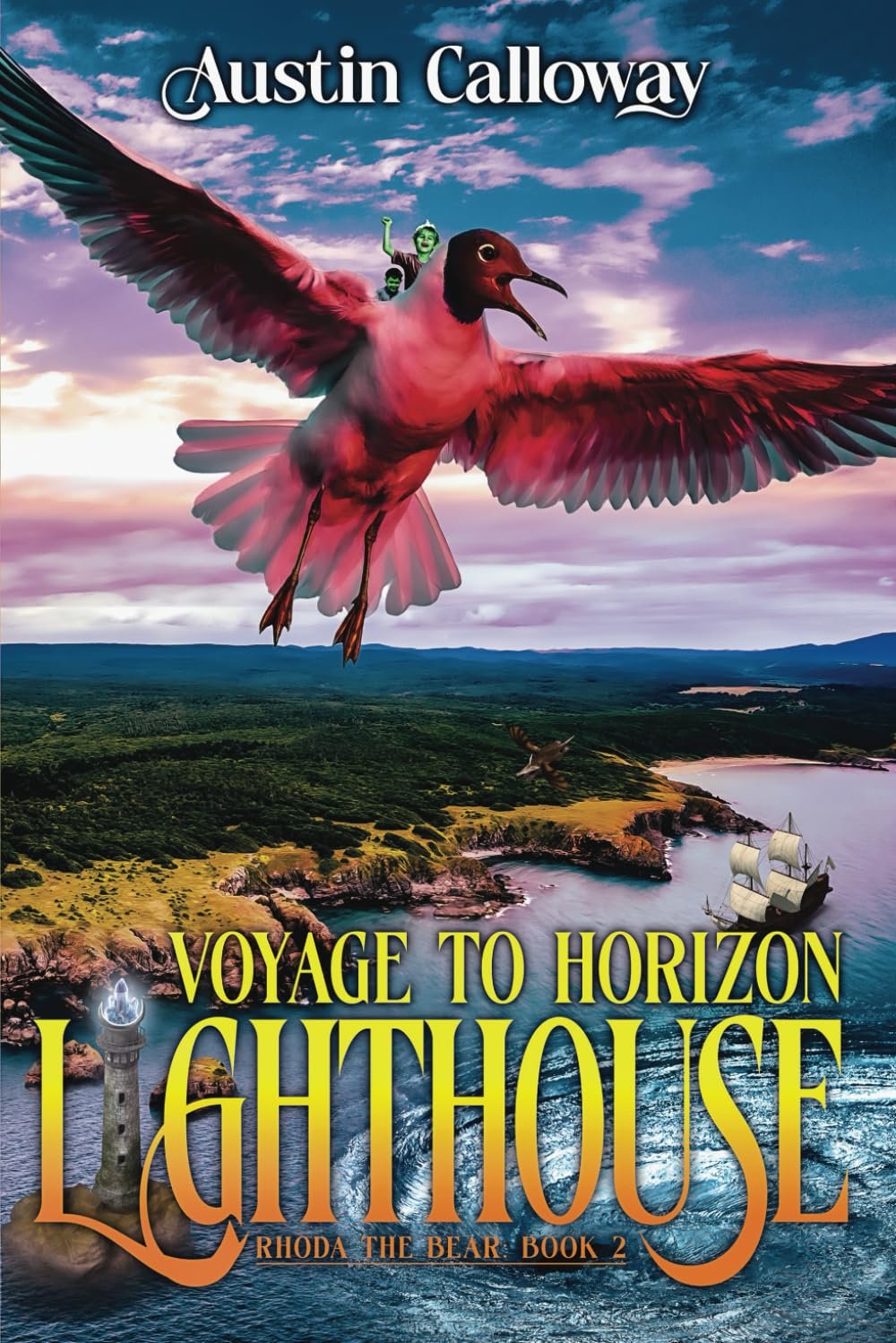
Voyage To Horizon Lighthouse: Rhoda the Bear, Book 2
The absence of two cubs turns a magical rumor into a family emergency. In Voyage to Horizon Lighthouse, the second Rhoda the Bear novel, Austin Marshall Calloway sends Rhoda after her older children…
Books worth discovering. Authors worth knowing.
The absence of two cubs turns a magical rumor into a family emergency. In Voyage to Horizon Lighthouse, the second Rhoda the Bear novel, Austin Marshall Calloway sends Rhoda after her older children Scott and Daisy, who have travelled with the enigmatic Carlyle toward an ancient lighthouse reputed to possess unusual power. She travels with familiar…
Considered reviews, grounded in the book’s documented promise.
The absence of two cubs turns a magical rumor into a family emergency. In Voyage to Horizon Lighthouse, the second Rhoda the Bear novel, Austin Marshall Calloway sends Rhoda after her older children Scott and Daisy, who have travelled with the enigmatic Carlyle toward an ancient lighthouse reputed to possess unusual power. She travels with familiar companions—including Eunice, Gideon and Miro Del—alongside Mac and Priscilla, crossing dangerous waters toward the continent of Arboris. The story builds outward from the earlier Baraj Kingdom adventure, but its emotional center is immediately legible: a mother must decide how far to follow children who have set off into danger.
A sequel that begins with absence
A sequel can open with a fresh threat or the consequences of an earlier triumph. The bookseller synopsis explicitly locates this journey after the Baraj Kingdom adventure and begins with Rhoda visiting her youngest cub, Mac. The discovery that Scott and Daisy are gone creates a different kind of urgency from the omen that initiated Book 1. An unknown magical disturbance asked Rhoda to investigate; the disappearance of her children asks her to act before she knows whether their departure was reckless, purposeful or coerced. That distinction can deepen a series protagonist. A parent may have courage in abundance but still struggle with the boundary between protecting and controlling a growing child. The public description gives the departure and pursuit, not the children’s motives or the eventual meeting.
The lighthouse as a promise and a trap
Lighthouses conventionally mark safety, navigation and the possibility of seeing a coast through danger. Here the named destination also holds rumors of magical power. That doubling is attractive: a structure built to guide sailors may attract travellers for reasons unrelated to safe passage. The result could be a conflict between finding one’s way and pursuing a power one does not understand. The synopsis does not establish what the lighthouse actually does. It would be a mistake to claim that it grants wishes, houses an artifact or conceals a villain. Its literary appeal rests instead on how strongly the symbol invites both hope and suspicion. Rhoda’s pursuit becomes a journey toward an object that may mean very different things to her children and to the adults following them.
The water between known worlds
Where the first book moves from swamp toward desert, Voyage crosses perilous waters. The promotional material names pirates and strange monsters as rumors on the journey. Sea travel can intensify fantasy because escape becomes limited by weather, supplies and the need to trust a travelling party for a long period. It also creates opportunities for the world’s geography to feel larger than the protagonist’s immediate concern. Arboris, the jungle continent near the lighthouse, is associated with Turlocque Academy and the history of Eunice and Gideon. This suggests that the book might connect present danger with companions’ earlier lives. Whether those connections deepen the characters or simply increase lore requires reading the chapters. The blurb provides a map of possibilities, not an inventory of scenes.
Familiar companions, changing roles
Returning figures are important to the series’ credibility. Rhoda, Miro Del and Eunice are already identified with the first adventure; Gideon and newcomer Priscilla enlarge the group. A second volume should allow familiar traits to change under new pressure rather than repeat the dynamics of the previous quest. The family motive may also alter who takes the lead: Rhoda’s urgency is not necessarily shared in equal degree by every traveller. That difference can create believable friction without making a character disloyal. A critic should watch how the novel distributes practical competence among the group and whether newcomers receive reasons for joining beyond the need for a larger cast. Those are expectations supported by the roster, not claims about verified interpersonal disputes.
Two adventures, one growing world
The Rhoda books demonstrate why author-based deduplication is unreliable. The titles differ, the settings and catalysts differ, and the later story explicitly occurs after the Baraj Kingdom adventure. A review of Voyage cannot simply be recycled from Battle Below the Storm. The first promises an inquiry into a supernatural threat; the second places family bonds and a possibly magical navigational landmark at the heart of its plot. The common world and recurring party may enrich both, but each requires its own description, edition details and critical questions. A conscientious reader may start with Book 1 to appreciate the histories; the current synopsis nevertheless provides enough of the new stakes to identify the second book on its own terms.
The agency of the missing cubs
Scott and Daisy are introduced through their disappearance, but that should not settle their narrative role. A search story gains complexity if those being sought have purposes of their own, even misguided ones. The enigmatic Carlyle and the promise of an enchanted lighthouse may have attracted the cubs for reasons their mother does not yet understand. A story that allows their choices to matter would deepen the central relationship; a story that turns them into passive objects of rescue would narrow it. The synopsis preserves those motives as a mystery. The appropriate critical expectation is not that Rhoda must be proved right, but that a reunion—if one occurs—should alter what family members know about one another.
Who will value this book
Voyage to Horizon Lighthouse is a natural choice for readers continuing the Rhoda the Bear series and for fantasy fans who enjoy maritime journeys, found companions and a parent’s determined search. Anyone looking for a quick picture-book story should inspect the novel’s length and sample, because the series appears to be longer-form fantasy. The precise role of the lighthouse, the children’s motives and the final outcome are not disclosed by the public description. This review recommends the premise and the way it enlarges Rhoda’s world without claiming to know those answers or substituting its plot for that of the earlier book.
Scope of this assessment
This is a research-based editorial review drawn from identified bibliographic, author and publisher sources. It considers the work’s documented premise and the critical questions it invites, without claiming a complete firsthand reading. No unverified scene, character action or ending is asserted.
About the book.
An evidence-bounded critical introduction to animal-character fantasy sequel and maritime quest. Published descriptions support the stated premise; interpretations are identified as editorial analysis, not confirmed plot details.
This review concerns a book marked sponsored in the current MarketAnyBook queue. Sponsorship is disclosed, and all observations remain research-based. This is Book 2 of Rhoda the Bear, a distinct work from MAB-1117 despite shared author and setting.
Found a book worth opening?
Books worth discovering. Authors worth knowing.
Return to the Journal →