
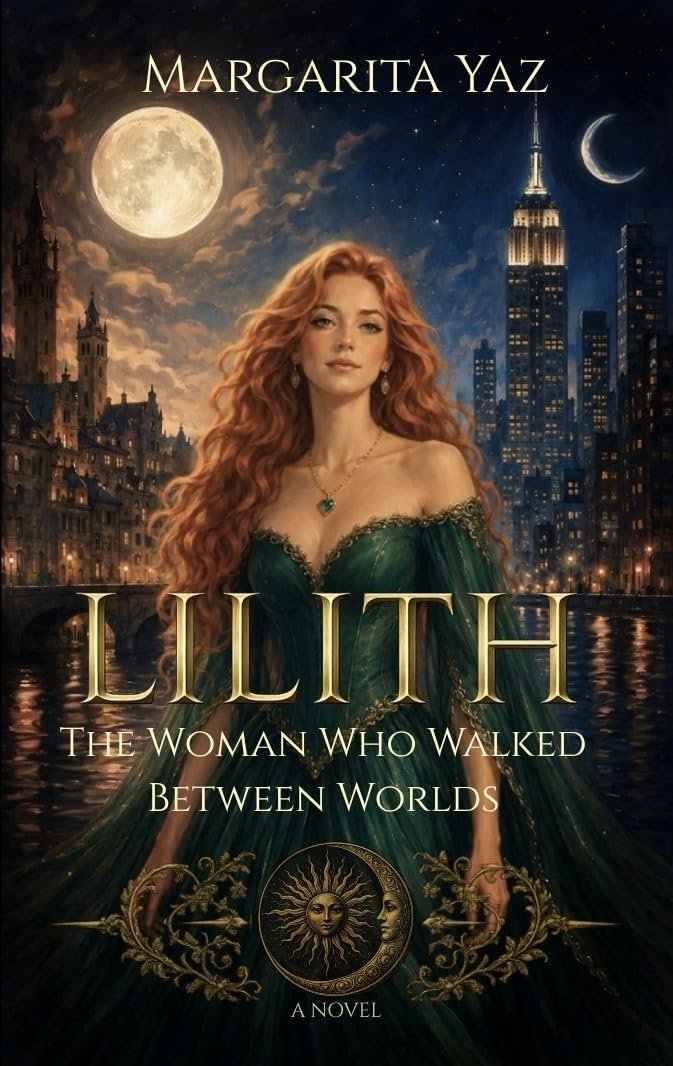
LILITH: The Woman Who Walked Between Worlds
Margarita Yaz’s Lilith: The Woman Who Walked Between Worlds presents love as a mystery that may outlast a single historical life. In contemporary St. Augustine, Florida, Lilith’s encounter with…
Books worth discovering. Authors worth knowing.
Margarita Yaz’s Lilith: The Woman Who Walked Between Worlds presents love as a mystery that may outlast a single historical life. In contemporary St. Augustine, Florida, Lilith’s encounter with Marek begins an overwhelming connection and eventually a rupture. Years later, his account opens another perspective, including a movement toward…
Considered reviews, grounded in the book’s documented promise.
Margarita Yaz’s Lilith: The Woman Who Walked Between Worlds presents love as a mystery that may outlast a single historical life. In contemporary St. Augustine, Florida, Lilith’s encounter with Marek begins an overwhelming connection and eventually a rupture. Years later, his account opens another perspective, including a movement toward late-fourteenth-century Florence and a mythic framework in which shadow and light mirror one another. The published synopsis promises alternating first-person perspectives and two timelines. Its strongest narrative question is whether the language of destiny clarifies human choices or risks making people less responsible for them.
Two narrators, no single possession of truth
Dual-point-of-view romance often promises to reveal a secret previously withheld from the reader. Here the two perspectives also imply a larger problem: people experience the same relationship differently and then spend years making their private versions seem coherent. A first-person story makes this especially delicate. Each narrator can tell a persuasive emotional truth while omitting motives that the other finds central. The structure could turn a story of heartbreak into an inquiry into memory itself. But it requires careful management of trust; the later voice should complicate the earlier one rather than merely invalidate it. Public descriptions confirm the alternating perspectives but do not provide enough material to assess the precise quality of either voice.
Florence and historical distance
The fourteenth-century Italian setting offers a richly different arrangement of social authority, religion and intellectual life. A time-slip narrative becomes convincing when history changes what characters can imagine and do, rather than simply decorating an otherwise contemporary psychology. The novel is described as a movement toward the edge of the Renaissance and a confrontation with an inherited bond. This suggests a tension between recurrence and change: does the past imprison the lovers, or give them a chance to recognize a pattern that can finally be resisted? The historical particulars and their accuracy cannot be certified from retailer summaries alone, but the choice of period creates an ambitious obligation.
The Lilith–Selena polarity
The story invokes a cosmology of two moons, one in shadow and the other in light. As an invented or adapted mythic language, the duality may express fragmentation, estrangement and the work of self-reconciliation. Such symbols can deepen a narrative if they operate through characters’ decisions rather than explaining those decisions away. A woman named Lilith also carries a complicated cultural inheritance; readers may bring expectations about rebellion, autonomy and demonization. The strongest treatment would allow the heroine to be more than a ready-made mythological emblem. The publisher descriptions identify the symbolic current but do not verify the novel’s full engagement with historical traditions.
Love beyond the authority of fate
A karmic bond can provide romance with epic scale, yet it can make a troubling claim: that persistence proves rightness, regardless of what partners choose or endure. Yaz’s premise is most intriguing if it keeps choice alive even while hinting at cosmic repetition. Marek’s later voice reportedly addresses betrayal, so accountability must remain part of the story. The reader should be wary of treating mystical connection as an excuse for harm. That concern is not a charge against the novel; it is the standard by which a serious metaphysical romance can distinguish the language of transcendence from the erasure of consequence.
A story of worlds within worlds
The title implies multiple kinds of crossing: geographical, historical, psychological and spiritual. Even without literal certainty about reincarnation, a reader can take such crossings as a metaphor for the way a person changes under the force of love and loss. Its narrative architecture is best suited to readers willing to interpret rather than simply solve. Whether the symbolic layers remain integrated is a question the complete text would answer. The public synopsis supplies a textured framework, but an assessment of style and dramatic rhythm must remain provisional.
The risks of cosmic explanation
A past-life bond can feel emotionally satisfying because it converts a confusing encounter into part of a beautiful design. Yet relationships sometimes hurt precisely because people remain unknowable, inconsistent and capable of harm. Lilith’s structure—two narrators separated in time—offers a way to keep that difficulty alive. Marek’s later account may illuminate what the first voice could not see, but a satisfying novel would resist suggesting that a mystical pattern automatically redeems betrayal. The distance between destiny and responsibility is where serious romantic drama begins. Readers should look for a resolution that preserves the emotional cost of decisions even if the fictional universe grants those decisions a vast temporal history.
The historical section has work to do
Florence before the Renaissance promises more than picturesque streets and alluring mystery. The city’s older world of religion, craft, hierarchy and political conflict could change what an enduring attachment means to those living within it. A dual-timeline novel needs some friction between periods: if the characters think and act identically in every century, time travel becomes an expensive costume change. Yaz’s promotional description emphasizes an encounter with earlier history and a feminine mythic structure. That creates a demanding artistic opportunity to make historical difference matter without reducing the past to a lesson written for modern characters. Whether that opportunity is realized requires scene-level reading.
Two kinds of freedom
The story’s imaginative ambition is clearest when spiritual continuity and ordinary consent pull against one another. No matter how strong a metaphysical bond becomes in the fiction, a present-day character still deserves to be treated as a person capable of saying no. That tension is a better source of drama than destiny alone.
Who will value this book
Readers of reflective romance, historical time-slip fiction and mythic symbolism will find an unusually layered premise. Those who prefer linear realism or strictly evidenced historical narrative may find the metaphysical framing less congenial. This appraisal uses verifiable edition descriptions and does not claim certainty about the novel’s ending or the exact theological claims of its fictional mythology.
Scope of this assessment
This is a research-based editorial review drawn from identified bibliographic, author and publisher sources. It considers the work’s documented premise and the critical questions it invites, without claiming a complete firsthand reading. No unverified scene, character action or ending is asserted.
About the book.
An evidence-bounded critical introduction to dual-timeline metaphysical romantic fiction. Published descriptions support the stated premise; interpretations are identified as editorial analysis, not confirmed plot details.
This is an unsponsored, research-based editorial review, not a claim to firsthand reading of the complete book.
Found a book worth opening?
Books worth discovering. Authors worth knowing.
Return to the Journal →