
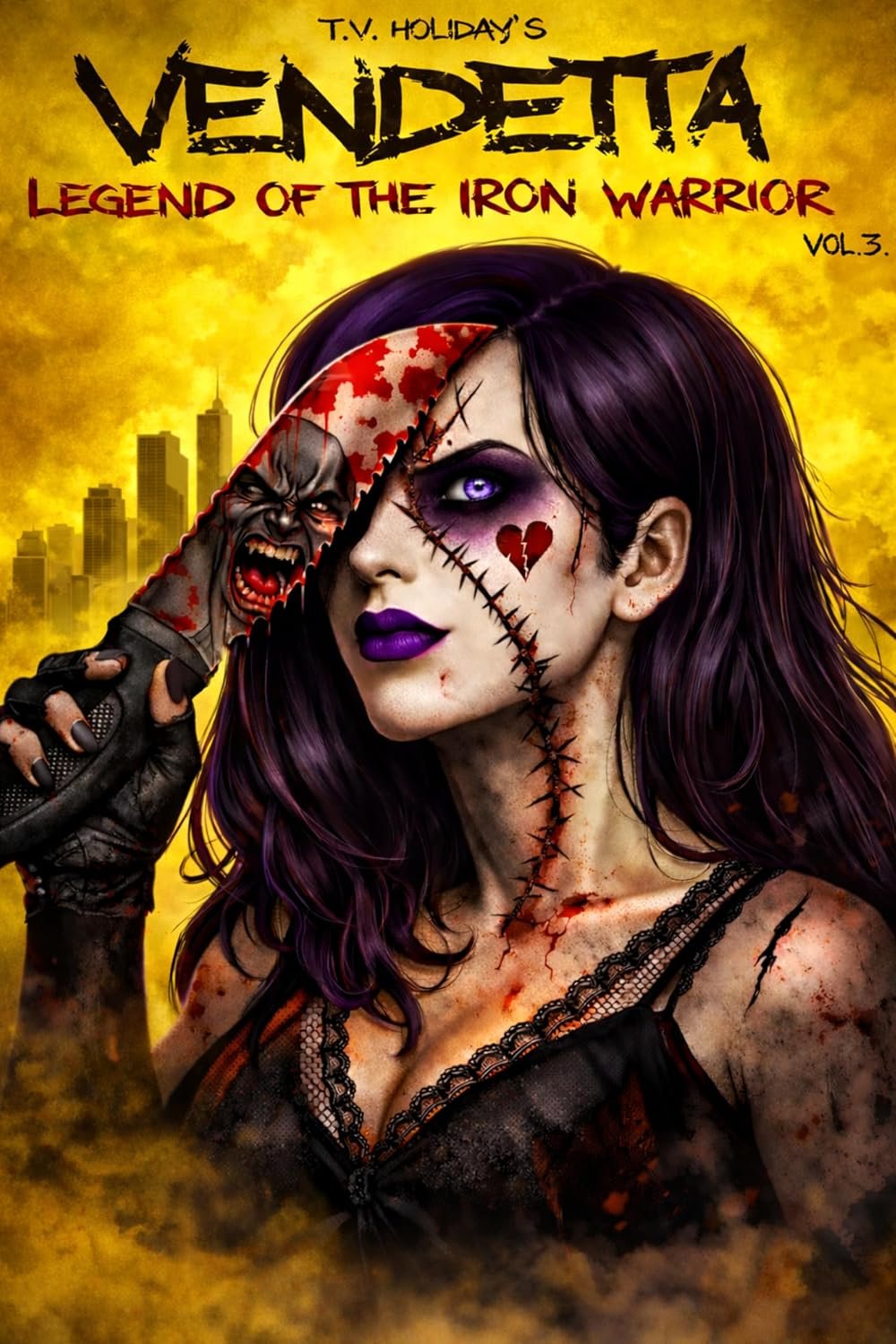
T.V. Holiday's Vendetta: Legend of The Iron Warrior Vol. 3
A superhero's most punishing enemy may be somebody whose grievance began with an act of rescue. Vendetta, the third Legend of the Iron Warrior volume, brings Travis Holiday back from a two-year…
Books worth discovering. Authors worth knowing.
A superhero's most punishing enemy may be somebody whose grievance began with an act of rescue. Vendetta, the third Legend of the Iron Warrior volume, brings Travis Holiday back from a two-year self-imposed exile to face Candace Loveless, a woman reportedly connected to his first night as the Iron Warrior. A publisher-style description identifies a…
Considered reviews, grounded in the book’s documented promise.
A superhero's most punishing enemy may be somebody whose grievance began with an act of rescue. Vendetta, the third Legend of the Iron Warrior volume, brings Travis Holiday back from a two-year self-imposed exile to face Candace Loveless, a woman reportedly connected to his first night as the Iron Warrior. A publisher-style description identifies a city called Carnage Coast, a continuing struggle between heaven and hell, and an antagonist targeting people close to the hero. This is the material of an urban-fantasy reckoning rather than a straightforward return to action: an old identity is being summoned to answer for costs it cannot control.
The cost of returning to the mask
The two-year absence gives the premise its emotional leverage. An exiled hero has presumably tried to live without the role that once defined him; the return implies that history is not content to stay past. Superhero storytelling sometimes treats resuming the mantle as an unambiguously noble choice. This finale has a potentially stronger alternative: ask whether the mask protects an ordinary self or allows that self to avoid accountability. What happens when people touched by heroic intervention do not share the hero's understanding of salvation?
A vendetta with a memory
Candace Loveless's threatened attacks on those connected to Travis make the conflict intimate and ethically untidy. The reported origin in an earlier rescue offers a disturbing inversion of gratitude. Yet a critical reading should not automatically turn an antagonist's violence into proof that rescue is harmful. The more compelling question is how the novel represents distorted attachment, grievance and the desire to make another person feel powerless. If the antagonist is given motives rather than merely cruelty, the confrontation can become a test of the hero's self-conception rather than a contest of strength.
The problem of divine authorization
A protagonist framed as God's champion inhabits a world where cosmic categories seem clear. But readers need drama to complicate those categories. The Iron Warrior's claimed purpose may carry obligations that conflict with private loyalty, personal anger or ordinary mercy. The promise of a concluding volume is not simply that good wins a final battle, but that the hero discovers what kind of goodness can survive contact with his own failings. A series finale is most convincing when earlier symbols are made accountable to earlier choices.
Continuity and accessibility
The sources position Vendetta as a third volume resolving a long-running confrontation with a figure named Luc. That means returning readers will likely recognize a history of conflicts and relationships that cannot be reproduced here without access to the earlier books. It also means new readers should not expect a self-contained entry point. The task facing the author is to reward accumulated attention without substituting exposition for dramatic discovery. An ending promised for years must feel earned from the characters' choices, not merely impressive in scale.
The identity question beneath spectacle
A city threatened by supernatural conflict can become an excuse for escalating destruction. The premise avoids that trap only if people remain more than names on an antagonist's target list. The greatest pressure on Travis is moral: what must he reveal about himself to keep others alive, and who is entitled to demand that revelation? Those questions make the reported high stakes useful rather than decorative. The accessible descriptions provide a strong direction for evaluation but do not certify its final execution, tone or narrative closure.
The revenge plot and the rescuing hand
The description's most charged irony is that Candace once benefited from the very hero she now seeks to hurt. Revenge stories regularly rest on a perceived debt that has become inverted. The moral force of this inversion depends upon the narrative refusing to treat rescue as ownership. Did the earlier intervention produce consequences the hero did not anticipate? Does the antagonist's interpretation contain a recognizable grievance even when her actions are indefensible? The accessible synopsis does not answer. It does, however, create an unusually rich opportunity for a finale: the hero must assess a past act not by his original intention alone, but by the human lives that continued after his departure.
Spiritual warfare and human responsibility
A cosmology with a battle between heaven and hell can encourage characters to understand themselves as pieces of a vast predetermined conflict. That can be exhilarating; it can also reduce the moral burden of choosing. Travis's self-questioning is therefore crucial. A person who believes himself appointed to a divine mission may have the greatest need to admit mistakes, because certainty can insulate a cause from criticism. The advertised crisis of worthiness creates room for humility and sacrifice that are more compelling than a mere upgrade in physical power. This is the kind of ethical pressure that can turn superhero convention into a serious drama of vocation.
The finality a trilogy deserves
A three-book architecture creates a contract with its audience. Earlier relationships and wounds must matter, but the last book should not simply count down unresolved plot threads. It needs to answer what the sequence has been about. For the Iron Warrior, the strongest answer would not be a tally of defeated enemies. It would be a changed relation between personal grief and public duty, between the person called Travis and the symbolic role he has come to inhabit. Author interviews indicate that a confrontation with Luc has been anticipated for years. The measure of the ending will be whether that battle changes our understanding of what came before.
The necessary warning to new readers
Promotional descriptions suggest extreme conflict, spiritual violence and difficult choices. Readers entering at volume three may find the mythology and emotional stakes insufficiently explained, not because the text is deficient but because serial storytelling distributes context across books. A more informed reading would begin with the first volume and trace the hero's relationship to Candace, Luc and the responsibility of intervention. Without that background, even a climactic scene can seem merely loud. The current editorial assessment should be valued as a guide to the finale's premise, while reserving judgment on the precise payoff of the trilogy.
Who will value this book
Readers invested in the Iron Warrior sequence and in explicitly Christian-inflected superhero fantasy will find a clear reason to investigate the finale. This is not a recommendation to start at volume three. The queue attributes the book to T.V. Holiday, while another bibliographic record credits Travis Easter; the authorship/pen-name relationship should be verified before publication.
Scope of this assessment
This is a research-based editorial review drawn from identified bibliographic, author and publisher sources. It considers the work’s documented premise and the critical questions it invites, without claiming a complete firsthand reading. No unverified scene, character action or ending is asserted.
About the book.
An evidence-bounded critical introduction to supernatural urban fantasy, volume-three series finale. Published descriptions support the stated premise; interpretations are identified as editorial analysis, not confirmed plot details.
This is an unsponsored, research-based editorial review, not a claim to firsthand reading of the complete book. External Google Books lists Travis Easter as author; source queue credits T.V. Holiday. Verify pen-name/author identity before publishing.
Found a book worth opening?
Books worth discovering. Authors worth knowing.
Return to the Journal →