
Crash of the Heavens
The historical record often turns a courageous person into an emblem and leaves the private contradictions behind. In Crash of the Heavens, Douglas Century recounts the life of Hannah Senesh, the…
Books worth discovering. Authors worth knowing.
The historical record often turns a courageous person into an emblem and leaves the private contradictions behind. In Crash of the Heavens, Douglas Century recounts the life of Hannah Senesh, the Hungarian-born Jewish poet who emigrated to British Mandatory Palestine and later volunteered for a perilous wartime parachute mission into occupied Europe…
Considered reviews, grounded in the book’s documented promise.
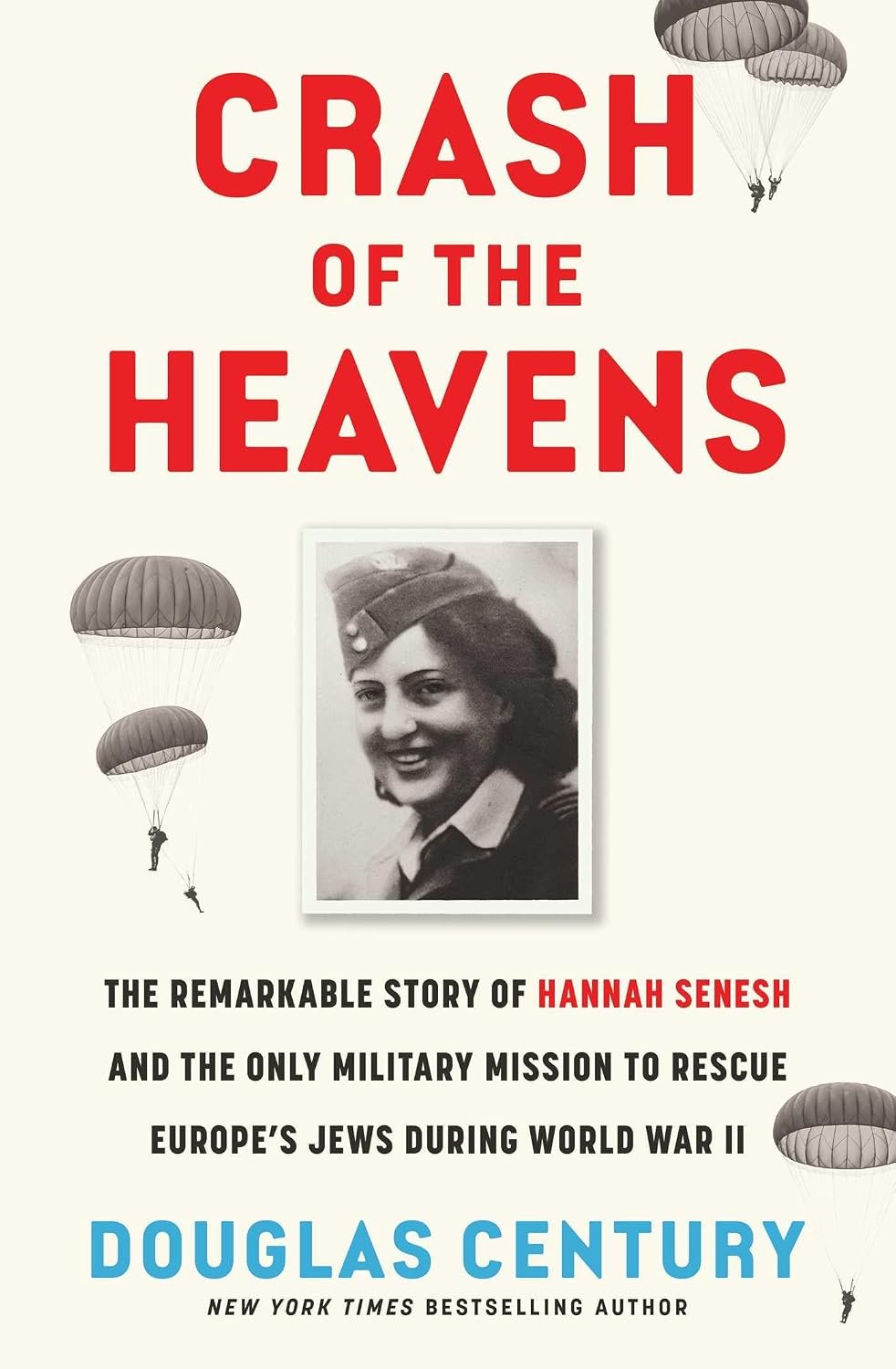
The historical record often turns a courageous person into an emblem and leaves the private contradictions behind. In Crash of the Heavens, Douglas Century recounts the life of Hannah Senesh, the Hungarian-born Jewish poet who emigrated to British Mandatory Palestine and later volunteered for a perilous wartime parachute mission into occupied Europe. Publisher records describe an intelligence operation intended to help Allied personnel and Jewish civilians amid Nazi persecution. The book's greater undertaking is the restoration of a young woman's human scale: someone capable of fear, longing and literary ambition who nonetheless made extraordinary choices. Such a biography must honor courage without allowing reverence to erase personality.
Before the image, the person
Senesh left Hungary in 1939 at eighteen, years before returning on a mission as a trained parachutist and radio operator. Those details matter because they interrupt the false idea that an extraordinary act springs fully formed from a heroic temperament. Between departure and return lie exile, education, political commitment and the difficult process of becoming someone able to act under catastrophic conditions. Century's published synopsis foregrounds a writer as well as a fighter. Her poetry and diaries suggest ways to understand her not simply through an operation's eventual outcome but through the vocabulary she used to understand herself.
The operation and its terrible asymmetry
The planned mission emerged from an unequal wartime calculus. The struggle against Nazi Germany dominated Allied military priorities, while Jewish civilians under immediate threat could not count on rescue at the scale required. The volunteer parachutists were tasked with aiding downed airmen and escaped prisoners while also seeking ways to help those facing extermination. Describing these objectives together reveals a conflict between state strategy and an endangered community's urgency. A reader must not confuse the existence of one courageous operation with proof that the larger international response was sufficient.
Poetry within the machinery of war
For a biographer, Senesh's writing presents both a gift and a temptation. The gift is access to a mind engaged with its own life rather than merely observed by others. The temptation is to read every youthful sentiment as a prophecy of her death. A fair account should resist that retrospective determinism. The young woman who wanted to teach, write and belong was not simply rehearsing martyrdom; she had a life whose possibilities were violently curtailed. The publisher's account emphasizes her refusal to disclose radio codes after capture, but the significance of that courage increases when we remember what was stolen from her.
The texture and risk of cinematic history
Century is an experienced narrative journalist. Published criticism has praised the book's urgency and scene construction, and the outline lends itself to a dramatic movement between large wartime events and the experiences of a small group. But cinematic momentum poses an ethical test in Holocaust writing: suspense must not make real torture into entertainment, nor make the fate of civilians merely the background against which a heroine shines. Historical narrative earns its intensity through careful attribution, proportion and specificity. Its task is to keep contingency visible even when readers know that the mission ends in tragedy.
A legacy too large for a single metaphor
Senesh is often described through simplified heroic comparisons. Such language can make public memory accessible, but it can also obscure the specificity of Jewish resistance and the circumstances of a woman active in both art and armed struggle. The strongest reason to read Century's book is therefore not to acquire another icon. It is to see the labor of decision under conditions that made every option inadequate. Her continued presence in poetry, testimony and public commemoration should inspire historical curiosity rather than substitute for it.
What a responsible verdict can say
The accessible publisher synopsis and contemporary criticism establish the subject, the mission and the book's narrative ambition. They do not give this review direct access to every archival citation or judgment in the finished text. That limit is important, particularly for a work dealing with disputed strategic decisions and individual testimony. The book appears to offer a richly contextualized entry to the life of Senesh and the broader history of Jewish wartime volunteers; a definitive assessment of its historiography requires checking the documentation and notes in full.
The difference between commemorating and understanding
A life such as Senesh's has been told often enough that repeated narration carries an obligation to add depth rather than merely renew admiration. The danger is that the familiar ending organizes every earlier detail into evidence of destiny. Yet people in war do not know their own afterlives. Senesh's artistic ambition, letters and youthful friendships should not be reduced to a prelude to her execution. Century's announced reliance on firsthand records offers a route beyond the monument, one that could restore decision, doubt and unfinished possibility. For the reader, that shift changes grief: one mourns not only a heroic death, but an interrupted life.
The limits of an exceptional example
Stories of rare courage can inspire, but they can also impose an impossible moral standard on people who survived by fleeing, hiding or remaining silent. A serious Holocaust history ought not turn its central figure into a rebuke to those who lacked her training, circumstances or opportunities. The parachutists' chosen mission was extraordinary partly because it was so difficult and so unlikely to succeed. Readers can honor their action while recognizing that the larger catastrophe cannot be interpreted through exceptional heroism alone. The question of what other institutions might have done remains central to the period, and no single biography can resolve it. The historical courage is real without becoming a formula for judging everyone else.
Why the record matters
The existence of letters and diaries changes the conditions under which we encounter a dead person. They offer voices from before the ending was known. Their importance is not that every sentence can be decoded into a lesson; it is that they let the subject resist the historian's categories. A reader should pay attention to how Century distinguishes Senesh's own testimony from later remembrance and from reconstructed scenes. That is where narrative nonfiction earns trust: it knows the difference between the past speaking in a document and the modern writer making the past feel immediate. A compelling scene can clarify a historical decision, but it should never substitute atmosphere for evidence.
Who will value this book
A substantial prospect for readers of Holocaust history, narrative nonfiction, women's wartime lives and the relationship between art and political resistance. It is not light inspirational reading: the events involve imprisonment, torture and execution. Readers should value the book for its humane historical questions as much as its extraordinary central figure.
Scope of this assessment
This is a research-based editorial review drawn from identified bibliographic, author and publisher sources. It considers the work’s documented premise and the critical questions it invites, without claiming a complete firsthand reading. No unverified scene, character action or ending is asserted.
About the book.
An evidence-bounded critical introduction to documentary World War II biography and Holocaust history. Published descriptions support the stated premise; interpretations are identified as editorial analysis, not confirmed plot details.
This is an unsponsored, research-based editorial review, not a claim to firsthand reading of the complete book.
Found a book worth opening?
Books worth discovering. Authors worth knowing.
Return to the Journal →