
That Does Not Belong to Me
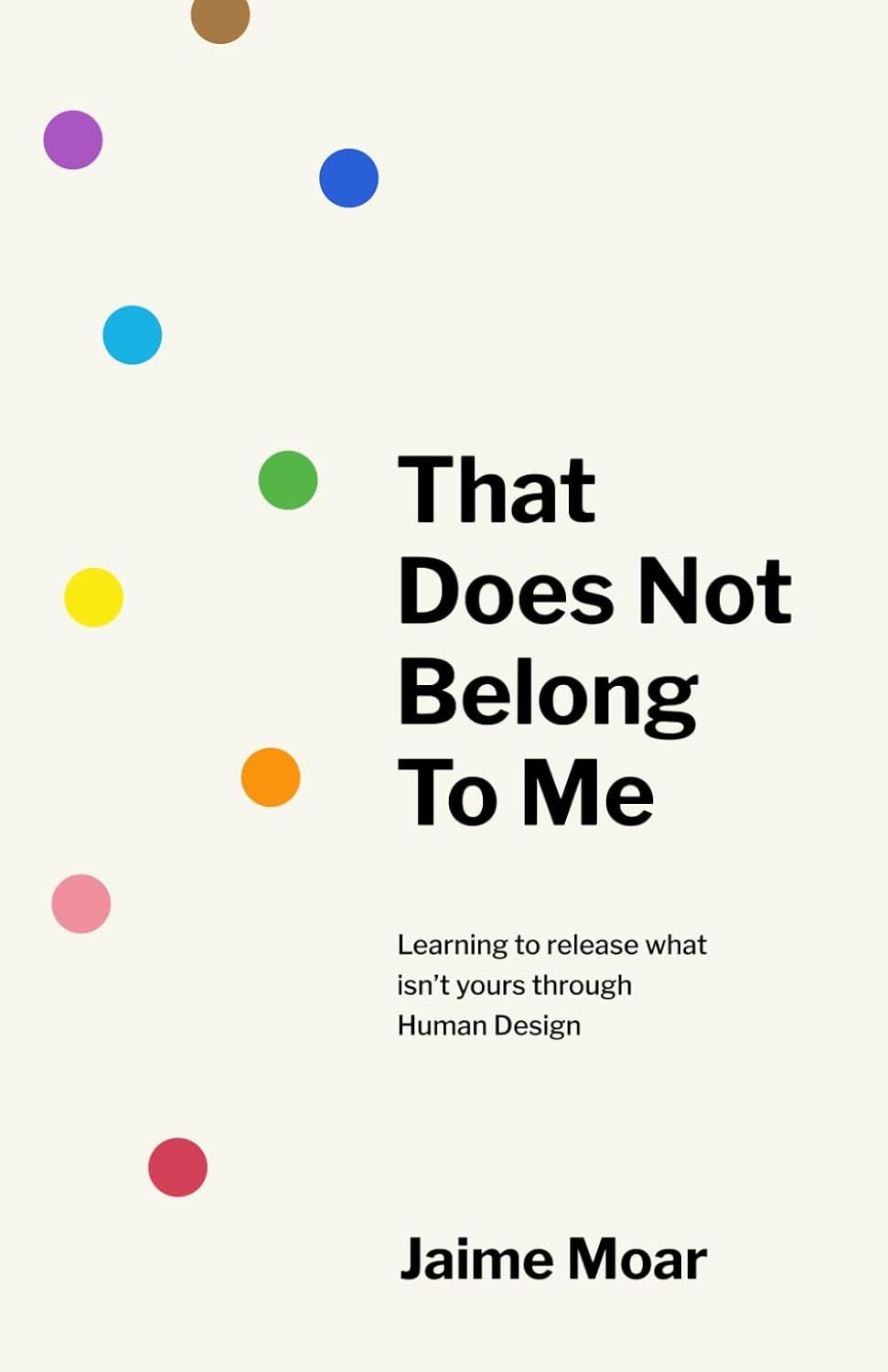
That Does Not Belong to Me begins with a boundary that is easy to state and difficult to live: not every expectation we carry originated with us. Jaime Moar's account, described by the author as…
Books worth discovering. Authors worth knowing.
That Does Not Belong to Me begins with a boundary that is easy to state and difficult to live: not every expectation we carry originated with us. Jaime Moar's account, described by the author as part memoir and part field guide, approaches that difficulty through personal storytelling, small experiments and the interpretive framework known as Human…
Considered reviews, grounded in the book’s documented promise.
That Does Not Belong to Me begins with a boundary that is easy to state and difficult to live: not every expectation we carry originated with us. Jaime Moar's account, described by the author as part memoir and part field guide, approaches that difficulty through personal storytelling, small experiments and the interpretive framework known as Human Design. Its ambition is not merely to help readers refuse outside pressure but to notice how thoroughly pressure can become mistaken for identity.
The burden that arrives disguised as duty
Many people experience inherited obligations as if they were unchangeable facts. A good self-examination guide must separate commitments one freely endorses from roles accepted through fear, habit or a wish to avoid disappointing others. Moar's central phrase makes that examination approachable. Yet there is a challenge in the apparent simplicity of release: an expectation may be unreasonable and still be attached to someone we love or a responsibility we cannot instantly abandon. The best guidance should give complexity room to remain, rather than present boundaries as a slogan that dissolves real dependence.
Small practices rather than grand conversion
The author's website emphasizes tiny, usable changes. That is one of the book's more credible promises. A brief experiment—whether a pause before agreement, a considered refusal or an honest inventory of what drains attention—can yield information without demanding that someone reinvent a life overnight. Memoirs often focus on decisive turning points because they make dramatic scenes; field guides have to work on dull Tuesdays. The proposed scale of Moar's practices could therefore be an advantage, provided the book remains specific about what the reader is invited to try and how to interpret mixed results.
Human Design as a language, not a scientific verdict
Human Design is a spiritual and personality framework, not an established scientific account of individual psychology. Moar's public description offers it as gentle suggestion rather than rigid rule. That matters. Such systems may give readers metaphors that prompt useful reflection, while their explanations should not be mistaken for independently validated descriptions of a person's traits or future. A discerning reader can try the author's questions without surrendering judgment to a chart. The most responsible value proposition for this book is exploration and personal meaning, not proof that the framework can diagnose one's authentic self.
A health crisis and the test of advice
The author links her approach to a period when a health disruption put earlier practices under pressure. This is a meaningful memoir device because ideas that feel convincing in easy circumstances can fail when plans collapse. Still, a private experience cannot validate a universal method. Moar's real narrative authority lies in describing what she tried, what she reconsidered and how uncertainty felt. An account that makes room for adjustment would be more generous than one that treats difficulty as evidence the reader was insufficiently aligned.
Freedom is relational
A life more faithful to one's desires is not necessarily a life without compromise. Relationships require negotiation; work requires cooperation; a family may depend on choices that feel unglamorous. The difficult work is distinguishing generosity from self-erasure. The title supplies a memorable threshold question, but the richest discussion would concern those obligations that belong partly to us and partly to others. In that borderland, self-help becomes ethics rather than simply self-expression. The accessible author material suggests this nuanced potential while leaving the execution of individual exercises unverified.
Choice as the test of a framework
A useful interpretive system should make choices more considered, not decide them in advance. Human Design can give a reader prompts for noticing preferences, but a reflective author must leave room for someone to reject a label that does not fit. Moar's promotional emphasis on experimentation is encouraging in that respect. The difference between a guide and a doctrine is whether an exercise can be stopped, revised or contradicted by experience. That is especially relevant to a book about releasing obligations that never truly belonged to a person. Another borrowed system should not become one more obligation.
The danger of mistaking comfort for truth
A practice may make someone feel calmer or more understood, which can be valuable in itself. That outcome does not establish every theory used to explain the effect. Readers can use the book as an invitation to journaling and boundary-setting while remaining skeptical of universal personality claims. It is important to say so explicitly because seekers of self-knowledge are often vulnerable to confident descriptions of who they really are. Moar's apparent willingness to treat Human Design gently rather than prescriptively creates space for a healthier relationship with the material.
Memoir gives the questions stakes
Personal development writing can become curiously impersonal when the narrator appears only as proof that the method works. Moar's reference to a health disruption offers a chance to show a real person testing ideas under uncertainty. The more valuable scenes would include moments of reluctance, failed experiments and conflicting desires, rather than a perfectly linear account of growth. Such details make a practice transferable because they show why someone might hesitate. This review cannot confirm those scenes exist; it identifies the standard a mixed memoir and field guide should meet.
Who owns the result
The title shifts responsibility away from pleasing an abstract audience and toward making decisions one can recognize as one's own. Yet autonomy is not achieved through isolation. Others continue to have legitimate needs, and one person's boundary may require another person to adapt. A sophisticated discussion would hold those facts together, allowing the reader to be neither a martyr nor a permanent defendant. The strongest promise of Moar's approach is not escape from all claims; it is a clearer way of discerning which claims deserve a willing response.
Who will value this book
Moar's book is likely to interest readers exploring boundaries, role fatigue and reflective spiritual practice, especially those who prefer practical experiments to stern prescriptions. Readers should understand Human Design as an optional interpretive device, not a clinically established diagnostic tool. The manuscript's style and depth still need direct evaluation; its publicly stated method provides a clear basis for this provisional critical appraisal.
Scope of this assessment
This is a research-based editorial review drawn from identified bibliographic, author and publisher sources. It considers the work’s documented premise and the critical questions it invites, without claiming a complete firsthand reading. No unverified scene, character action or ending is asserted.
About the book.
An evidence-bounded critical introduction to memoir and practical reflective guide incorporating Human Design. Published descriptions support the stated premise; interpretations are identified as editorial analysis, not confirmed plot details.
This is an unsponsored, research-based editorial review, not a claim to firsthand reading of the complete book.
Found a book worth opening?
Books worth discovering. Authors worth knowing.
Return to the Journal →