
The Forgotten Skills of Self-Reliance
A spiral-bound guide promises 200 illustrated household and preparedness skills, from gardening to food storage; its author credit remains unverified.
Books worth discovering. Authors worth knowing.
A workbench-ready handbook can be more useful than a shelf full of good intentions—provided its instructions are complete, safe and easy to follow.
Practical reference design meets questions of attribution, evidence and safety.
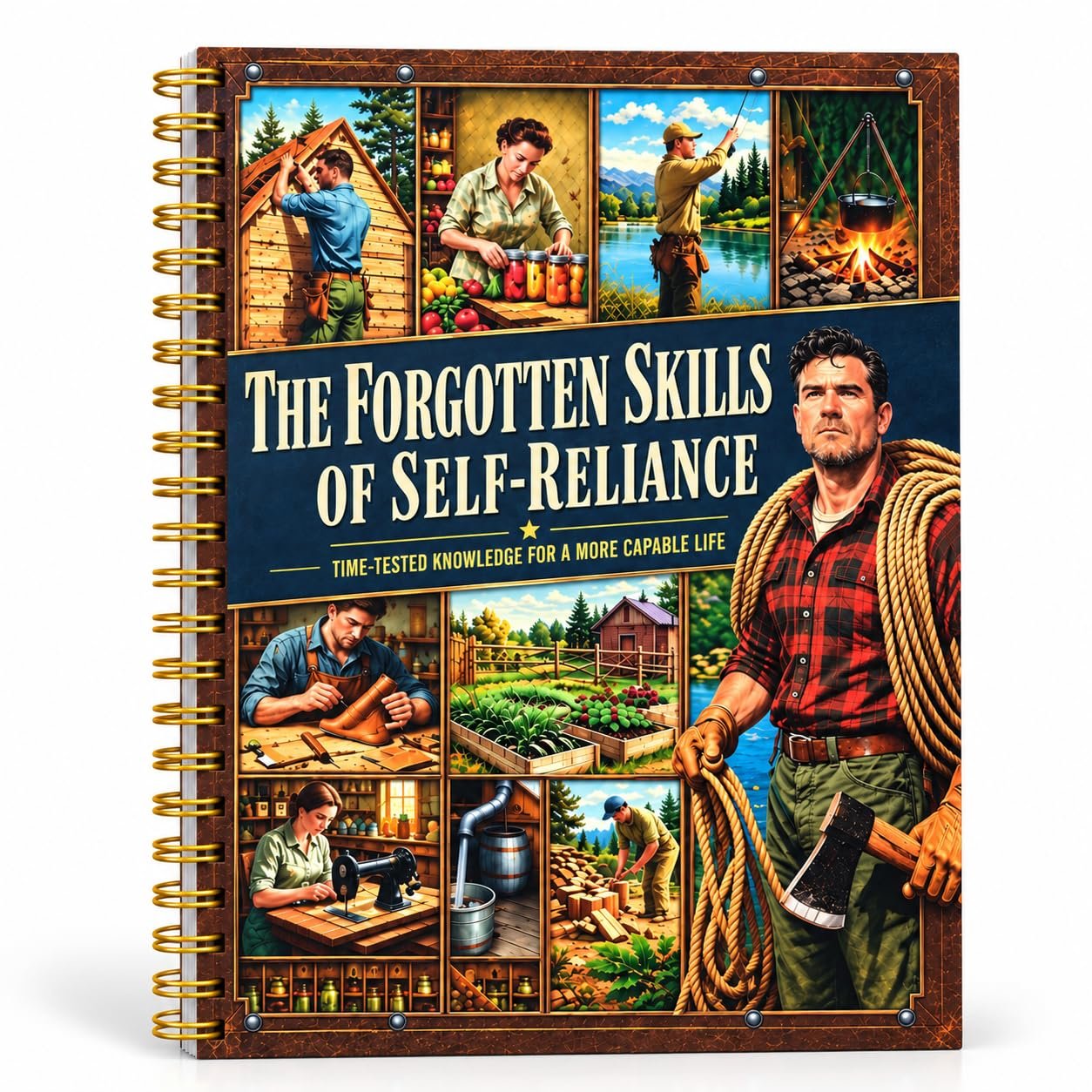
The appeal of The Forgotten Skills of Self-Reliance: 200+ Forgotten Skills Encyclopedia begins with a familiar frustration: modern households depend on systems that work beautifully until they do not. A power cut, a broken household fixture or a garden that needs attention can reveal the difference between owning information and being able to use it. The product description for the specific Amazon-linked edition, paired with its spiral-bound cover, presents this volume as an illustrated reference for everyday capability. It promises roughly two hundred practical guides, checklists and material lists covering household repairs, gardens, food storage and basic readiness. The central proposition is not that readers should abandon modern life. It is that a set of learnable skills can make ordinary life more adaptable.
Why the physical format matters
Unlike a linear memoir or novel, a handbook often gets judged while lying open on a counter or workbench. This edition is promoted as a spiral-bound volume designed to stay flat while the reader is working. That is a concrete publishing decision rather than a cosmetic selling point. An instruction manual is difficult to consult when its binding continually closes over the relevant step. The cover reinforces the hands-on ambition through images of building, growing, cooking, collecting and repairing. Together, those details identify an audience that wants to act on information rather than merely read about a way of life.
The same product listing claims illustrated step-by-step directions and tool or ingredient lists for projects. If the pages deliver that consistently, the structure could help beginners estimate the preparation involved before starting a task. But a product listing cannot verify the clarity of every diagram, the adequacy of safety warnings or whether a described project is practical in a particular location. The full interior was not available for this review. The fair assessment is therefore of the edition’s stated scope and reference design, with its instructional accuracy left for hands-on editorial verification.
From an abstract ideal to manageable categories
Self-reliance is often sold as an enormous ambition. Its realistic version begins with smaller domains: keeping tools organized, caring for clothing, maintaining a space and knowing how to respond when the usual supply chain is interrupted. The indexed themes advertised for this book—gardening, household maintenance, food preparation and emergency planning—suggest a modular approach. Readers need not build an entire off-grid system to benefit from knowing how to make a minor repair or prepare useful supplies. In principle, an encyclopedia of short projects allows someone to select the skill most relevant to an immediate problem.
That flexibility also creates a challenge. Two hundred topics can mean unusually broad coverage or overly brief treatment of complex work. The crucial question is whether each entry explains not only what to do, but when the procedure is appropriate, what equipment is required, how to recognize an unsafe condition and when to seek specialist assistance. A reference guide needs boundaries as much as enthusiasm. Repair tasks involving electricity, structural work or fuel systems do not become safe simply because they appear beside low-risk activities such as organizing food supplies or mending fabric.
The gardening promise
The matching retail description highlights self-watering raised beds, efficient use of growing space and rainwater collection. These topics fit well together because they move from the desire to grow food toward the practical questions of water, location, maintenance and time. A reader with a small yard or balcony may appreciate projects that are adaptable rather than tied to an idealized rural homestead. Yet the usefulness of any gardening method depends on climate, drainage, local rules, available light and the needs of the plants. Claims about increased yield should be treated as possibilities to evaluate rather than universal guarantees.
Rainwater harvesting deserves particular care. Collecting roof runoff for non-potable uses can be useful, but it does not make that water automatically safe to drink or cook with. The U.S. Centers for Disease Control and Prevention explains that collected rainwater may contain germs or chemicals and that its suitability depends on intended use, system maintenance and appropriate testing or treatment. The product blurb does not establish whether the book addresses those distinctions adequately. Readers should consult local guidance and authoritative public-health sources before adopting a water system for human consumption.
Food preservation is where accuracy becomes essential
Preserving food is among the most attractive traditional skills because its benefits are tangible. The listing advertises long-term storage techniques, preserved eggs, meat curing and baking in jars. These examples immediately raise the question that any serious preservation reference must answer: which methods have been tested for safety, and under what conditions? Nostalgia is not a substitute for validated processing times, temperatures and acidity controls. If the encyclopedia offers recipes or procedures, they need to be examined against current food-safety recommendations rather than accepted because they are described as time-tested.
For instance, the U.S. National Center for Home Food Preservation does not recommend canning bread or cake in jars, noting a potential botulism hazard with many such products. University of Minnesota Extension guidance explains why low-acid foods such as meat need appropriate pressure-canning methods. These points do not prove that this book endorses an unsafe method; its pages have not been checked. They do show why a responsible reader should verify instructions independently when preservation practices can lead to serious illness. A manual can be a starting point for learning while authoritative safety guidance remains the decision standard.
Readiness without catastrophe thinking
The book also presents itself as an emergency-preparedness resource. This is a more everyday concept than its dramatic marketing language might suggest. Household readiness can mean having essential supplies, keeping contact information accessible, understanding local weather risks or planning for a temporary disruption in basic services. A practical encyclopedia is well suited to that mindset when entries are easy to locate and when checklists can be adapted to households of different sizes and budgets. Its value would lie in helping people perform small, repeated acts of preparation rather than convincing them that a disaster is inevitable.
A broad skills collection may also work well for families who want to teach practical judgment rather than dependence on a single gadget. Repair, cooking, gardening and maintenance can become shared tasks, each with opportunities to learn limitations and responsibilities. The book’s visual pitch makes that possibility appealing. At the same time, an illustrated layout should not be confused with independently tested instruction. The relevant evaluation is whether guidance is legible, accurate, feasible and suitable for the reader’s actual level of experience. Those points require examining the printed pages and perhaps following a selection of projects under safe conditions.
A critical attribution gap
There is also an unusually important bibliographic limitation. The original MarketAnyBook queue leaves the author field blank, and the supplied cover does not show an author or editor. The matching product record is recognizable through its specific product identifier and spiral-bound presentation, but the available sources do not establish who wrote, compiled or technically reviewed the instructions. Separately listed books with similar titles have different named authors and cannot responsibly be substituted for this edition. For a safety-relevant reference work, knowing who is accountable for the advice is not a minor publishing detail. It is an important part of assessing reliability.
This makes the book simultaneously an interesting browsing proposition and a publication hold for a professional review. A prospective reader can reasonably be drawn to the compact, practical format and the breadth of advertised skills. A publisher should still confirm the creator or issuing organization, the edition represented by the Amazon link, and the presence of adequate safety qualification before presenting a definitive recommendation. Without those checks, it would be misleading to attach another writer’s identity or imply that the encyclopedia’s instructions have been tested.
Who the guide is for—and what remains to check
On the evidence available, The Forgotten Skills of Self-Reliance is aimed at gardeners, do-it-yourself learners, household organizers and readers building a basic emergency reference shelf. Its likely appeal is convenience: a single illustrated, lay-flat volume bringing many categories of practical knowledge together. The advertised design sounds particularly well suited to browsing one project at a time. Readers seeking professional training for electrical work, medical care, water treatment or food preservation should not use a general-purpose guide as their sole authority, especially when a project’s safety depends on local standards or specialized equipment.
The most useful way to assess the book is to ask three concrete questions of the actual pages: Are the materials and steps sufficiently specific for a beginner? Are hazards and limits clearly identified? Can a reader verify the instructions against reliable current guidance? The title’s promise of forgotten knowledge is appealing, but the measure of a modern handbook is how responsibly that knowledge can be put to work today. Until the author credit and interior are independently verified, this remains a carefully sourced editorial preview rather than a final publication-ready review.
About the book.
A spiral-bound guide promises 200 illustrated household and preparedness skills, from gardening to food storage; its author credit remains unverified.
The source queue does not label this book feature sponsored. This editorial draft is based on checked source descriptions, not a complete first-hand reading of the book. The source author field is blank and an accurate creator credit is required before publication. All drafts require independent editorial approval and publishing preflight.
Found a book worth opening?
Books worth discovering. Authors worth knowing.
Return to the Journal →