
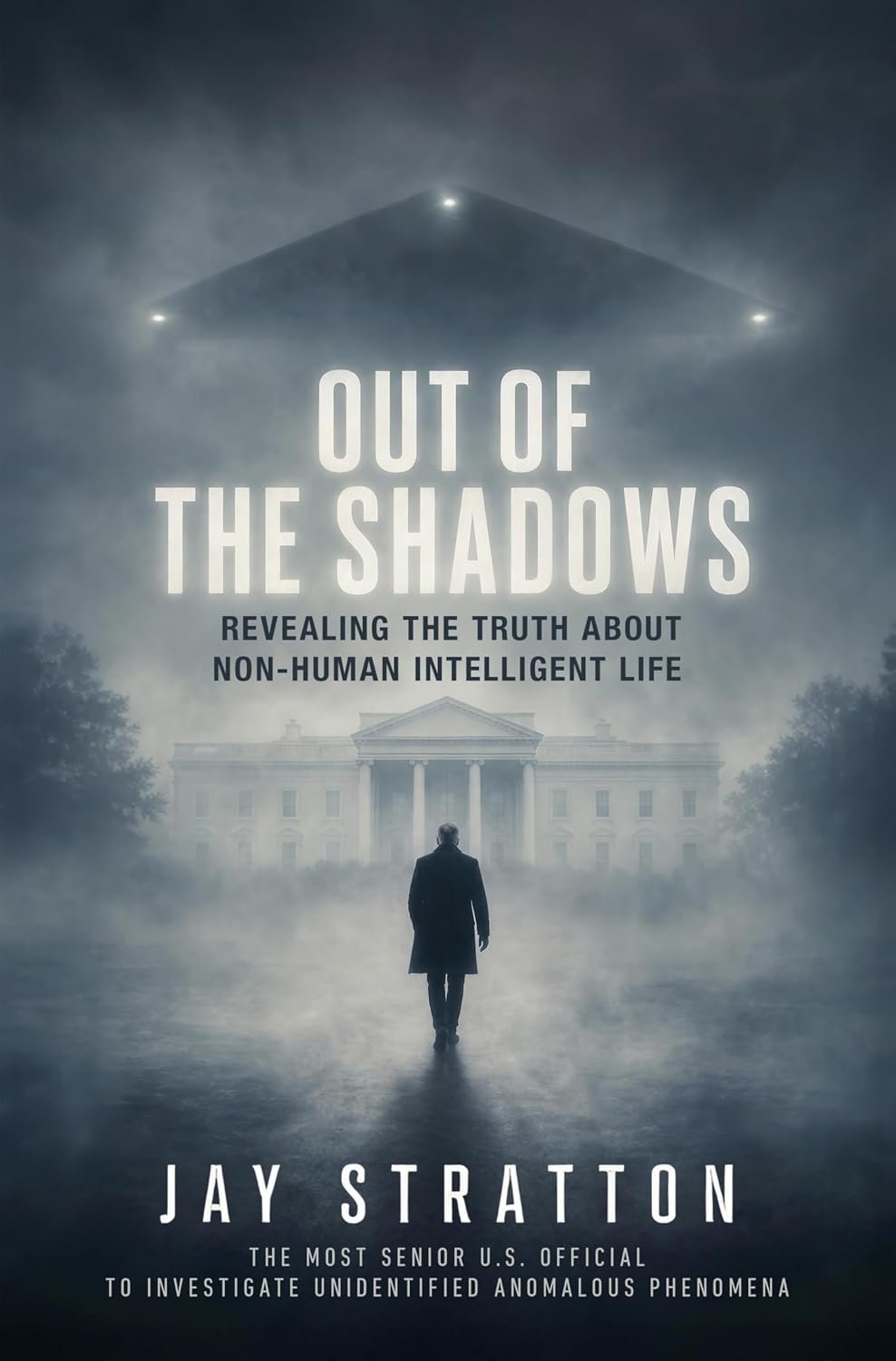
Out of the Shadows
Jay Stratton’s UAP memoir places extraordinary allegations beside questions of secrecy, national security and what public evidence can establish.
Books worth discovering. Authors worth knowing.
A former intelligence official makes his case for a hidden history of unidentified phenomena. The crucial task for readers is to distinguish firsthand testimony from independently established proof.
A high-stakes account of intelligence work whose most consequential claims remain contested.
Out of the Shadows: Revealing the Truth About Non-Human Intelligent Life announces its stakes before the reader reaches the first chapter. Jay Stratton, a former United States intelligence official associated with the government’s modern investigation of unidentified anomalous phenomena, presents an account of what he says he learned behind institutional barriers. The publisher describes a career spanning military service, aerospace intelligence, and years of inquiry into unexplained aerial incidents. The result is marketed as a memoir with the urgency of a political thriller. Its central proposition, however, is not merely that unusual objects have been reported. It is Stratton’s much larger allegation that elements of government have concealed evidence of non-human intelligence. Those two propositions deserve to be kept separate from the outset.
A memoir built around access and secrecy
The book’s distinctive advantage as presented in available publisher and library descriptions is its claimed vantage point. Stratton is not portrayed as an enthusiastic outsider collecting stories from a distance; he describes work inside the national-security establishment, where even the question of who is allowed to know can become consequential. The promotional account begins with footage of an unusual aerospace vehicle reportedly seen near a sensitive nuclear site. That episode, as summarized by the publisher, initiates a prolonged investigation into what the objects were, what they might imply, and why information about them was difficult to obtain. For readers, this offers a recognizable narrative engine: a professional tasked with assessing threats encounters a problem his ordinary methods cannot readily settle.
Institutional access can make testimony compelling, but it does not automatically transform an assertion into public proof. Classified systems make verification especially complicated because a witness may say that the decisive evidence cannot be shown. That asymmetry is fundamental to evaluating the book’s promised revelations. The memoir offers a perspective on what its author claims to have experienced and been told; it should not be mistaken for a publicly reproducible demonstration of the origin of unidentified objects. The questions are different: What does Stratton report? Which parts can others corroborate? What alternative explanations have been examined? And which conclusions depend primarily on readers accepting his interpretation of inaccessible material?
The national-security story beneath the extraordinary claim
One of the most promising threads in the advertised narrative concerns the development of government processes for taking anomalous reports seriously. The publisher identifies Stratton with the Advanced Aerospace Weapon System Applications Program, or AAWSAP, and with the establishment of the Unidentified Aerial Phenomena Task Force. These initiatives place his story within an administrative history rather than a purely speculative debate about visitors from elsewhere. Unknown objects near military ranges, aircraft, or sensitive sites can pose legitimate operational questions regardless of their eventual explanation. Pilots, radar operators, analysts, and policymakers have practical reasons to want reports recorded accurately and investigated consistently.
This distinction matters because an unanswered observation is not an empty question. It may warrant serious inquiry even when the evidence is insufficient to classify its cause. Stratton’s book appears to build dramatic momentum out of the tension between the need to investigate and the difficulty of drawing conclusions. That is a useful subject for a memoir about intelligence culture. The reader need not endorse the most extraordinary allegation in order to recognize the importance of institutional reporting channels, the problems of fragmented oversight, or the public interest in a more coherent account of what agencies know and do not know.
Where the book’s claims meet contrary official findings
Responsible engagement with Out of the Shadows requires acknowledgment of the record beyond the publisher’s promotional account. In 2024, the U.S. Department of Defense reported that its All-domain Anomaly Resolution Office found no verifiable evidence that observed UAP represented extraterrestrial activity and no verifiable evidence of government or private-industry possession of extraterrestrial technology. NASA’s public UAP guidance likewise says it has not found credible evidence of extraterrestrial life or evidence that UAP are extraterrestrial. Those conclusions do not tell readers everything about every classified file. They do establish that Stratton’s larger claim is disputed rather than settled fact.
The resulting contrast could be the book’s most intellectually significant tension. Stratton frames the matter through testimony, access and alleged resistance from powerful gatekeepers; the official assessments stress evidentiary standards, incomplete data and the absence of independently verifiable proof for extraterrestrial explanations. Neither a confident assertion nor an official denial should be read without attention to its methods and limitations. Readers can ask whether a proposed explanation accounts for the available observations, whether named claims are linked to testable records, and how an investigator differentiates a hidden program from a mistaken inference about a real but unrelated classified project.
The human cost promised by the narrative
The publisher’s description indicates that Stratton also writes about pressure on his professional and family life. That element matters to the shape of the memoir. A book devoted solely to alleged technology might become a list of disputed incidents; an account of the people involved can instead explore what prolonged uncertainty and institutional conflict do to a person’s judgment, relationships and sense of safety. Personal costs may be real even when particular interpretations remain unproven. A memoir can be valuable as a record of conviction, anxiety and institutional experience without requiring agreement with every conclusion the narrator reaches.
There is nevertheless a difficult narrative challenge here. If the reader is asked to understand exceptional claims through the exceptional stress they caused the claimant, emotional intensity may begin to substitute for external corroboration. The strongest version of a story like this keeps its human dimension and its factual assertions in dialogue without conflating them. The available synopsis promises a tale of obstacles, risk and disclosure efforts; only a full reading could establish how carefully Stratton handles evidentiary gaps on the page. This Journal review is based on publisher, library and public-agency material, not on a complete independent reading of the memoir.
Why the thriller comparison is attractive—and limited
Descriptions repeatedly compare the book’s pace to a thriller. The ingredients make that understandable: a mysterious video, highly restricted institutions, claims of concealed programs, meetings with lawmakers, and a professional life affected by the pursuit of an answer. There is suspense in the possibility that different offices possess different pieces of a consequential story. A strong nonfiction narrative can use those tensions to help readers understand systems that would otherwise remain abstract. Yet suspense is a storytelling property, not an evidentiary category. A dramatic revelation does not become verified because it arrives after a sequence of obstacles, and a narrative climax cannot replace documentary corroboration.
Readers who favor investigative nonfiction should therefore be attentive to the book’s hierarchy of knowledge. Is an incident based on something the author directly saw, a document he reviewed, a source he trusted, or a conclusion assembled from several accounts? Are the boundaries between those levels explicit? How are competing explanations handled? These are fair questions for any political or intelligence memoir, not special objections to a controversial topic. The greater the claim, the more useful it is for the reader to identify the exact kind of support offered for it.
A readership divided by different expectations
For those already following the UAP debate, Out of the Shadows offers an influential participant’s account of how the issue moved through defense and intelligence channels. Its author’s association with official investigations is a reason to take his testimony as worthy of examination, though not as decisive proof of non-human life. Readers interested in secrecy, bureaucracy and national security may find the account worthwhile even if they remain unconvinced by its central allegation. Others may approach the book expecting the definitive physical evidence promised by the subtitle and find that their assessment depends on information unavailable for independent public testing.
That disparity is not a flaw readers must solve before opening the book; it is the book’s defining critical context. The strongest reading position is simultaneously curious and discriminating. Firsthand narratives can expose genuine institutional difficulties and introduce leads that merit further investigation. They can also be shaped by imperfect memory, incomplete information and contested interpretations. Recognizing those possibilities does not require dismissiveness. It requires treating testimony as testimony, distinguishing unexplained from extraterrestrial, and seeking independently checkable support whenever a claim moves from unusual observation to sweeping historical conclusion.
An important account, but not an endpoint
Stratton’s memoir enters an unusually charged public conversation. Its reported history of official UAP programs, its portrait of institutional resistance and its personal stakes are plausible subjects for substantive nonfiction consideration. The publisher and library descriptions give enough detail to identify those themes and the questions they raise. They do not give this reviewer grounds to certify the alleged concealment of non-human intelligence. As a reading proposition, Out of the Shadows is best understood as the testimony of a prominent figure in a disputed field—potentially revealing about how he understands that field, and most rewarding when considered alongside independent reporting, scientific standards and government findings that do not reach his conclusions.
About the book.
Jay Stratton’s UAP memoir places extraordinary allegations beside questions of secrecy, national security and what public evidence can establish.
The source queue marks this as a sponsored book feature. This editorial draft distinguishes documented descriptions from opinion, and sponsorship is not presented as proof of quality. All drafts require independent editorial approval and publishing preflight.
Found a book worth opening?
Books worth discovering. Authors worth knowing.
Return to the Journal →