
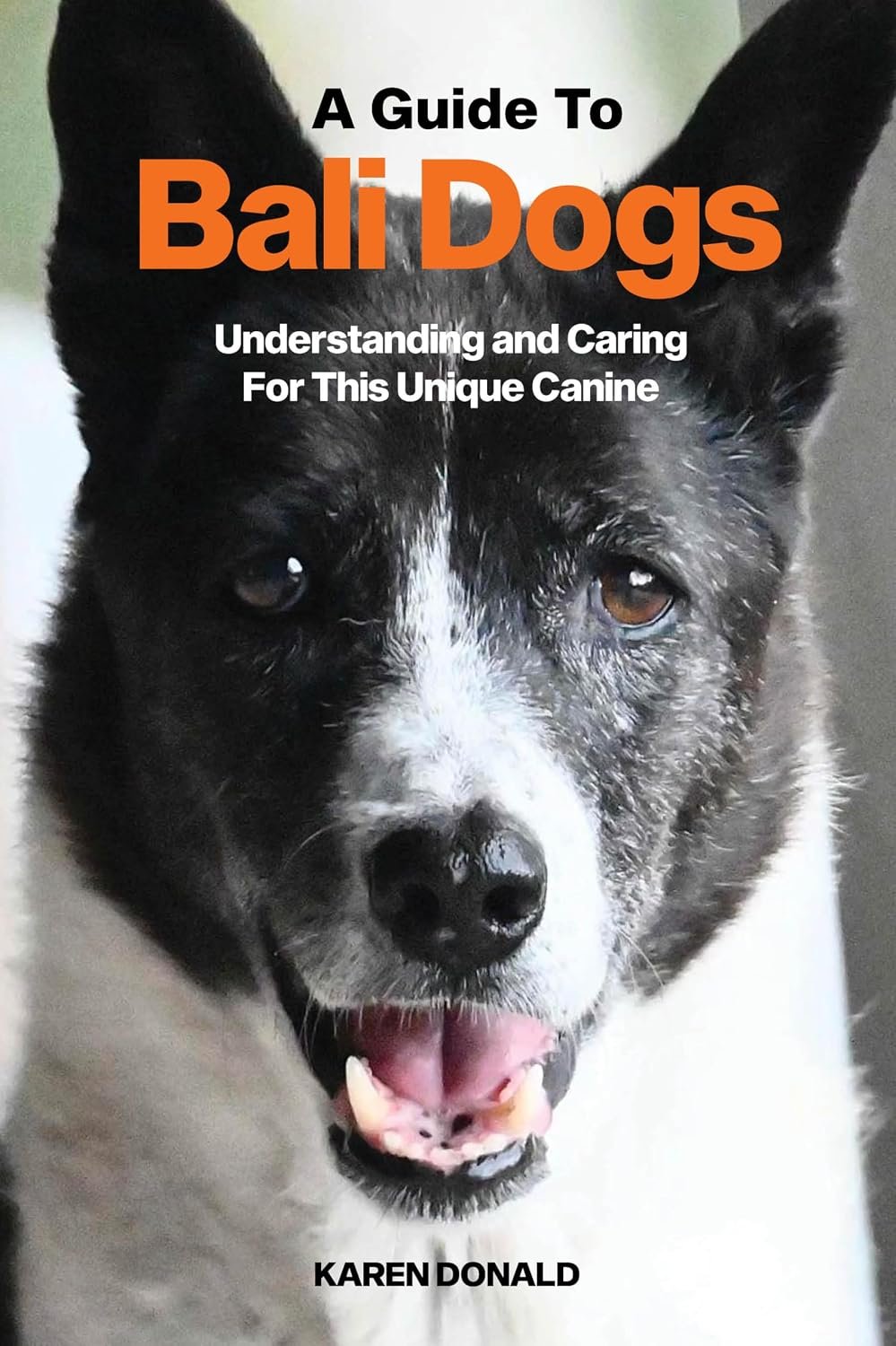
A Guide to Bali Dogs
Karen Donald connects the heritage of Bali’s indigenous dogs with responsible adoption, veterinary awareness and conservation.
Books worth discovering. Authors worth knowing.
Karen Donald connects the heritage of Bali’s indigenous dogs with responsible adoption, veterinary awareness and conservation.
Original editorial introduction, grounded in the verified book edition and public descriptions.
A dog can be both a familiar companion and part of a landscape’s living history. In A Guide to Bali Dogs: Understanding and Caring For This Unique Canine, Karen Donald brings those ideas together. Public descriptions identify a book concerned with Bali’s indigenous dogs, their origins and inherited characteristics, their relationships with local people, and the practical questions surrounding rescue, health and adoption. The guide is also framed as an effort to draw attention to a distinctive canine heritage that faces pressure. That combination makes the book more than an owner’s manual. It asks readers to see an animal often encountered on a street as a subject of culture, science and responsibility, rather than as a generic stray awaiting a new home.
The dog and the island
Bali’s dogs have long occupied space within the island’s daily life. The guide’s publisher and festival descriptions emphasize their deep history and suggest that understanding them means attending to the communities alongside which they live. This is a useful correction to the idea that all free-roaming dogs can be understood in exactly the same way. A dog’s behavior is shaped by many things: individual temperament, social experience, health and the conditions in which it lives. An account of a locally adapted canine population may therefore be most revealing when it resists easy stereotypes. Donald’s project promises discussion of origins, types and characteristic traits, while public descriptions connect the animals’ story to Bali’s cultural setting.
A 2024 festival description highlights the significance of genetic research and comparisons with other indigenous dog populations, including the Australian dingo and New Guinea singing dog. These comparisons should be understood as a summary of the book’s stated research interests rather than a license to claim a specific genetic relationship or evolutionary conclusion without reading the underlying studies. The distinction matters because discussions of ancestry can become simplified very quickly. Readers can appreciate the invitation to learn about canine history while asking where the scientific evidence comes from, which populations were studied and how confidently any broad conclusion can be applied to individual animals.
A guide with more than one purpose
The published table of contents divides the book into three broad parts: understanding Bali dogs, adopting and caring for them, and considering their future. The first part addresses what a Bali dog is, the types encountered, the development of bonds and key characteristics. The second discusses adoption, training, socialization, essential care, and risks. The final part includes rabies, veterinary and welfare resources, stories of rescue and ways to contribute. This structure is unusual in its breadth. Readers can enter out of curiosity about heritage and find themselves thinking about the practical responsibilities of care, or begin with an interest in adopting and discover why the wider context deserves attention.
That breadth also has limits. A printed guide can provide orientation but cannot assess a particular animal’s behavior or medical condition. The presence of sections on risks and rabies makes responsible interpretation especially important. Readers should seek current veterinary and public-health advice when dealing with bites, suspected infection or decisions about vaccination. Local policies, welfare conditions and available services can change after publication. The book’s scientific and practical claims are best treated as information to evaluate alongside qualified professionals, not an alternative to veterinary care or official guidance.
Rescue does not erase a dog’s history
An animal adopted from a different environment may bring a history that its new caretaker understands only partially. Donald’s inclusion of training, socialization and bond formation suggests she is attentive to the transition from meeting a Bali dog to living responsibly with one. Adoption stories can be moving, but they should not encourage the belief that affection alone resolves every challenge. Trust may take time, and a dog’s needs can differ sharply from the owner’s hopes or assumptions. A conscientious reader might use the book to prepare questions for rescuers and veterinarians: what information is known about the animal, what adjustment might be needed and what support is available if difficulties appear?
The wider welfare context matters as much as an individual adoption. Public festival material connects the guide to conservation of Bali’s indigenous canine heritage and concern about declining numbers. Protecting a population and helping one particular animal can overlap, but they are not identical projects. Readers interested in rescue might ask how sterilization, community welfare, veterinary access and preservation of locally adapted dogs interact. The book’s description names experts, including genetics and behavior specialists, as interview subjects, and identifies animal-welfare voices. It does not establish that all specialists agree on every policy, so readers should be alert to distinctions among advocacy, science and local community priorities.
The cultural dimension of care
A traveler may encounter a street dog as part of a holiday and want to help immediately. Good intentions are important but insufficient when an animal belongs to a wider human and ecological setting. Donald’s emphasis on Balinese cultural connections encourages a more attentive response. It asks people not only what they want for the dog, but what local residents, caretakers and welfare organizations know about the situation. A rescued animal may need support that is practical, sustained and locally coordinated. The most effective form of help is not necessarily an impulsive intervention by a visitor. The guide’s apparent combination of local context and care information gives readers a framework for asking better questions before acting.
This perspective also complicates the label “street dog.” For some readers it may suggest abandonment; for others it simply describes an animal commonly seen in shared public spaces. The underlying circumstances can be very different. The book’s distinction between types of Bali dogs and its interest in their future suggest a need for precise language. Generalizations about aggression, friendliness or suitability for family life should not be inferred from origin alone. Individual animals deserve individual assessment. The book’s merit as a potential reading choice lies partly in its refusal, as described by the publisher, to keep heritage, behavior and welfare in isolated categories.
Photography and the work of seeing
Public descriptions mention color photographs alongside the reported research and expert conversations. In animal nonfiction, photographs can make difference visible: a posture, an environment, a relationship with a caretaker or features that a verbal description struggles to convey. They can also encourage affection that makes readers more willing to engage with difficult welfare questions. The photographs cannot substitute for evidence, and this article does not claim to have assessed the quality or captions of every image. Their advertised inclusion nonetheless suggests a book intended to be explored visually as well as read, appealing to people who learn through looking carefully and returning to details.
Who might enjoy this book
A Guide to Bali Dogs is a strong prospect for canine enthusiasts, prospective adopters, animal-rescue supporters and travelers who want to understand the animals they encounter in Bali. Readers interested in indigenous breeds, the relationship between people and animals, or conservation questions may appreciate the mixture of cultural history and practical guidance. It could also be valuable as a starting point for conversations with experienced rescue workers and veterinarians. Someone seeking only a quick generic puppy-training handbook may find the broader focus less direct, while a scientific specialist should consult the research cited within the book before relying on detailed genetic claims. Readers should also understand that the guide is not a substitute for current local welfare law, veterinary assessment or public-health advice. Its special appeal is the attempt to connect affection with informed responsibility.
Seeing a familiar animal differently
The book’s lasting invitation is to notice what may be easy to overlook. A dog at the side of a Balinese road is not merely an anonymous figure in a travel photograph; it belongs to a complex network of inheritance, environment and human care. Donald’s guide, as described by publishers and a literary festival, offers tools for thinking about that network through history, behavior, welfare and the possibility of preservation. Readers can arrive because they love dogs and leave with more precise questions about whose knowledge matters, which actions truly help and what a living heritage requires. That is a distinctive reason to open a guide that treats ordinary encounters as the beginning of deeper attention.
About the book.
Karen Donald connects the heritage of Bali’s indigenous dogs with responsible adoption, veterinary awareness and conservation. Public bibliographic details have been distinguished from editorial interpretation.
Sponsored book feature: the MarketAnyBook queue lists this book as sponsored. This original research-based editorial article is not a firsthand reading or an independent endorsement. Bibliographic descriptions and author or publisher statements are interpreted with clear source limits. The original purchase URL remains unchanged; WordPress cover media is added later by the owner’s publisher. Advice in the book reflects the author’s perspective and is not individual medical or financial advice.
Found a book worth opening?
Books worth discovering. Authors worth knowing.
Return to the Journal →