
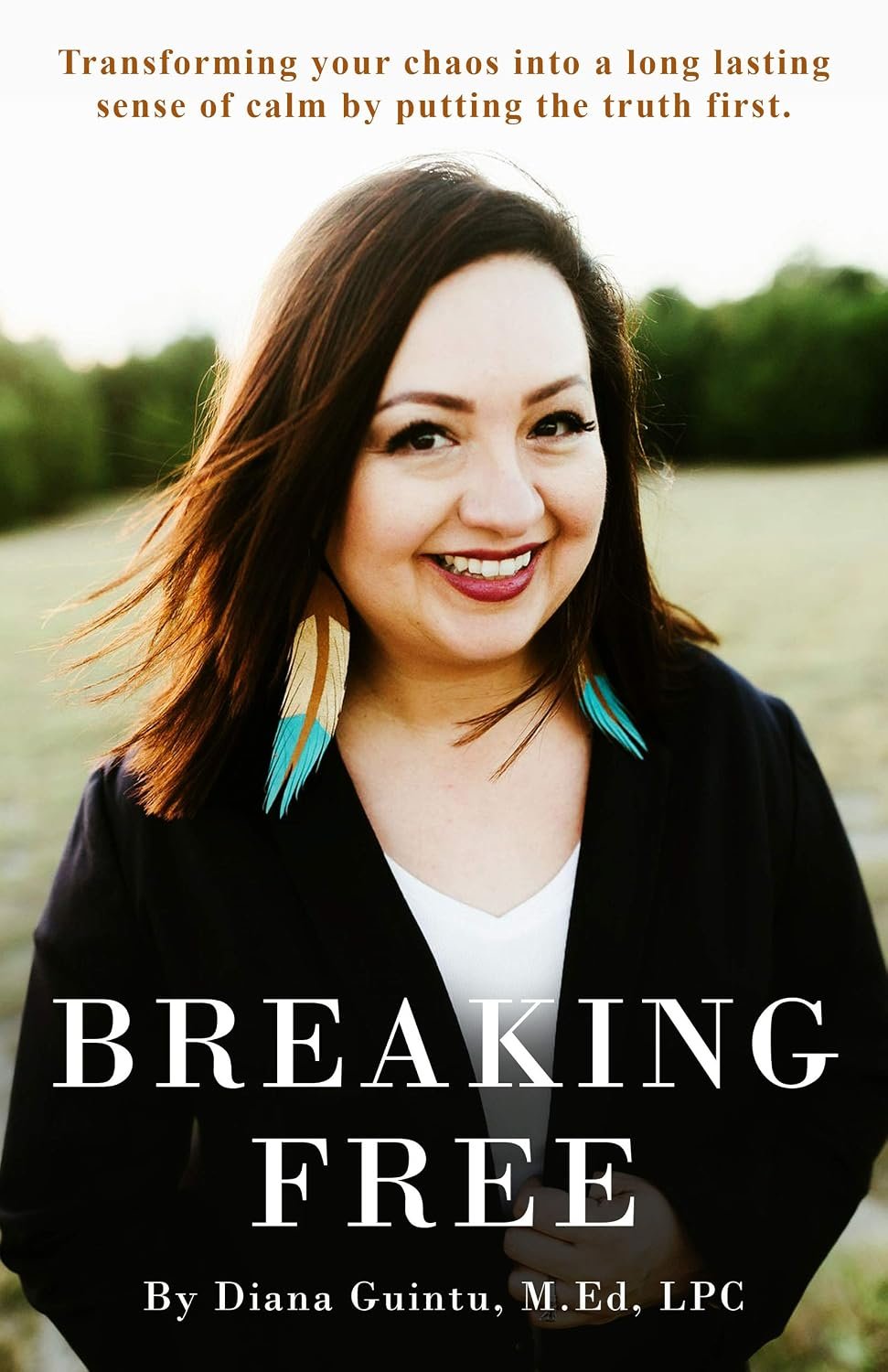
Breaking Free
Diana Guintu connects speaking the truth about lived experience with a search for steadier emotional life and renewed personal agency.
Books worth discovering. Authors worth knowing.
What if lasting calm begins not by denying upheaval but by naming the experiences that make everyday life feel chaotic?
Author site confirms the book, and podcast conversations link Guintu’s story to trauma, self-worth, burnout and emotional recovery.
Calm begins with a difficult admission
Breaking Free: Transforming your chaos into a long lasting sense of calm by putting the truth first announces its priority in the subtitle. Diana Guintu does not frame change as a matter of decorating difficult circumstances with cheerful language. The claim is that honesty about one’s life can become the beginning of a more settled relationship to it. Her public website lists the book among her resources, and podcast conversations describe her experiences with trauma and the work of helping women navigate periods of uncertainty. Those materials establish the broad orientation of the book even where a detailed table of contents is not publicly verified.
The idea of putting truth first deserves attention because the word can sound simpler than it is. A person may know that work is exhausting, a relationship is unsupportive, or a long-standing pattern is painful while still lacking the language or conditions needed to respond. Naming a problem does not automatically resolve it, and speaking openly can carry risks in unsafe environments. A responsible reading of this premise treats honesty as a possible source of clarity, not as a blanket instruction to disclose deeply personal experiences to anyone who demands them. The distinction helps preserve the book’s empowering intention without turning it into an obligation to be vulnerable on command.
Chaos is not always visible
Some forms of chaos announce themselves through missed deadlines and overcrowded schedules. Others are quieter: a nervous expectation of conflict, difficulty resting, a persistent sense of inadequacy, or the effort of appearing composed while overwhelmed. Guintu’s public speaking and coaching materials discuss burnout, negative spirals, and rebuilding confidence. Those concerns give readers a reasonable basis for approaching the book as an exploration of internal patterns alongside external events. They do not establish that any one method produces a long-lasting sense of calm for every reader.
It may be especially helpful to distinguish a difficult week from a life structure that repeatedly creates distress. A short-term schedule change can ease immediate pressure, while more entrenched conditions may involve finances, caretaking, health, or harmful relationships. Self-development advice is most humane when it notices these realities rather than presuming that every difficulty can be solved through better attitude. Guintu’s emphasis on truth can be read as an invitation to describe circumstances accurately before deciding what can change. That description may include the limits of individual control.
The story behind a public message
In interviews, Guintu has discussed painful lived experiences and how they influenced her work with others. Her website describes a focus on healing, growth, confidence, and reclaiming a sense of personal agency. This context matters for a book that puts authenticity at the center of transformation. The author does not approach the subject only as a marketing abstraction; she publicly connects her message with personal struggle. A feature should nevertheless avoid inferring that every incident mentioned in later interviews appears in the book, or reconstructing traumatic scenes that have not been verified from the text. Respect for memoir-related material requires restraint.
The relationship between testimony and guidance is also worth examining. When an author describes a path through hardship, readers can find recognition and courage in the specificity of that example. Yet the same specificity limits the claim: what helped one person may not suit another. Breaking Free appears to bring personal experience to the work of self-reflection. It can be approached as an invitation to consider useful questions, rather than a system that has been independently established to treat trauma, anxiety, or depression.
Self-worth in everyday decisions
Personal agency often appears in ordinary moments rather than dramatic declarations. Someone may begin recognizing when a request exceeds their capacity, when a familiar inner criticism has become automatic, or when support is needed before an exhausting situation worsens. Guintu’s published interests in burnout and impostor feelings make these practical questions relevant to her broader body of work. They are interpretive examples, not a claim that the book prescribes a particular daily checklist. The questions can help a reader translate an appealing phrase such as reclaim your power into something grounded in actual circumstances.
Truthfulness toward oneself need not mean constant self-scrutiny. Rest, pleasure, companionship, and practical assistance may be as important as reflection. If every difficult feeling becomes another task to analyze, personal growth can take on the same oppressive quality as the pressure someone hopes to escape. A sustainable sense of calm would need room for uncertainty and imperfect days. This broader consideration is useful because the subtitle’s ambition is substantial: lasting calm is not a single mood that can be maintained by force, but perhaps a more flexible capacity to respond to life as it unfolds.
Boundaries, relationships, and outside help
Truth operates socially as well as privately. Acknowledging that a relationship feels unsafe or unequal can change what a person decides to share, request, or refuse. But readers should not be pushed into confrontations that could make a dangerous situation worse. Safety, trusted support, and professional guidance can be essential when abuse or serious psychological distress is involved. The book’s broad personal-development positioning should not be confused with an individualized clinical recommendation. An author may describe practices that felt transformative without supplying the kind of controlled evidence needed to claim medical effects.
The possibility of asking for help is itself an important expression of agency. Someone may need a counselor, a friend, legal protection, practical childcare, or simply time away from persistent demands. None of these choices is a confession of weakness. Guintu’s rhetoric of freedom can be read in a generous way: to break free is not necessarily to become independent of every other person, but to regain meaningful choice about one’s life and relationships. A supportive reading keeps that choice in the hands of the individual rather than imposing an externally defined version of success.
The difference between calm and compliance
Calm can be misunderstood as the absence of disagreement, even when remaining silent about a harmful situation carries its own cost. Guintu’s subtitle asks readers to place truth first, which opens a more demanding possibility: sometimes a clearer life requires a difficult conversation, an altered routine, or the recognition that another person’s expectations cannot always be met. Such choices can produce temporary uncertainty rather than immediate comfort. They also require judgment about timing and safety. An emotionally sustainable approach cannot insist that people endure dangerous confrontations to demonstrate authenticity. The useful meaning of freedom is a widening of practical choice, not the performance of bravery for an audience. Readers may find the most helpful questions are concrete: what is actually happening, what support is available, what is safe to change, and what deserves patience rather than a forced resolution?
Who should read it
Breaking Free may interest readers drawn to personal-development writing rooted in an author’s lived story, especially those reflecting on burnout, negative self-beliefs, boundaries, and the desire for steadier emotional life. Its emphasis on truth and agency offers a clear starting question: what do I need to acknowledge before I can decide what should change? Readers seeking a clinical workbook, a guaranteed mental-health intervention, or a comprehensive treatment plan should choose a different resource or consult a qualified professional. Those comfortable with reflective self-help may find value in the book’s central invitation while keeping their own pace, circumstances, and safety firmly in view.
About the book.
Self-development / trauma-informed personal reflection. Author site confirms the book, and podcast conversations link Guintu’s story to trauma, self-worth, burnout and emotional recovery. Research-based editorial feature, not a claim of firsthand reading.
Independent editorial book feature; marked not sponsored in the source queue. Research-based commentary using verified public material, not a firsthand review. Cover media fields await the owner’s publishing automation.
Found a book worth opening?
Books worth discovering. Authors worth knowing.
Return to the Journal →