
Chrysalis
A poetry debut connects the changing natural world with memory, solitude, loss, and personal transformation.
Books worth discovering. Authors worth knowing.
A poetry debut connects the changing natural world with memory, solitude, loss, and personal transformation.
A Poetry Box collection examining changes in nature and the poet’s inner life across different places and periods.
Change in nature and change within a life
Luna Moore Latorre’s Chrysalis is a poetry collection about the relationship between changes in the natural world and changes within the poet’s own life. The publisher, The Poetry Box, identifies three central concerns: difficulty letting go of the past, the shifting relationship between loneliness and solitude, and observations of nature that make personal transformation easier to accept. This is a precise and appealing description because it does not reduce growth to cheerfulness. The collection acknowledges that change can bring relief and grief at the same time, and that neither feeling cancels the other.
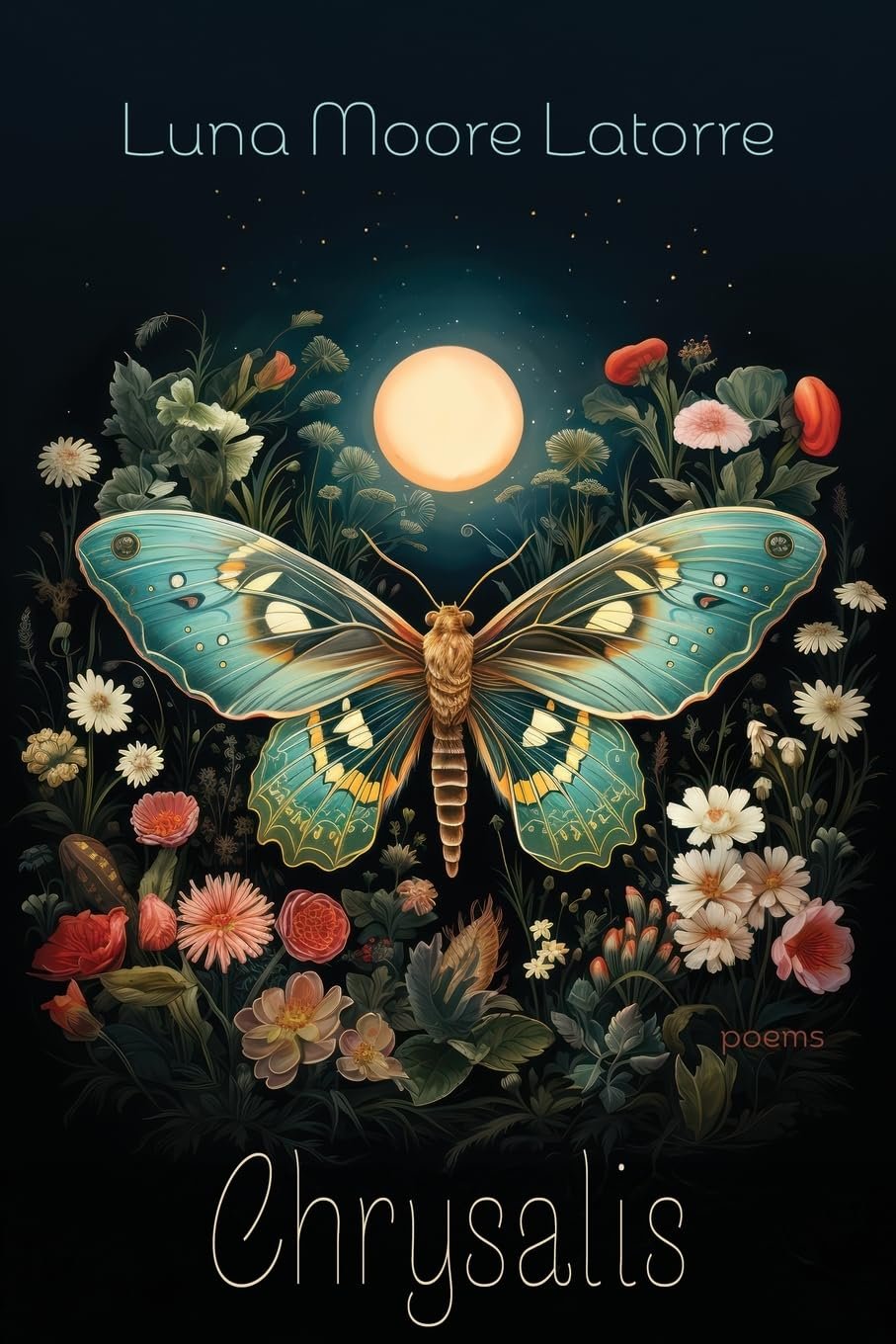
The title evokes the enclosed stage in which a caterpillar becomes a butterfly. That image can suggest beauty and new possibility, but transformation is not the same as effortless improvement. Change requires the end of one familiar form before another becomes visible. In a poetry collection, such a title invites close attention to moments of uncertainty, waiting, and reorientation. It would be misleading to assign a particular butterfly image to an unseen poem, yet the collection’s publisher explicitly connects the work with nature and inward transition, making the metaphor relevant to its public framing.
Letting go of a past that still has meaning
One stated theme is the difficulty of letting go. The past can hold relationships, places, and versions of oneself that still matter even when they can no longer be recovered. A poem may provide a space in which conflicting desires can coexist: wishing to move ahead and wishing something had never changed. The published description does not provide a table of contents or authorize quotation from individual pieces, so a feature should not invent scenes, speakers, or lines. It can describe the emotional territory the publisher identifies and explain why that territory is well suited to lyric reflection.
The contrast between loneliness and solitude is especially fruitful. Loneliness is often experienced as an absence of wanted connection, while solitude can be a chosen state in which a person discovers room for thought. Both may occur in the same place, sometimes on the same day. Latorre’s collection is described as exploring her relationship with both conditions, rather than treating isolation as uniformly painful or uniformly healing. That distinction makes room for readers whose own experiences of being alone do not fit into simple inspirational slogans.
The difference between loneliness and solitude
Nature offers the collection another vocabulary. Seasonal change can make impermanence visible without arguing about it. A tree sheds leaves, weather shifts, and a place that seemed permanent looks different from one year to the next. These are general observations about the natural world, not claims about a particular poem. Their relevance comes from the publisher’s statement that Latorre pays attention to nature as she considers the necessity of change. Such noticing can make philosophical questions intimate, bringing them down to the scale of an ordinary encounter with a landscape.
The poems are described as spanning Portland, Los Angeles and Orange County, Miami, and other locations. Geography gives the collection more than a decorative sequence of city names. Moving among places can make time visible: a remembered landscape belongs to a particular period, and returning to it may reveal how the observer has changed. The publisher notes that the poems come from different phases of the poet’s life. A reader can therefore approach the collection as a set of emotionally varied snapshots rather than a single argument that proceeds in a straight line.
The editorial material also emphasizes opposing emotional states. Humor and loss, affection and grief, delight and difficulty can share the same life without resolving into one dominant mood. This breadth is one of the reasons poetry can be an effective form for writing about transformation. A short piece does not need to explain every contradiction. It can hold attention on an experience that remains unresolved, allowing the reader to feel the pressure between two truthful but incompatible responses. Latorre’s description foregrounds precisely that refusal to view life from only one side.
Places and seasons as emotional coordinates
A poetry collection can be read differently from a novel. The reader may enter through an individual poem, pause over a particular image, or return to a sequence after personal circumstances have changed. Chrysalis invites a similarly patient approach, at least in its stated attention to observation and emotional nuance. No responsible feature can promise the effect of a specific piece without access to it. What can be said is that the themes give a thoughtful reader reason to slow down and consider how private experience is reflected in recurring patterns of the natural world.
A collection organized around different times and places can prompt the reader to listen for changes in the speaker’s attention. An early memory may attach to a landscape differently from a later observation of the same natural process. The Poetry Box describes the poems as coming from several periods in Latorre’s life, which makes variation part of the book’s declared form. Rather than expecting a single emotional lesson repeated throughout, readers can look for the ways perception changes with experience. Poetry is particularly good at capturing a moment before its meaning becomes settled.
The image of growth also deserves freedom from the language of constant self-improvement. Becoming different does not always mean becoming happier in any measurable way. It can involve acknowledging limits, grieving what cannot return, or learning to inhabit solitude without denying the desire for connection. Latorre’s stated interest in emotional opposites suggests a collection comfortable with such complexity. A reader may find more companionship in a poem that recognizes uncertainty than in one that promises a neat conclusion, because lived change so rarely arrives with an explanatory label.
Poetry that makes room for contradiction
The Poetry Box identifies Chrysalis as Latorre’s debut collection and lists its release in March 2025. That factual context matters more than attempting to inflate the book with unverified awards or a fabricated publishing history. A debut often introduces a voice to readers who do not yet have a large body of work with which to compare it. The available description provides an accessible starting point: attention to nature, an inward reckoning with change, and the willingness to hold grief and humor together.
Early praise reproduced on the publisher’s site emphasizes the poet’s observations of the world and the combination of love, loss, wonder, and humor. Endorsements are expressions of other readers’ responses, not objective guarantees. They nevertheless align with the publisher’s description of the collection’s emotional range. Someone drawn to reflective contemporary poetry will find those themes familiar, while the range of geographical settings suggests a particular personal path. The poetry itself remains the place to test how those concerns are realized in language.
An intimate debut shaped by transformation
The collection may appeal to readers living through a move, a separation, a difficult ending, or an ordinary but disorienting period of growth. It does not need to be marketed as a treatment for grief or a method that will deliver guaranteed healing. Poetry can offer companionship and perspective without solving the circumstances that prompt a reader to open it. Latorre’s announced attention to loneliness, solitude, and the natural world suggests the book is interested in recognition rather than prescription. Its value is in the invitation to notice.
Chrysalis brings its title and themes into clear alignment. As the natural world changes form, a person confronts the uncertainty of becoming someone slightly different. Luna Moore Latorre’s debut treats that experience as complex enough to contain tenderness, humor, loss, and appreciation at once. The publisher’s account supports a portrait of an intimate, place-conscious collection without requiring imagined poems or invented quotations. For readers who like contemporary lyric writing about memory, nature, and the evolving self, Chrysalis offers a thoughtful point of entry into a new poetic voice.
About the book.
A Poetry Box collection examining changes in nature and the poet’s inner life across different places and periods.
Independent MarketAnyBook editorial book feature. Prepared from verified published descriptions and contextual analysis, not a firsthand review, rating, or guarantee. WordPress cover media are resolved by the publisher.
Found a book worth opening?
Books worth discovering. Authors worth knowing.
Return to the Journal →