
Clara and the Invisible Coins
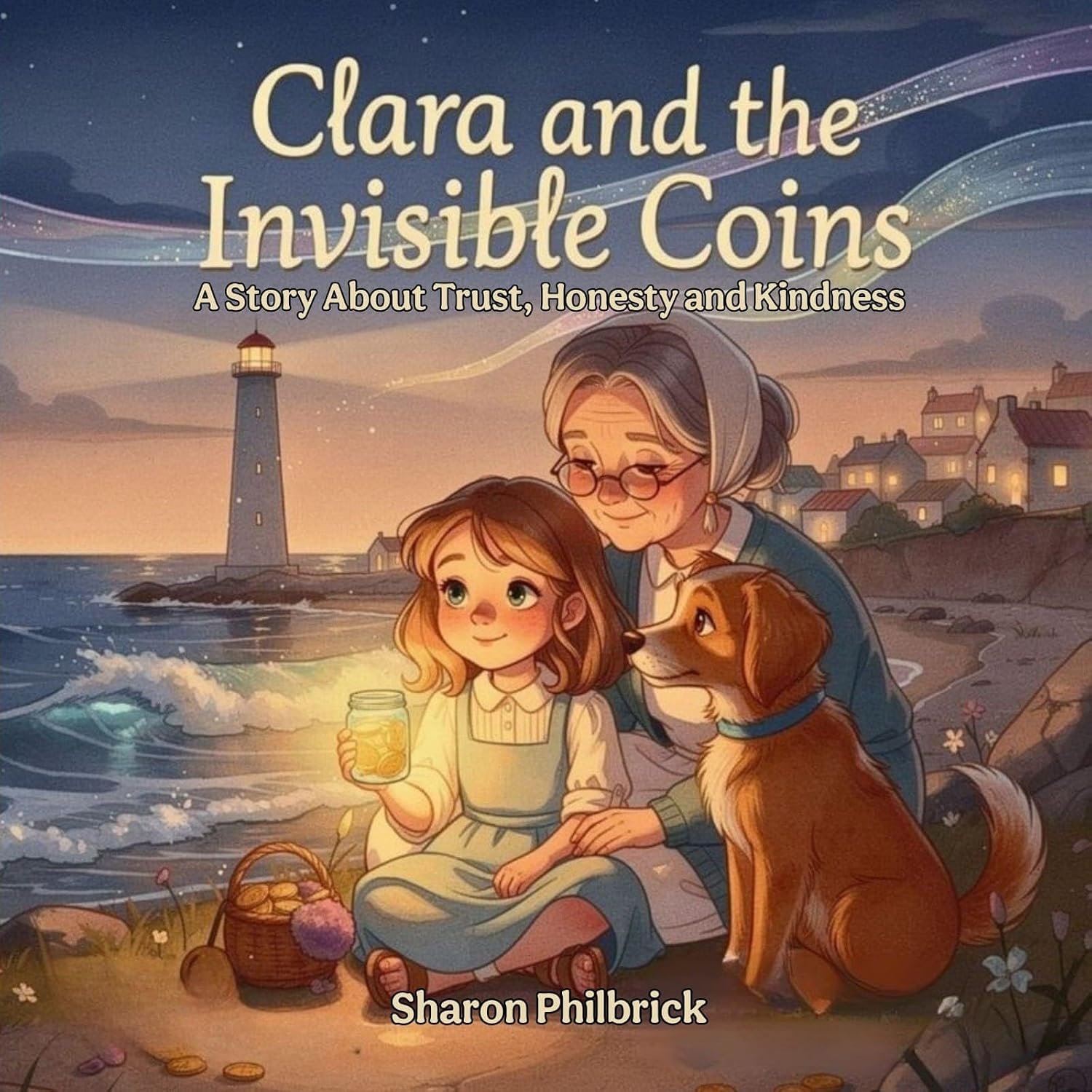
Clara and the Invisible Coins introduces a child who discovers mysterious coins visible only to her, then learns that their value emerges through honesty, fairness and generosity. Sharon Philbrick's…
Books worth discovering. Authors worth knowing.
Clara and the Invisible Coins introduces a child who discovers mysterious coins visible only to her, then learns that their value emerges through honesty, fairness and generosity. Sharon Philbrick's illustrated story makes a clever choice of image: money usually measures value through possession, whereas these coins become meaningful when Clara helps…
Considered reviews, grounded in the book’s documented promise.
Clara and the Invisible Coins introduces a child who discovers mysterious coins visible only to her, then learns that their value emerges through honesty, fairness and generosity. Sharon Philbrick's illustrated story makes a clever choice of image: money usually measures value through possession, whereas these coins become meaningful when Clara helps other people. A seaside town provides the social setting in which that lesson can acquire consequences. The premise is imaginative enough to invite discussion about what a community notices and what it overlooks.
A currency for the uncounted
Children learn early that numbers can make an object seem valuable. The invisible coins challenge that belief by moving attention toward actions whose worth is difficult to price: sharing, keeping a promise and treating somebody fairly. This is not simply a story telling children to be nice. Its device can make an abstract ethical idea concrete. A strong picture book would let the child watch consequences accumulate without relying on adult explanation to label each action. The publisher's description confirms that the coins connect with generosity, not the exact mechanics of every episode.
A town is a moral network
The seaside setting and multiple people Clara helps open the possibility of an expanding story. A small act may matter to someone who then treats another person differently; shared trust grows through repeated choices. That is a more interesting lesson than a solitary reward for being good. It also makes the invisible metaphor useful: a community can be held together by acts not formally registered anywhere. The book's treatment of fairness and transparency may resonate in classrooms, but detailed narrative success still depends on the situations actually depicted.
The problem of perfect child heroes
Instructional stories risk giving the central child unerring wisdom. Yet real fairness often involves uncertainty; competing obligations can make honesty difficult. Clara will be most persuasive if readers can recognize hesitation or the need to rethink, not simply admire a flawless moral example. The official synopsis emphasizes curiosity and courage, both of which might complicate an overly simple virtue lesson. Whether such development occurs across the thirty-eight pages remains to be checked against the complete work.
An image that can be read aloud
The story is marketed for ages six to nine and for classroom discussion. At that age, children can interrogate motives and distinguish a rule from a reason. The invisible-coin conceit is accessible, but illustration and conversational rhythm will decide how long the idea stays alive after reading. A reviewer would need to see the pages to discuss image/text relationships or the handling of shifts between magic and everyday life. Those craft questions matter precisely because the moral is clear from the back-cover description.
The value of asking why
A helpful conversation after this book might ask why an invisible coin should grow when someone gives rather than receives. That question allows a reader to discover the difference between charity and reciprocity, and to notice that kindness can be complicated by unfair systems. The book is not a treatise on economics, and it should not be judged as one. Its literary task is to make a child newly attentive to ordinary decisions.
Transparency as a story children can use
The subtitle includes transparency, a word rarely associated with picture-book adventures. Young readers may not use the term, but they recognize its substance: a rule that is applied fairly, a promise that is kept, an explanation that can be trusted. Invisible coins are an elegant way to stage that problem because their value cannot be enforced by an adult's visible accounting. The story's idea may help children question why some good actions go unnoticed. A literary critic should ask whether the book gives the child room to discover that principle rather than preempting each question with an explanation.
An imaginative device should remain surprising
The magic of invisible currency could easily become predictable if every act of kindness produces the same reward. Children's fantasy requires a sense of pattern, but it also benefits from variation. A reader should wonder what will happen when a familiar rule is applied to a difficult situation. Such complications could be especially effective in a seaside town, where different residents' needs overlap. The synopsis confirms that Clara helps friends and solves problems; it does not establish the exact types of complication or the mechanism of the coins. Those should be verified rather than embellished.
Fairness is not merely being pleasant
An instructive moral story must distinguish kindness from avoiding conflict. Being fair can involve telling an uncomfortable truth; generosity can require giving up an advantage; honesty can disappoint someone one loves. The book’s premise includes these virtues, but a careful review should ask whether it makes their cost visible. That is the difference between a story whose moral is already familiar and one that changes how a child thinks about ordinary choices. Even if the stakes remain gentle, they can be morally serious at a child's scale.
What a classroom can ask next
Teachers may find the coins a useful starting point for discussing the difference between recognition and worth. An honest action can matter even when nobody praises it, and a fair rule can feel inconvenient to the person who benefits less immediately. The magical premise gives children distance from these difficult questions. The book's stated purpose is educational, but a literary assessment should still ask whether the characters behave as people rather than examples invented solely to illustrate a rule. An engaging story can inspire moral conversation without requiring every reader to produce the same answer. That flexibility would give Clara's small discoveries lasting value.
Who will value this book
An appealing choice for early readers, parents and teachers seeking an imaginative route into discussions of honesty and generosity. The verified description supplies a coherent premise, but full-page illustrations and actual prose cadence were not inspected for this editorial assessment.
Scope of this assessment
This is a research-based editorial review drawn from identified bibliographic, author and publisher sources. It considers the work’s documented premise and the critical questions it invites, without claiming a complete firsthand reading. No unverified scene, character action or ending is asserted.
About the book.
An evidence-bounded critical introduction to illustrated moral fantasy for young readers. Published descriptions support the stated premise; interpretations are identified as editorial analysis, not confirmed plot details.
This is an unsponsored, research-based editorial review, not a claim to firsthand reading of the complete book.
Found a book worth opening?
Books worth discovering. Authors worth knowing.
Return to the Journal →