
Dear Red Straw
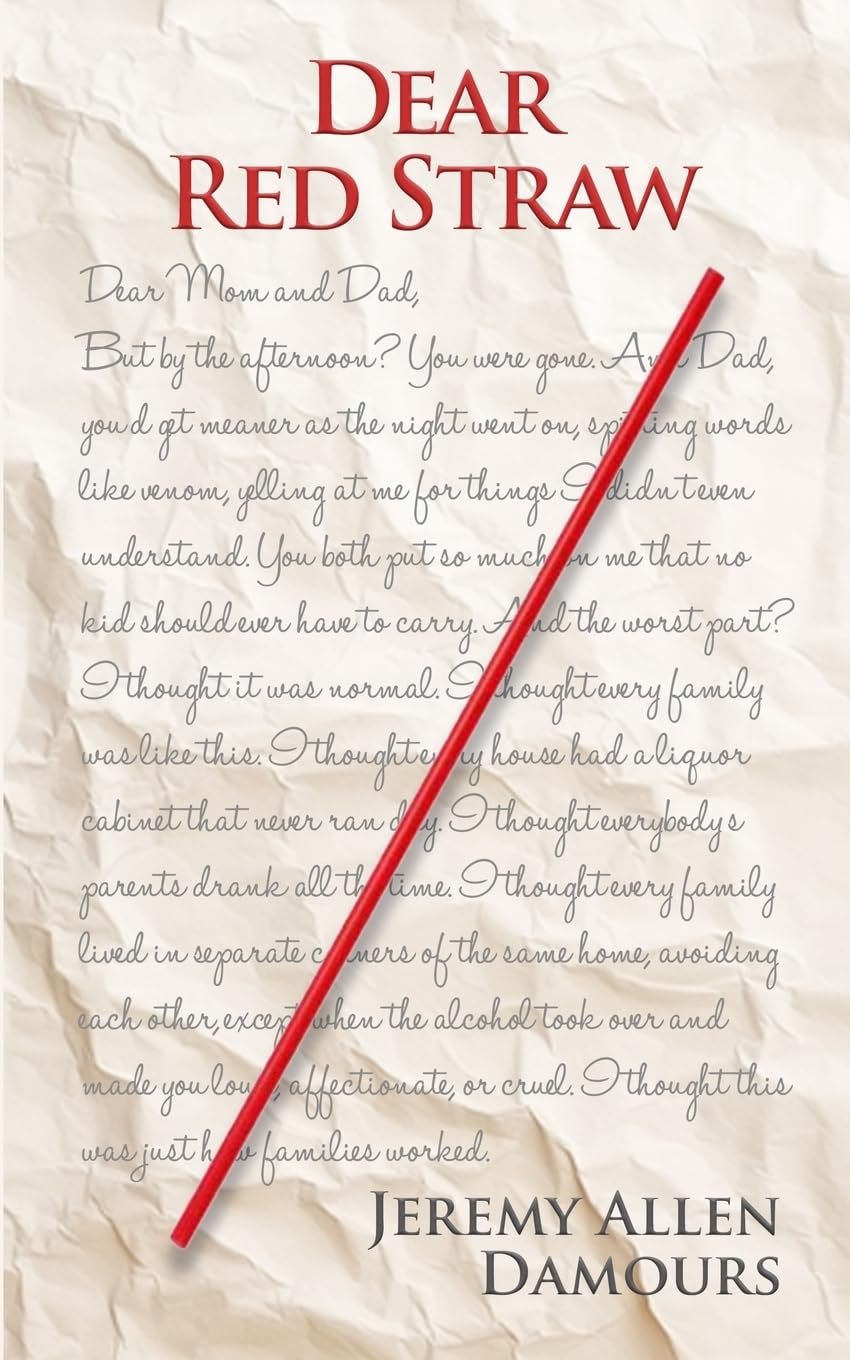
In Dear Red Straw, an ordinary object becomes an emblem of damage transmitted through a household. Jeremy Allen Damours’s published description depicts a childhood and adulthood shaped by…
Books worth discovering. Authors worth knowing.
In Dear Red Straw, an ordinary object becomes an emblem of damage transmitted through a household. Jeremy Allen Damours’s published description depicts a childhood and adulthood shaped by alcoholism, unsafe domestic environments and the temptation to mistake chaos for intimacy. The “red straw” is not a whimsical prop: it stands for the drink, ritual…
Considered reviews, grounded in the book’s documented promise.
In Dear Red Straw, an ordinary object becomes an emblem of damage transmitted through a household. Jeremy Allen Damours’s published description depicts a childhood and adulthood shaped by alcoholism, unsafe domestic environments and the temptation to mistake chaos for intimacy. The “red straw” is not a whimsical prop: it stands for the drink, ritual and dependence around which other people are forced to organize their lives. The book is presented as part memoir, part reckoning. Its moral challenge is to recognize how deeply someone else’s addiction can write itself into a child’s future without making that child permanently synonymous with the injury.
Domestic objects as emotional evidence
Memoir often uses everyday detail to recover what a general diagnosis cannot capture. A couch, a drink, an affectionate name spoken in a frightening moment: such things can become charged because they belong simultaneously to an ordinary home and to the threat that distorts it. The retailer’s synopsis includes sharp images of instability and contradiction, and they suggest that Damours wants to resist clinical abstraction. A reader can understand why a seemingly trivial object might carry more psychological history than a formal explanation. An ethical review should attend to these choices without sensationalizing the violence. Pain is not more authentic merely because it can be described vividly.
How the past trains the present
The book’s description explicitly links early experiences to adult relationships in which dishonesty feels like familiar affection and leaving can feel cruel. This is perhaps the memoir’s most consequential idea: a person may recognize harm intellectually while remaining attached to patterns that once made survival possible. The vocabulary of recovery can become facile when it assumes that insight immediately produces freedom. What matters is the slow work of rebuilding expectations about care, responsibility and choice. Damours positions that work as demanding rather than miraculous. The precise narrative techniques through which he conveys it require the full text, but the stated emotional argument is clear.
Compassion without enforced rescue
Family narratives about addiction can place enormous moral pressure on the sober relative. To refuse another crisis may look like abandonment, even when repeated rescue has become destructive. The public description addresses the exhaustion of giving everything while feeling unable to step away. That tension deserves a treatment that does not demonize the person with addiction or romanticize unlimited sacrifice by everyone else. The deepest ethical question is how empathy survives the establishment of boundaries. Damours’s healthcare and ministry background may influence the book’s language of care, but professional credentials are not proof that every psychological explanation is universally applicable.
Writing the family without reducing it
The title’s direct address suggests a reckoning with someone or something that has long occupied too much emotional space. Memoir gives the author ownership of their perspective, not comprehensive access to every other person’s motives. A careful reader should notice which observations are first-hand, which are remembered from childhood and which involve interpretations developed later. That distinction strengthens rather than weakens testimony. It allows a memoir to be both morally urgent and intellectually fair, refusing to flatten every family member into a single role. The publisher description confirms the book’s subject but not every circumstance behind it.
Hope that does not erase the record
The book’s promotional language insists that understanding can restore the capacity to choose. That is a better promise than a declaration that past injury can simply be forgotten. Healing, in this framework, would mean gaining room to act differently while acknowledging what happened. Readers with similar backgrounds may find recognition in the pattern described, but no memoir can prescribe a universal path through addiction-related trauma. Dear Red Straw deserves consideration as an emotionally specific account, not as a clinical treatment guide.
What a metaphor must be able to bear
The red straw condenses an entire system of behavior into a portable object. In ordinary life a drinking straw is almost nothing; in the described household it becomes a sign that comfort, disorientation and danger are dangerously entangled. The metaphor is persuasive because it is not inherently grand. It is the kind of detail a child might retain even when the sequence of adults’ arguments has blurred. Memoir can use this asymmetry of memory without claiming that every remembered image provides a complete account of cause. The adult writer’s task is to interpret the detail while respecting the limits of what a younger self understood. That gives the title its literary promise.
Where the language of survival can become too neat
Accounts of recovery often end with an imperative to move on, as though recognition were the final act. Damours’s material points toward a harder truth: people trained to care for unreliable adults may continue to repeat that responsibility long after they recognize its cost. A credible memoir must let the aftereffects remain inconvenient, even when the narrator finds new strength. It can also acknowledge that the person whose addiction damaged a family is not reducible to the addiction. Such complexity does not require minimizing harm. It asks the prose to distinguish responsibility from condemnation and compassion from forced rescue. That ethical precision will matter to readers whose experiences do not end in tidy reconciliation.
The form of the reckoning
An honest reckoning does not require every remembered injury to receive a satisfying explanation. Sometimes the literary accomplishment lies in making a pattern visible while admitting what cannot be recovered. That restraint can be especially valuable when family members remember the same years in irreconcilable ways.
Who will value this book
This memoir is likely to matter to readers interested in intergenerational trauma, addiction-affected families and the difficult relationship between loyalty and self-protection. The author has a documented background in nursing and ministry. Our assessment remains source-bounded, and readers should expect frank discussion of harmful domestic circumstances.
Scope of this assessment
This is a research-based editorial review drawn from identified bibliographic, author and publisher sources. It considers the work’s documented premise and the critical questions it invites, without claiming a complete firsthand reading. No unverified scene, character action or ending is asserted.
About the book.
An evidence-bounded critical introduction to memoir of family alcoholism and trauma. Published descriptions support the stated premise; interpretations are identified as editorial analysis, not confirmed plot details.
This is an unsponsored, research-based editorial review, not a claim to firsthand reading of the complete book.
Found a book worth opening?
Books worth discovering. Authors worth knowing.
Return to the Journal →