
Endless Treasure: Book One of the Songs of Chorus
On a strange island, a shipwrecked prince pursues treasure that may be easier to find than to understand.
Books worth discovering. Authors worth knowing.
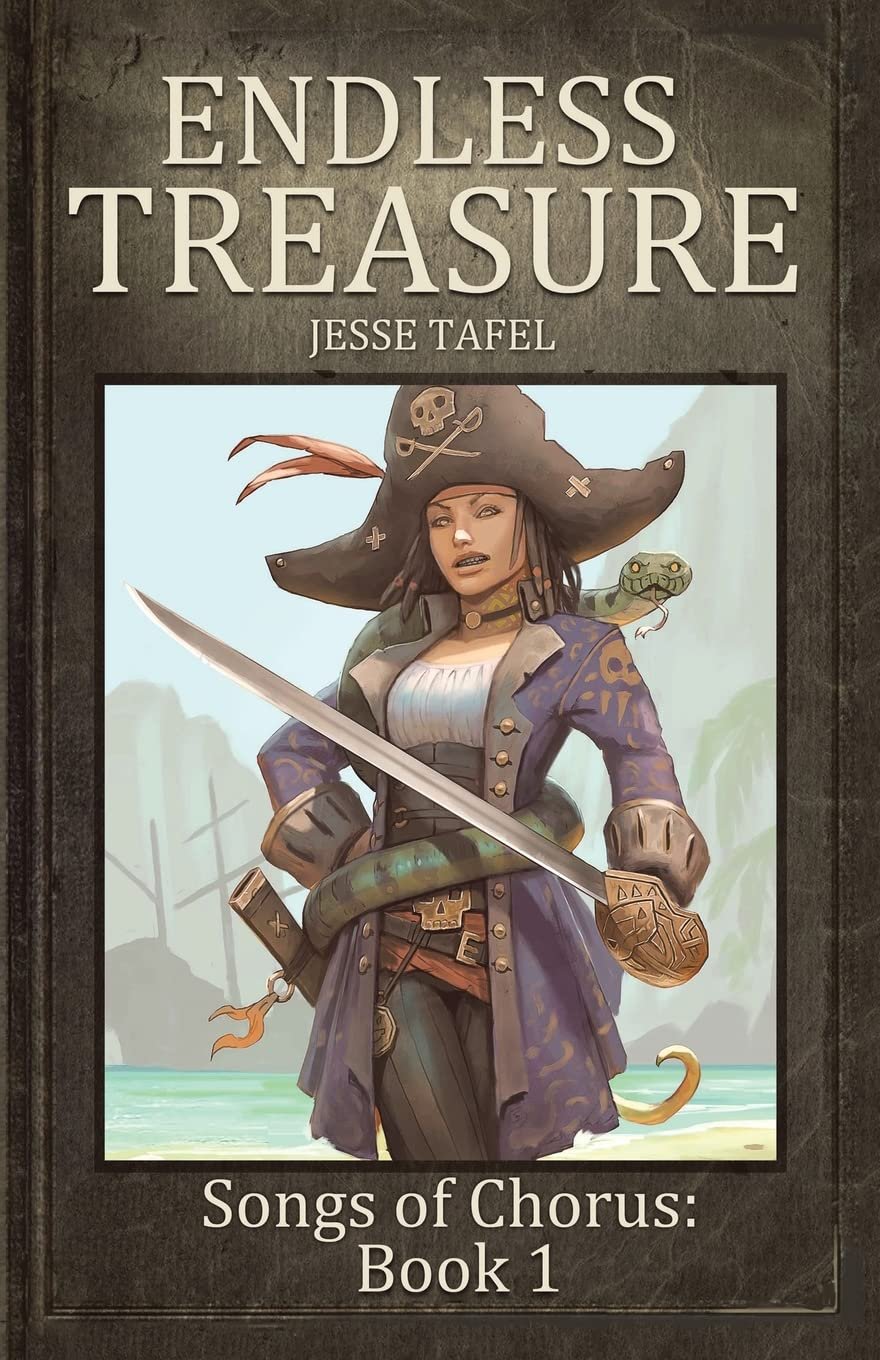
An endless supply of treasure sounds like the easiest possible answer to an adventure story's central desire. If a chest can never be emptied, what remains difficult about finding it? Jesse Tafel's Endless Treasure: Book One of the Songs of Chorus places that question on Bowyang Island, where a shipwrecked prince, companions with unusual gifts and dangerous pirates all circle a legendary prize. The verified publisher description offers a lively mixture of seafaring peril and fairy-tale invention. It also leaves the outcome open, which is exactly where an introduction to the story should leave it.
An editorial introduction to the book and its published premise, not a full-book review.
Shipwreck as an invitation to the unknown The book begins, according to its retailer description, with teenage Prince Maxwell shipwrecked on Bowyang Island. That premise does more than transport a character from one geographical point to another. A prince is ordinarily associated with inherited position and recognizable structures of power; a castaway must deal with a place that may not recognize any of those advantages. This is an interpretation of the advertised setup, not a claim about Maxwell's internal monologue. Readers of island adventures will recognize the immediate dramatic opportunity: unfamiliar ground makes even basic decisions into discoveries.
Bowyang is not offered as an ordinary remote island. The public synopsis promises talking trees, gorillas and mermaids, as well as a dangerous company of pirates. That combination signals a world where the rules of nature and the rules of social life may differ from those a traveler expects. Fantasy can turn the work of learning a place into something more visible and playful than realism allows.
Companions whose knowledge is uneven Maxwell is joined by Eddison, identified as a native of the island who knows nothing about his earlier life or how he came to be there. The apparent contradiction is intriguing. Someone may understand a landscape while remaining a mystery to himself. Such a companion offers a different kind of knowledge from the prince's presumed familiarity with life elsewhere. Their relationship is one of the reasons to approach the book as a character-driven quest as well as a search for an object. Exactly how their trust develops belongs to the novel, not to an advance description.
The third named companion is Marinus the Waterbender, presented as wise and thrill-seeking. Those qualities create another useful contrast. Wisdom often implies caution, while the pursuit of a thrill suggests an appetite for uncertainty. Combining them in one character promises a more flexible guide than a purely solemn elder or a purely reckless adventurer. Readers may enjoy watching how a party balances eagerness, experience and incomplete knowledge.
A prize that refuses to run out At the center of the journey stands King Azurpah's chest, described as containing a bottomless supply of gold and jewels. The description is unusually precise: treasure can be removed, and the chest replenishes itself. In an ordinary treasure hunt, scarcity gives the sought object its value. Here the very absence of scarcity raises a different kind of puzzle. What happens when something desirable is not limited by quantity? The publisher calls the treasure cursed, but the source does not explain the curse's mechanism or effects. It would spoil the mystery—and mislead the reader—to supply an answer.
A perpetually refilling chest can also be read as a test of motives. Is the quest about prosperity, prestige, rescue, curiosity or the power attached to possession? The description does not say which purpose dominates Maxwell's thinking. Yet the premise makes those questions worth considering before the first page. Adventure fiction often places an apparently simple object at the intersection of many competing desires.
Pirates and pressure from outside The crew of bloodthirsty pirates is led by Captain Anne Belle, described by the publisher as unhinged. Her presence ensures that the party is not exploring in a vacuum. An opposing group can change the pace of a quest by making delays, disagreements and discoveries suddenly costly. The synopsis asks whether Maxwell and his companions will obtain the treasure or be stopped by the pirates. It does not specify how frequently they clash or which tactics each side uses. The promise is one of contest, not a confirmed account of individual battle scenes.
There is a familiar attraction to maritime fantasy in the meeting of two forms of danger: the sea itself and people with their own plans. A coastline can be beautiful and lethal; a pirate ship can be both a vehicle of adventure and a threat. The talking trees and mermaids complicate those expectations by ensuring that not every encounter fits a standard nautical model. The resulting tonal blend, at least from the advertised premise, is expansive rather than narrowly historical.
The first installment and its open horizon The subtitle identifies this as Book One of the *Songs of Chorus*. That designation can help a reader choose how to approach the story. The trip to a legendary chest may have its own immediate stakes, while the larger series title suggests room for a world beyond one expedition. No source reviewed here confirms which threads are completed by the ending, so it would be premature to promise either a perfectly self-contained conclusion or a specific cliffhanger. The best preparation is to enjoy the discoveries without assuming that every question will be settled at once.
The length listed by the Google Play and Apple Books entries is 174 pages for the identified ebook edition. That context suggests a compact fantasy adventure, although pacing cannot be determined from page count. For some readers, an approachable scale is a benefit: the quest is easy to grasp and the principal companions can be named without a long lineage chart. For others, the deciding factor may be whether the playful inventory of fantastical inhabitants suits their taste. The description strongly favors imaginative adventure over a grimly realistic voyage.
What makes this particular treasure hunt distinctive Three verified elements give the book its identity: a displaced teenage prince, a companion with an unknown past and an artifact that seems to overturn ordinary economic logic. Marinus and Captain Anne Belle add mentorship and opposition to that arrangement. None of those elements needs to be inflated into a claim of literary revolution. Their interest is in the combinations. An island where animals speak could become merely whimsical, but a dangerous pursuit forces its wonders to share space with decisions and consequences. A bottomless chest could end a quest instantly, but a curse restores uncertainty.
For readers drawn to young adventurers, magical settings and pirate stories, the publisher's description supplies enough concrete orientation to decide whether to sample the opening. Those who prefer detailed magic-system explanations or complex political fantasy should check the sample before assuming those features are present. Endless Treasure is most accurately presented as an imaginative expedition with a clearly stated prize and an unresolved result. The joy of the invitation is that the route to the chest may matter at least as much as the riches inside it.
About the book.
Prince Maxwell, Eddison and Marinus seek King Azurpah’s cursed, endlessly replenishing treasure on Bowyang Island, encountering magical inhabitants and pirates.
Non-sponsored Book Feature based on the queue record and cited public materials; this is not a full-book review. Interpretive observations are distinguished from the publicly documented synopsis. Verify all copy before publication. Source research: primary reference and second reference.
Found a book worth opening?
Books worth discovering. Authors worth knowing.
Return to the Journal →