
FEAR
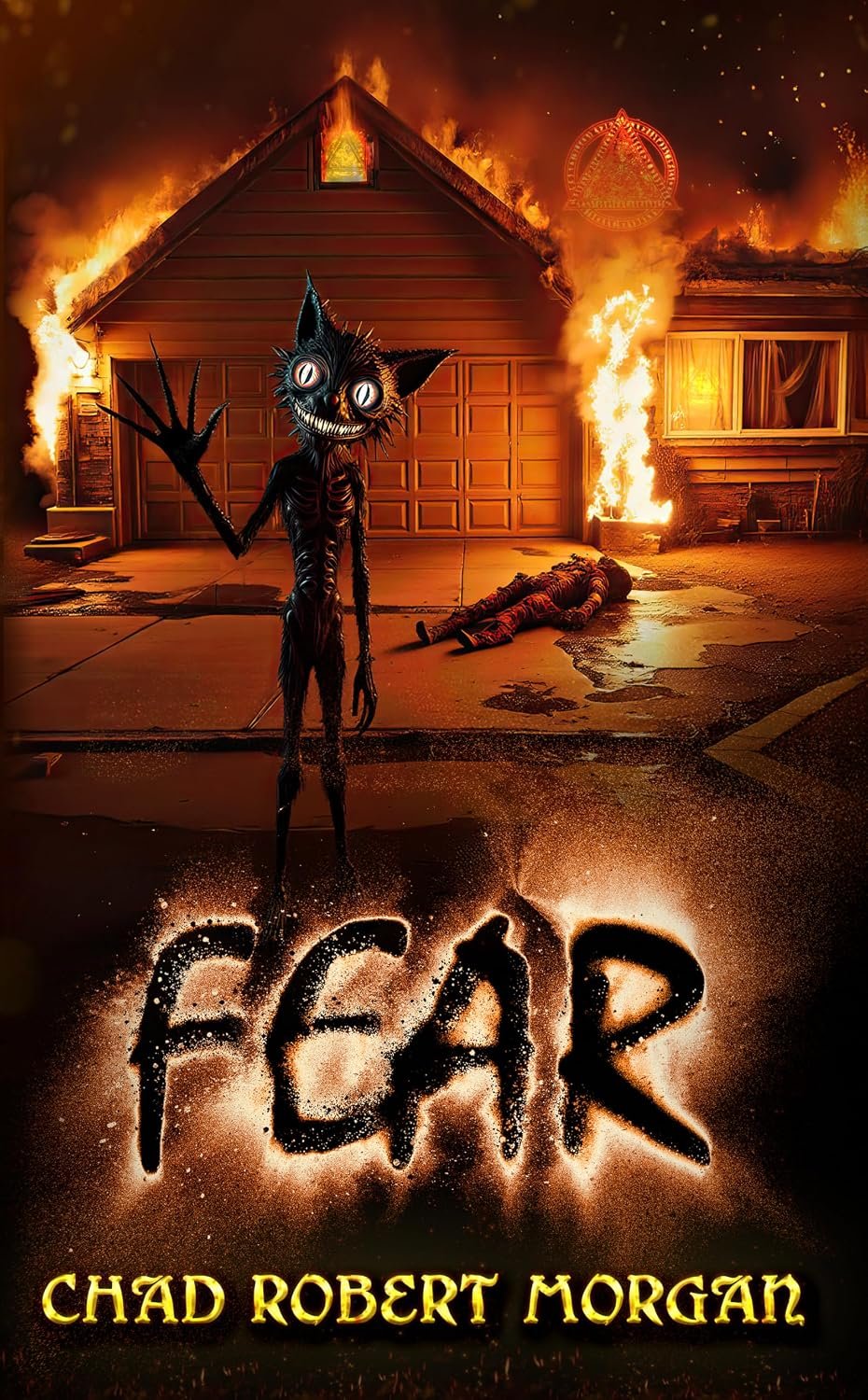
A desert legend becomes deadly after a fire forces a supernatural presence into a community.
Books worth discovering. Authors worth knowing.
A desert legend becomes deadly after a fire forces a supernatural presence into a community.
The third Last Rite horror installment follows the consequences of disturbing the Demon of the Desert and asks what happens when nightmares invade daily life.
The first frightening thing about FEAR is not its monster. It is the ease with which people learn to treat a warning as part of the landscape. In Chad Morgan’s third Last Rite book, children grow up with a tale about the Demon of the Desert. The local rule seems simple: leave the creature alone and it will leave you alone. Then a reckless act changes the land itself, and the story can no longer remain a comforting explanation of what might be hiding beyond familiar streets. This book feature examines the premise and its horror possibilities rather than claiming a full-text critical reading.
When an old warning becomes an immediate threat
The official audiobook description supplies an unusually economical premise: an urban legend, an act of eco-terrorism, and a supernatural presence driven into the community when its former territory burns. Those details give the story a distinctive entry point. A demon does not simply arrive from nowhere; an act that destroys the desert creates the conditions for people to discover what they had been dismissing. The visible relationship between damaged habitat and displaced danger invites a reading of consequence without requiring the story to be reduced to an environmental fable. Supernatural horror works differently when a disaster helps open the door.
The distinction between what is known and what can be inferred matters. The public synopsis identifies the demon, the damaged land, and nightmares entering everyday reality. It does not establish every character’s name, the identity of the people responsible, or the final confrontation. What the available description does establish is an escalating community crisis. The danger spreads from house to house. Fear becomes an experience shared across a neighborhood, not an isolated encounter in a remote place. That broadening of scale gives readers a reason to anticipate interpersonal tension alongside the monster itself.
A title that operates on two levels
FEAR is both the book’s title and the force characters must overcome. That directness is useful in horror. A creature may have teeth, shadows, or a voice, but the emotional mechanism that allows it to dominate a community is often less tangible. When residents begin to imagine that the ordinary boundaries of their homes are unreliable, daily decisions become tests of nerve. An unexplained sound, an empty room, or a neighbor’s hesitation can turn into a question about whom to trust. This is a reader-oriented account of the setup, not a report of unverified individual scenes.
The synopsis says nightmares bleed into reality, a phrase that suggests the weakening of one of the mind’s most reassuring distinctions. People ordinarily wake from bad dreams and regain control over what counts as real. A narrative that threatens that separation attacks a basic source of security. Readers drawn to psychological as well as supernatural horror may find this overlap compelling, particularly if they prefer stories in which emotional pressure is as consequential as the pursuit of an external enemy. The title prepares them to think about a feeling as more than a reaction; it is the battlefield.
The desert and the town
A desert can signify openness, endurance, and isolation at once. For people who live near it, however, the surrounding landscape is also a place with its own histories and customary rules. The premise of an inherited local warning makes that relationship important. A legend is one way a community explains the danger beyond what it can verify. Whether the warning is historically true is beside the point until the conditions change. The rupture caused by the fire forces the town to reconsider what its residents thought they knew, and what they ignored because belief was inconvenient.
This pairing creates two kinds of accountability to watch for while reading. The first concerns the human act that scorches the land. The second concerns the collective habit of laughing away warnings until they become impossible to ignore. Neither concern should be mistaken for a claimed moral delivered by the novel; it is a way to understand why these premises work together. The result is more interesting than a simple creature-loose-in-town scenario because the setting and the trigger are part of the story’s structure. Catastrophe produces a change of territory, and territory becomes personal.
Book three without inventing the earlier story
FEAR is identified in the queue and in the audiobook catalog as The Last Rite, Book 3. That series position may matter to readers who enjoy a connected supernatural world. It does not automatically prove that this particular threat depends on every event from the first two volumes. A newcomer should consult the series listing to decide whether to begin here or first explore the earlier books. Conversely, existing readers may value seeing how Morgan uses another manifestation of dread while remaining within the larger Last Rite banner.
Horror series can offer continuity through atmosphere, shared supernatural rules, recurrent themes, or recurring characters. The public descriptions available for this entry do not justify claiming which device dominates FEAR. That uncertainty is worth acknowledging rather than filling with invented mythology. What is confirmed is a specific narrative situation: a desert legend crosses into human dwellings after ecological violence, and a community must confront its fear. That is enough to make a grounded introduction and to explain why the third installment occupies a recognizable part of the genre.
Who might want this book
This is a promising selection for readers who gravitate toward modern urban legends, invasive supernatural threats, and frightening stories that transform a familiar environment into an unsafe one. Its appeal may be especially strong for those who like escalating communal danger rather than the lone protagonist trapped in a house. The interplay of perceived and actual threat suggests room for suspense that does not depend entirely on action. Readers seeking gentle speculative fiction, on the other hand, should note the disturbing supernatural premise and emphasis on terror before selecting it.
The book’s audiobook edition is narrated by Chad Robert Morgan, according to Audible, and its official synopsis provides a useful check on the narrative’s identity. Listening could be one possible route to experience the story, although the queue’s Explore button intentionally preserves the original Amazon book link rather than redirecting to a different format. Edition details and availability should be checked on that original listing. This feature does not pretend that a synopsis substitutes for the complete manuscript, nor that a narrator credit establishes the prose’s effectiveness.
What to notice while reading
A useful reading question is how the residents’ relationship with the legend changes once the threat reaches their homes. Another is whether the initial human disruption continues to shape their choices after fear takes hold. The eventual resolution is not disclosed by the available public description, so those are invitations to read closely rather than promises about events. Think also about how the book balances danger to individuals with danger to the wider community, and whether the title’s emotion remains a weakness or becomes something characters learn to face with greater clarity.
By building its hook from a specific place, a destructive act, and a haunting that will not stay confined to dreams, FEAR offers a compelling premise for supernatural-horror readers. Chad Morgan’s third Last Rite title is best introduced on those verified terms: not as a review assigning a verdict without reading it, but as an informed invitation to explore a disturbing story about what happens when a community’s oldest warning stops sounding like folklore.
About the book.
The third Last Rite horror installment follows the consequences of disturbing the Demon of the Desert and asks what happens when nightmares invade daily life.
Independent MarketAnyBook editorial book feature. This feature is based on identified public research sources, not firsthand reading or a star rating. WordPress image media will be resolved by the publisher.
Found a book worth opening?
Books worth discovering. Authors worth knowing.
Return to the Journal →