
FRACTALS
A personal collection about spiritualism framed by a metaphor of patterns, repetition, and reflection.
Books worth discovering. Authors worth knowing.
A personal collection about spiritualism framed by a metaphor of patterns, repetition, and reflection.
The subtitle explicitly frames personal thoughts on spiritualism; specific chapters and metaphysical claims unverified.
A title that finds patterns in personal thought
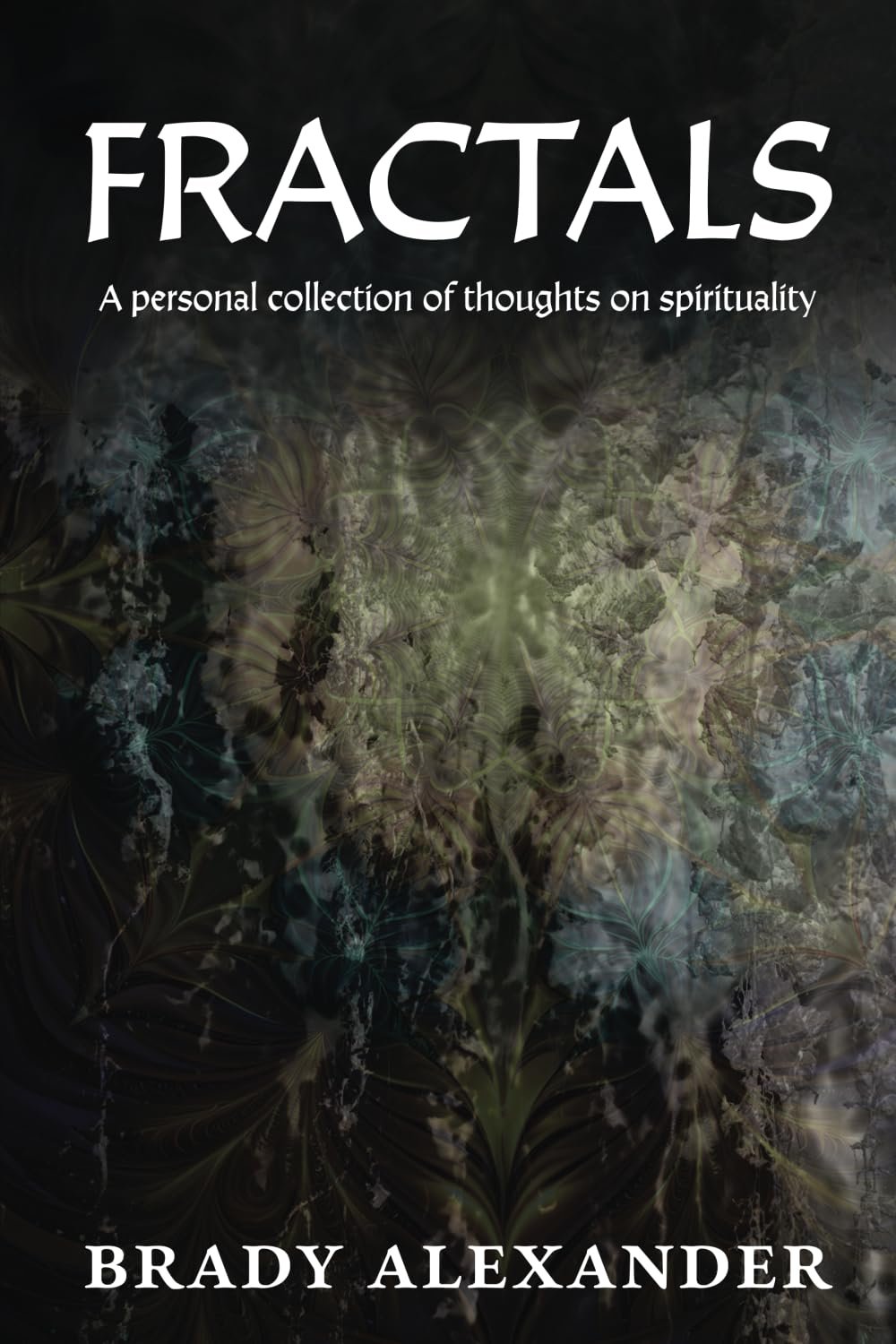
FRACTALS: A personal collection of thoughts on spiritualism by Brady Matthew Alexander is presented in the MarketAnyBook queue as an independently available book with an explicit subtitle. The words “personal collection” and “thoughts on spiritualism” are the strongest evidence about its intended territory. They suggest an individual reflective project rather than a mathematics textbook, although the available records do not disclose the actual contents or chapter structure. The verified cover adds an atmospheric image: dark, densely layered forms that look organic, branching, and partially obscured, with the title in large white lettering. This Journal feature introduces the book through its documented identity, its chosen metaphor, and the questions that metaphor raises—not through imagined quotations from unseen pages.
The word “fractals” comes from mathematics, where many fractal structures show complexity and patterns repeated or echoed at different scales. Its use in a personal reflection on spiritualism can therefore suggest the relationship between large questions and small experiences. But there is an important distinction between a mathematical concept and a spiritual claim. The title alone does not demonstrate that Alexander explains fractal geometry, argues for a particular metaphysical theory, or assigns specific spiritual meanings to scientific formulas. In this feature, the connection is an interpretive starting point, not a report on a thesis the author has been proven to advance.
Why repetition is a powerful metaphor
People often return to the same questions at different moments in life. What seemed clear in youth may look complicated after loss, work, parenthood, or change. A familiar thought can recur while carrying new meaning because the person asking it has changed. The metaphor of a repeating pattern can express that experience elegantly. It is easy to see why a writer considering spiritual matters might be attracted to the word “fractals.” Yet saying that is different from asserting that any specific life episode appears in Alexander’s collection. The publicly visible subtitle supports a discussion of personal reflection, but not an invented biography.
Patterns can be comforting or troubling. A recurring routine may create continuity; a repeated difficulty may prompt a person to reconsider inherited assumptions. In spiritual writing generally, repetition can appear through ritual, meditation, questioning, or the return of an image. These broad observations explain the metaphor’s possible appeal without attributing particular practices to this book. Readers approaching FRACTALS should allow the author’s own language to define how, or whether, pattern becomes a central idea. Not every title is an exact guide to a book’s internal organization.
Reading the cover as a visual invitation
The supplied cover favors texture over literal explanation. Greenish and dark forms overlap in an almost forest-like or mineral surface, and the eye can find smaller shapes within larger masses. This complexity suits the title visually: the design encourages lingering and looking again. However, the image does not prove that the collection discusses nature mysticism, sacred geometry, a specific religion, or any named supernatural phenomenon. A cover may suggest a feeling rather than encode the book’s arguments. The safest description concerns what can actually be seen—the intricate patterning and atmospheric palette—not what a commentator imagines hidden beneath it.
The bold uppercase typography contrasts with the subtler subtitle. The main title asks for attention; the line underneath establishes a personal, reflective frame. That relationship is a useful clue for the prospective reader. A work described as personal thoughts should be approached differently from a systematic introduction to the history of religion or an academic account of consciousness. Individual reflection can be exploratory, provisional, and inconsistent by design. Whether Alexander writes in that way can only be established by reading the work itself. The packaging signals intimacy of perspective without supplying evidence of any specific conclusion.
Spiritualism, spirituality, and careful language
The subtitle uses the word “spiritualism,” which has several meanings in ordinary conversation. Sometimes it is used loosely for personal spiritual inquiry; in more specific historical settings, Spiritualism names movements concerned with purported communication with spirits. A feature should not decide which meaning Alexander intends without evidence. Nor should it imply that the book offers medical advice, verified paranormal findings, or scientific proof of any religious worldview. The responsible course is to repeat the author’s stated subtitle accurately and leave its precise conceptual boundaries to the text.
This distinction is particularly important online, where search results often combine religious writing, mathematical fractals, meditation material, and unrelated books bearing the same title. A reader interested in the historical Spiritualist movement may have different expectations from someone looking for meditative personal essays. The linked edition is the authoritative object of discovery. Before assuming that a book serves a particular purpose, readers can look for a publisher description, contents page, or preview that clarifies how the author uses the term. That small act of verification helps a book reach the readers for whom it is actually intended.
What personal reflective writing can offer
A collection of personal thoughts invites a different kind of engagement than a step-by-step argument. Readers may look for moments that articulate a question they have carried privately, or for ideas that challenge a settled assumption. At its strongest, reflective prose can create a conversation rather than a final answer. That is a property of the form, not a verified verdict on Alexander’s achievement. Without access to the prose, the Journal cannot judge whether the writing is concise, lyrical, argumentative, conversational, or formally experimental. It can only identify the reading posture that the subtitle makes reasonable.
An open reader can pay attention to how experience and interpretation are separated. Does an author describe an event before explaining what it might mean? Are uncertainties acknowledged? Does a claim rest on personal testimony, comparison, faith, or argument? These questions are valuable when reading any material about spiritual matters because they distinguish the experience being reported from conclusions drawn about the wider world. They are not accusations or endorsements. They give readers tools for thinking alongside the text while maintaining their own standards of evidence.
The mathematics behind the metaphor
In mathematics, a fractal is not simply any beautiful repeated image. Many familiar fractals involve recursive procedures or patterns that reveal complexity at different scales; actual definitions vary depending on context. The idea has influenced art and popular imagination because it makes structure visible in unexpected places. A personal book titled FRACTALS may draw upon that cultural richness, but the subtitle tells us its stated focus is spiritual reflection. Readers should avoid confusing metaphorical use with a lesson in fractal dimension or an argument that mathematical patterns validate supernatural beliefs.
That distinction makes the book potentially interesting even without a detailed synopsis. A metaphor can bring scientific language into conversation with inward experience without claiming that the two are interchangeable. It can also become a provocation: are the shapes we perceive in our lives really patterns, or are we imposing order on chance? Such questions are part of the wider intellectual territory evoked by the title. They are not claims that Alexander answers them in specific chapters. The actual collection may use the term quite differently, and that possibility should remain open.
How to make an informed discovery
The most useful next step is to follow the precise edition attached to the MarketAnyBook entry, confirm the Brady Matthew Alexander attribution, and examine any available preview. Look for how the author introduces the project. Does “fractals” refer to repeating personal experiences, artistic structure, spiritual practice, or something else entirely? Does the writing proceed through separate meditations or a continuous argument? These questions cannot be answered from the cover alone, but they give readers a concrete way to assess the book once it is in hand.
FRACTALS is best introduced as a title with a clear personal subtitle and an intriguing visual concept, not as a book whose unverified internal claims can be confidently summarized. It may appeal to readers interested in reflective writing, metaphor, and questions of meaning, provided they understand that this is a discovery invitation rather than a critical review. The value of this Journal entry lies in accurate identification and a thoughtful reading framework. The words that determine what the collection actually says remain the author’s, and the reading experience begins with the text itself.
About the book.
The subtitle explicitly frames personal thoughts on spiritualism; specific chapters and metaphysical claims unverified.
Sponsored book feature according to the MarketAnyBook Journal Queue. Limited-source editorial spotlight: verified publication details and visual interpretation, not a firsthand review, rating, plot synopsis, or claim about unseen text. WordPress cover media are resolved by the publisher.
Found a book worth opening?
Books worth discovering. Authors worth knowing.
Return to the Journal →