
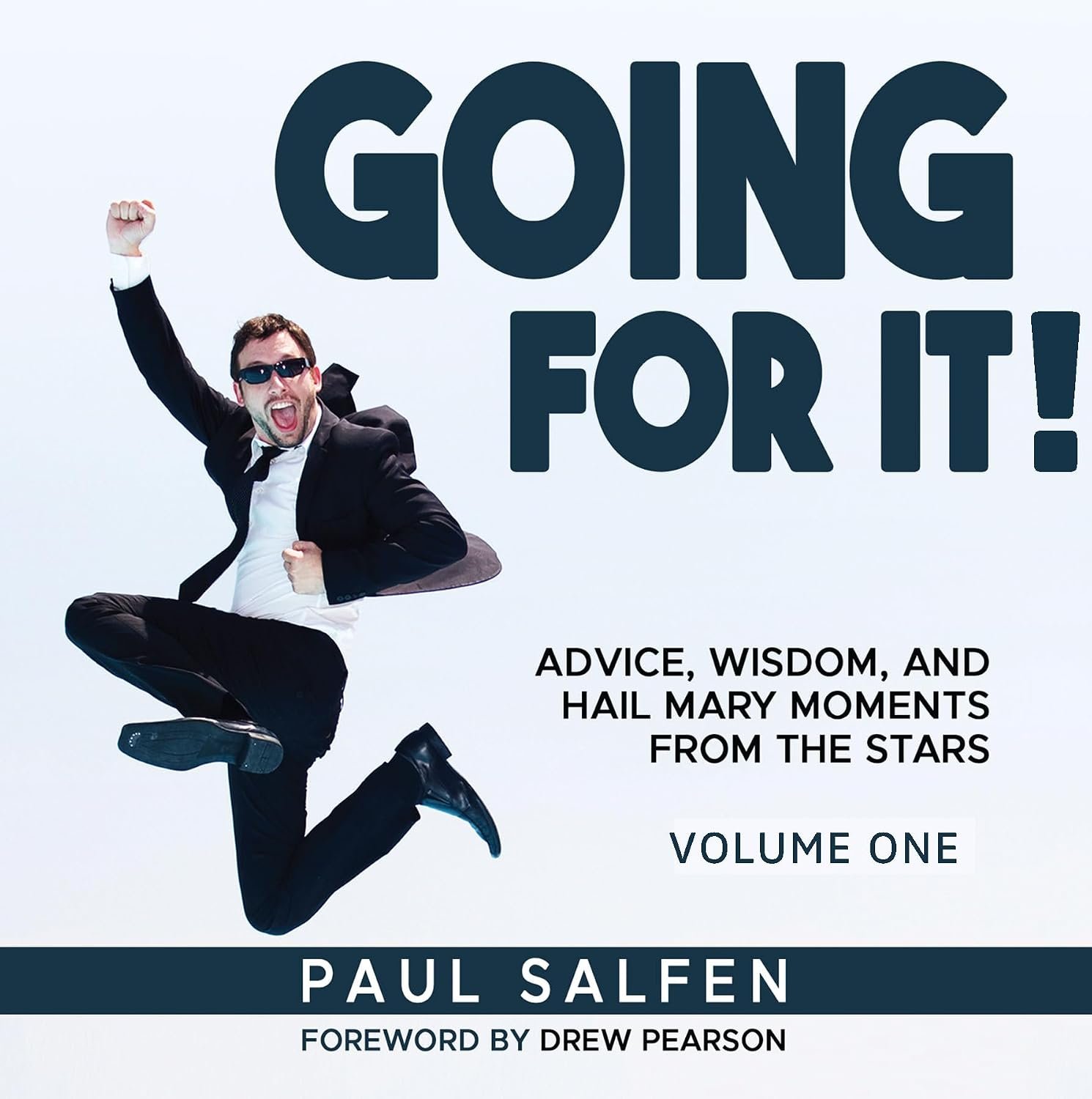
Going for It
Paul Salfen brings together interviews with stars about decisions, perseverance and career turning points.
Books worth discovering. Authors worth knowing.
Paul Salfen brings together interviews with stars about decisions, perseverance and career turning points.
An inspirational collection of advice, wisdom, and long-shot Hail Mary moments from figures in sport, entertainment and business.
Big career decisions are easier to admire after the person who made them has succeeded. Paul Salfen’s Going for It: Advice, Wisdom, and Hail Mary Moments from the Stars turns attention toward those earlier, more uncertain moments. Drawing on interviews with figures from film, music, sport, business, and public life, the book brings together stories and reflections about ambition, resilience, and the decision to act without a guaranteed outcome. Rather than presenting success as a mysterious talent reserved for famous people, Salfen’s project asks what readers can learn from the difficult choices behind visible achievements. That premise is grounded in the publisher’s listing and the author’s own media project.
Behind the moment of recognition
Salfen is a longtime interviewer and media host who has encountered people at widely different stages of their careers. The publisher describes the book as a collection of conversations, quotes, and stories from recognizable names, including performers, athletes, entrepreneurs, and entertainment figures. Such a range can help reveal how achievement looks different across disciplines. The actor’s challenge may involve risk and rejection; the athlete’s may involve disciplined repetition and a decisive competitive moment; the entrepreneur’s may involve committing to an idea when the outcome is unclear. Those are comparisons that a reader can consider without assuming each contributor gives the same advice.
The book is not best approached as a technical manual for entering any one profession. Its organizing interest is the decision-making process behind forward movement. That subject crosses fields because people everywhere face uncertainty about timing, preparation, and the possibility of failure. Famous guests make the material immediately recognizable, but the more useful question is whether a lesson remains meaningful when the reader strips away the celebrity’s resources, connections, and eventual fame. Inspiration becomes practical only when translated into circumstances that differ significantly from the original story.
Why a Hail Mary moment is a useful metaphor
The title borrows a phrase associated with a long-shot football play. In the book’s public history, former Dallas Cowboys player Drew Pearson contributed a foreword and participated in defining these decisive moments through conversations with Salfen. The metaphor captures a particular experience: reaching a point where preparation may have brought someone close, but a further leap remains necessary. That leap is not the same as carelessness. A successful story told afterward can make a risky choice seem inevitable, even though the person involved could not know the ending beforehand.
Readers should be alert to that difference between a decision and its retrospective explanation. When someone famous talks about the break that changed everything, the story may emphasize a dramatic yes or no. Real choices also involve smaller steps, unglamorous preparation, and support from people who never appear in the headline. The metaphor is most useful when it encourages thoughtful courage rather than indiscriminate risk-taking. A Hail Mary moment becomes meaningful because something important is at stake, not because an uncertain bet is automatically wise.
Three kinds of material in one collection
A publicly available table of contents and publisher information distinguish advice, wisdom, and Hail Mary moments as major strands of the book. These labels suggest different ways to read. Advice usually concerns actions one person recommends to another. Wisdom is more reflective, shaped by experience and reconsideration. A decisive-moment story gives the emotional and situational context in which beliefs were tested. The separation can be useful: someone might admire a guest’s courage while deciding that their precise career strategy would not translate to a completely different life.
This is also a reason to treat an anthology of interviews as a conversation rather than a single theory. Different guests may prioritize incompatible values or have taken contrasting routes to success. No responsible feature should invent quotations or attribute specific statements to particular celebrities without checking the page. What is confirmed is the work’s method of drawing insight from numerous interviews. The reader’s task is to notice patterns, exceptions, and ideas worth revisiting. The book’s breadth is an invitation to compare perspectives, not to assume there is one secret formula.
Fame does not cancel ordinary uncertainty
Public recognition can obscure how many years of effort, mistakes, opportunity, and adjustment preceded it. That makes interviews about turning points appealing: they can restore a sense of process to stories usually packaged as sudden triumph. Salfen’s background gives him a vantage point from which to ask people how they reached their positions. Yet the reader should avoid the opposite simplification, in which every famous person is treated as proof that anyone can obtain the same result through confidence alone. Structural advantages, chance, and unequal access also shape outcomes.
The most constructive way to read Going for It is therefore neither uncritical hero worship nor cynical dismissal. Treat stories as individual cases that may illuminate perseverance, creativity, collaboration, or courage. Then ask what conditions supported the choice and what costs were involved. Even a widely admired success can offer lessons more nuanced than work harder. Sometimes a story encourages asking for help, recognizing a timely opportunity, adjusting expectations, or persisting through an uncelebrated stage of development. Those are reflections prompted by the book’s format, not claims about specific unverified interview answers.
A format designed for dipping in and returning
The publisher’s listing identifies the book as a sizeable illustrated interview and inspirational collection, not a tightly plotted narrative that must be consumed in one sitting. That makes it naturally suited to browsing by theme or reading a few entries before returning later. Readers may find it useful to keep a small record of insights that resonate, especially when two speakers seem to disagree. Not every example needs to feel personally relevant. A musician’s defining moment can interest someone in business without serving as a direct blueprint for a commercial decision.
The title is also part of a broader Going For It media project that continued beyond the book. The project site describes interviews and inspirational stories, including later faith-oriented programming. Readers should distinguish the queued 2024 book from subsequent editions, related initiatives, or promotional material. The Amazon URL in the Journal file points to the particular listed volume. This matters whenever someone is comparing subtitle variations, publication information, or what material is included in a given format.
Who will appreciate the book
Going for It is aimed at readers who enjoy oral-history style interviews, memorable career anecdotes, and reflection on decisions that test commitment. It may suit students thinking about future paths, professionals considering a change, and readers who simply enjoy hearing how public figures describe their work. It is less suitable as a substitute for detailed occupational training, financial planning, or specialized coaching. Its emphasis is broad motivation made concrete through human stories. Whether any individual example becomes actionable depends on the reader’s goals and the context they bring to it.
An engaging way to approach the collection is to ask three questions after each interview: What choice did the person actually control? What lay outside their control? And what lesson survives when fame is taken out of the picture? These questions protect the reader from confusing an inspiring outcome with a universally replicable process. Paul Salfen’s Going for It offers a distinctive invitation to listen for the decisions beneath the headlines. Its value as a research-based book feature lies in that verified promise: many voices, memorable turning points, and a chance to think more carefully about what it means to move toward an uncertain goal.
About the book.
An inspirational collection of advice, wisdom, and long-shot Hail Mary moments from figures in sport, entertainment and business.
Sponsored book feature according to the MarketAnyBook Journal Queue. This feature is based on identified public research sources, not firsthand reading or a star rating. WordPress image media will be resolved by the publisher.
Found a book worth opening?
Books worth discovering. Authors worth knowing.
Return to the Journal →