
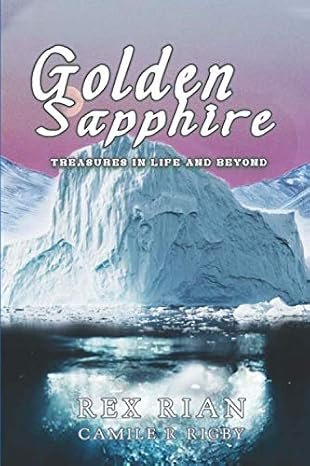
Golden Sapphire: Treasures in Life and Beyond
Austin Davis and Taylor Shaffer cross spectacular landscapes in a speculative quest shaped by sacrifice and spiritual questions.
Books worth discovering. Authors worth knowing.
Austin Davis and Taylor Shaffer cross spectacular landscapes in a speculative quest shaped by sacrifice and spiritual questions.
A series-linked speculative adventure following Austin Davis and Taylor Shaffer across physical and spiritual frontiers.
A journey whose geography is also spiritual
*Golden Sapphire: Treasures in Life and Beyond*, credited to Rex Rian and Camile Rigby, joins far-flung travel with an explicitly metaphysical search. An audiobook description identifies Austin Davis and Taylor Shaffer as figures whose journey takes them from southwestern Colorado toward Antarctica and through imagery invoking the Tree of Life and the depths of Hell. It describes spiritual ascension, sacrifice and the struggle to save one another and a wider world. These are substantial story coordinates, but they are not a license to invent individual scenes, conversations or the ultimate resolution. The most distinctive invitation is the conjunction of physical distance and inward change: movement across a map becomes a way of approaching questions that cannot be settled by geography alone. The subtitle is revealing because it combines the ordinary word “treasures” with two categories, life and beyond. It signals a story interested in value beyond possessions or victory. What, for example, deserves to be kept when a person changes? What obligations follow from discovering something that feels larger than the self? The source description establishes self-sacrifice as a central dilemma for Austin and Taylor, making these questions more than decorative philosophy. A reader approaching this volume might expect high-stakes speculative storytelling with an emphasis on connection and spiritual transformation, rather than a straightforward expeditionary thriller with a strictly material prize.
When two journeys become one question
The described pairing of Austin Davis and Taylor Shaffer creates an immediate relational center. A spiritual quest can become abstract if it depends only on systems of symbols or grand claims about existence. Two people making difficult choices for each other bring such questions into a human frame. The provided synopsis speaks of learning to sacrifice themselves to save one another and the world at large. That does not tell us the precise mechanism of sacrifice or who faces which decision. It does establish that personal attachment and a larger responsibility are intentionally connected in the novel’s design. Readers may find it useful to distinguish selflessness from self-erasure when interpreting this sort of premise. Fictional sacrifice may be heroic, tragic, misguided or some combination, and the power of a story often lies in making those possibilities difficult to separate. The phrase “separation of self and other,” used in the audiobook overview, points toward an inquiry into identity itself. Does love require the disappearance of boundaries, or does it demand respect for another person’s distinct existence? Those are interpretive questions prompted by the bibliographic synopsis. This feature does not attribute a definite philosophical answer to pages it has not examined.
The symbols of ascent and descent
A Tree of Life, the depths of Hell and the idea of spiritual ascension draw on long traditions of mythic and religious imagery. Their presence in the book’s description signals a symbolic register that may be especially appealing to readers of philosophical fantasy. Yet those symbols do not belong to one simple tradition, and their precise meaning here cannot be settled from a short sales description. The promising critical approach is to notice how they frame contrasting movements: up and down, connection and separation, preservation and relinquishment. A journey to Antarctica adds a different form of extremity, an environment associated in the popular imagination with isolation and elemental exposure. That interplay between landscapes and metaphysical language may give the book a notably wide canvas. It is possible for a story to place the largest existential questions in the starkest physical places, inviting a reader to consider what ordinary habits fall away under pressure. But a feature should not assume particular visions, supernatural encounters or revelations without verification. The reliable facts are the stated locations, named protagonists and broad spiritual stakes. The richer contribution of commentary is to show why those ingredients might attract readers who enjoy adventure with speculative dimensions and an interest in the meaning of connection.
Finding the right reading expectations
The audiobook listing places *Golden Sapphire* within the *Golden Copper* series as book three. That is useful orientation: readers who dislike entering an ongoing fictional world midway through may wish to investigate the preceding installments first. A series position does not automatically mean every earlier volume is indispensable, and the available evidence does not establish whether this installment can stand wholly alone. What it does establish is a wider creative context for Rex Rian and Camile Rigby’s collaboration. The core promise of the identified title is not solely action; it is the encounter between emotional bonds and speculative inquiry. Stories framed around spiritual progress can invite very different responses. Some readers want their fictional world to explain a coherent metaphysical system. Others value ambiguity and allegorical possibilities. A fair editorial approach leaves space for both preferences. It would overstate the evidence to claim that this volume convincingly resolves every question it raises, or that it represents any established religious doctrine. More useful is to identify its declared interests and the style of reading they suggest: alertness to metaphor, willingness to consider sacrifice as a narrative puzzle, and patience for questions that may be larger than the immediate itinerary.
Following the meaning rather than chasing a map
Readers encountering *Golden Sapphire* after other installments may bring expectations shaped by a continuing spiritual mythology. Those discovering it in isolation have a different task: identifying what the official blurb actually promises without filling the silence with imagined lore. Austin and Taylor, the extremes of location and the stated willingness to sacrifice form the secure narrative frame. Treating that frame as the beginning of inquiry rather than a complete synopsis respects both the authorial work and the reader’s right to encounter its turns firsthand. Even the title invites multiple possible readings, and the book rather than promotional speculation should determine which one proves central. An adventurous novel can use movement to make internal change visible. Distance traversed may mirror an altered sense of duty, and a perilous destination may dramatize a conflict that began much closer to home. Those are possibilities available to fiction in general; here they are especially apt questions because the identified synopsis pairs dramatic geography with spiritual ascent. The strength of the premise lies in refusing a simple separation between the love of one person and concern for a world beyond them. Its answers, however, remain for the book itself to reveal.
Who may want this sapphire
Readers drawn to metaphysical adventures, symbolic settings and the meeting of love with world-scale stakes may find *Golden Sapphire* intriguing. Those who appreciate journeys that cross ordinary geographic boundaries and conceptual ones are especially likely to be interested. It is less likely to satisfy someone seeking rigorously documented spiritual instruction or a realist travelogue, because the available source identifies the work as fiction. Newcomers should note its position in a series before purchasing. Above all, this is a title for readers happy to think about the meanings attached to adventure, rather than only the number of obstacles encountered along the way.
About the credited collaborators
The official queue credits Rex Rian and Camile Rigby; third-party audiobook and bibliographic listings independently associate both with *Golden Sapphire*. Audible’s listing names it the third book of the *Golden Copper* series. Detailed author biographies or claims about a specific spiritual background are not needed for this feature and have not been inferred.
About the book.
Metaphysical adventure fantasy / philosophical speculative fiction. A series-linked speculative adventure following Austin Davis and Taylor Shaffer across physical and spiritual frontiers. Research-based editorial feature, not a firsthand review.
Independent editorial book feature. Research-based commentary using verifiable published sources, not a claim of a complete firsthand reading. Cover placeholders await the owner’s Python automation.
Found a book worth opening?
Books worth discovering. Authors worth knowing.
Return to the Journal →