
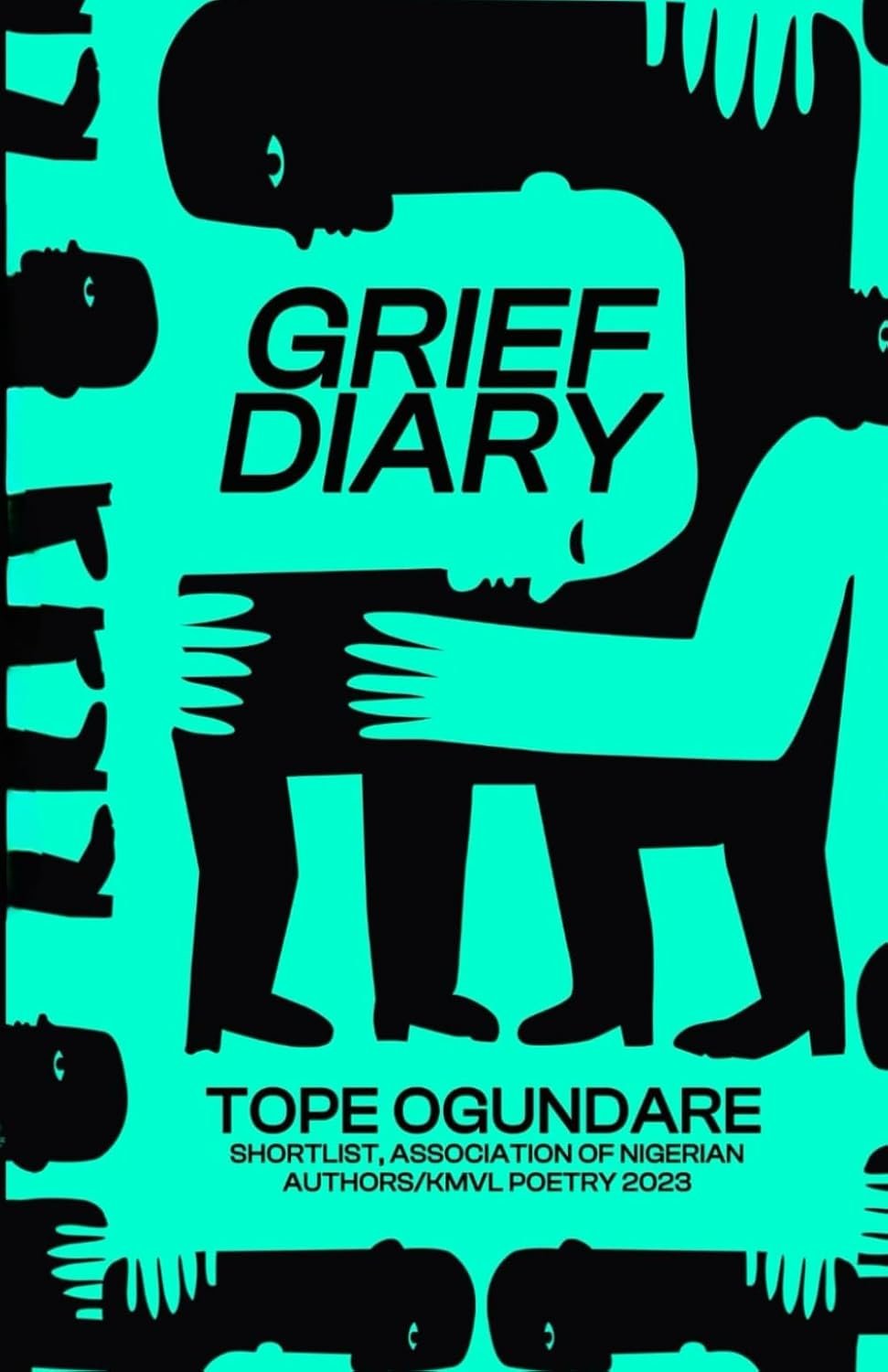
GRIEF DIARY
Tope Ogundare’s poetry collection reflects on a son’s love for his mother, the weight of her absence and the endurance of memory.
Books worth discovering. Authors worth knowing.
Tope Ogundare’s poetry collection reflects on a son’s love for his mother, the weight of her absence and the endurance of memory.
Poetry spotlight based on the published collection description, without invented lines or firsthand poem readings.
Grief recorded without a timetable
The title GRIEF DIARY suggests a private form of writing, but Tope Ogundare offers that intimacy to readers through poetry. Its public book description frames the collection as a son remembering his mother, confronting her absence and attempting to live alongside the weight of mourning. The poems are presented as both elegy and companionship for people who have lost someone they love. That is a specific and moving basis for an editorial feature, though it should not be stretched into claims about individual lines or the order of poems without seeing the text. The collection’s advertised focus is sufficient to ask why lyric language can sometimes carry feelings that ordinary explanations cannot.
Grief rarely proceeds as a clean sequence of stages. Memories may feel vivid on one day and unreachable on another. Public descriptions of Ogundare’s poems point to the ache of absence in quiet moments as well as the endurance of familial affection. Poetry is particularly suited to exploring that duality because it need not argue its way toward an answer. It can hold an image, a silence or a feeling unresolved. A reader does not need to agree with every interpretation of loss to recognize why someone might turn to short, concentrated writing when conventional conversation seems inadequate.
A son’s love and a mother’s absence
The collection is described as chronicling a son’s relationship to a mother who is no longer present. Such writing often carries two histories at once: the life of the person remembered and the life being lived after the loss. The public overview centers love and absence, not a detailed chronological biography. Responsible commentary should therefore avoid guessing the circumstances of the death, reproducing imagined conversations or naming particular family events. What can be discussed is the emotional structure established by the promotional description: grief is not simply the experience of losing someone, but the changed way the survivor inhabits ordinary time.
A mother can be remembered through advice, habit, laughter, places or objects, but it is the poet’s prerogative to decide which details enter a collection. Readers who have experienced bereavement might bring their own associations to the book. That resonance can be powerful, but it should not lead an editor to attribute readers’ memories to the author. One of the virtues of a poetry collection is that its language can remain particular while making room for another person’s feelings. In that exchange, empathy need not erase differences between lives.
Poetry as a place to place what cannot be fixed
A diary normally records days; an elegy often attempts to speak to what time has changed irreversibly. The title combines those ideas. It makes the project sound ongoing and personal rather than like a polished argument that mourning has been solved. The book’s description speaks of lyrical verse and a movement between raw sorrow and hope. It is possible to appreciate that framing without promising that any book can heal grief on demand. Personal writing can accompany the bereaved, offering recognition or respite, but support depends on the reader’s circumstances and may also involve community, ritual or professional help.
The form of a poem invites pauses. The reader may move through a collection slowly, stop after a few pages or return to a phrase that feels newly relevant. Such reading differs from following a conventional narrative toward a climax. It can be cumulative even when the poems remain separate. For someone navigating loss, the ability to close a book without abandoning a plot may itself be valuable. These are suggestions about how to engage with poetry in this genre, not a claim that Ogundare has arranged his collection according to a verified set of stages.
Culture, language and the individuality of mourning
Readers’ responses to grief are shaped by family life, language and cultural expectations. The publicly available description identifies the book as a lyric meditation on memory, and a reader review mentions Yoruba cultural elements, but one reader’s interpretation is not adequate evidence to chart every motif across the collection. That distinction is especially important when discussing African literary traditions: a broad label can flatten diverse practices and histories. The book’s author, rather than an outsider’s assumptions, should remain the source of any detailed cultural claims about specific poems. An informed feature can acknowledge the possible importance of cultural context without manufacturing ritual scenes or translated lines.
Literary mourning also invites questions about audience. An author may be speaking to the deceased, to the self, to a community or to nobody in particular. The title’s private register suggests inward reflection while publication turns that reflection outward. A reader might ask when the voice feels intimate and when it appears to reach across individual experience. Because the poems themselves have not been quoted or analyzed line by line here, those questions are invitations, not a substitute for direct reading.
Between remembrance and renewal
The marketing text uses the language of solace and renewal, which is understandable for a book about loss. Yet renewal should not be mistaken for forgetting. Someone may find moments of laughter or interest and still miss the same person profoundly. A strong elegiac collection can make room for that coexistence rather than cast hope as a betrayal of love. The advertised themes of memory, absence and endurance make this a worthwhile interpretive lens for Ogundare’s work. It remains a lens: readers will determine for themselves whether the individual poems support it.
The word “diary” is also a useful reminder that grief changes as life continues. A private record can preserve the shape of a feeling without claiming it will last forever in the same form. Readers who fear that time might erase the person they love may find meaning in writing that returns to memory deliberately. Others may find such writing too close to their own loss at a particular moment. Both responses are legitimate. The value of the collection does not depend on producing a uniform emotional effect.
The ethical limits of praising grief writing
It can be tempting to describe a collection about bereavement as beautiful or therapeutic simply because the subject is moving. That shortcut does the author no favors. The art of poetry involves choices of language, rhythm, metaphor, compression and sequence; these need firsthand attention before an editor can assess them in depth. This research-based feature does not claim to have examined every poem, so it avoids ratings and invented excerpts. Instead it identifies the supported themes and the kind of attentive, patient reading they call for. Emotional sincerity, literary craft and a reader’s personal response are related but distinct.
There is also an important difference between a book that addresses suffering and a book that can provide clinical care. Poetry may be comforting to some people; it cannot be responsibly promoted as a guaranteed treatment for complicated grief, depression or other health conditions. The description of GRIEF DIARY is strongest when taken as an artistic invitation. It asks readers to sit with loss rather than force it into a tidy program of self-improvement. That is substantial enough without exaggerated promises.
Who should read GRIEF DIARY?
This collection may speak to readers interested in elegiac poetry, personal writing about family, reflections on maternal loss and literature that takes sorrow seriously without reducing it to despair. It could also appeal to those who want to encounter a contemporary poetic voice working with memory and devotion. Someone in acute grief should approach the book at their own pace; a poem can evoke intense feelings unexpectedly. Readers who prefer poems discussed through close quotation should turn to the collection itself, since this feature deliberately avoids inventing textual analysis from an inaccessible full text.
Tope Ogundare is listed publicly as a poet and author of several collections, including GRIEF DIARY. Bibliographic and book-community descriptions identify the work as poetry about mourning his mother. That is the sound foundation for a feature: a personal literary act offered to a wider audience. Its promise is not the end of grief, but the possibility of finding language that can live beside it.
About the book.
Poetry; grief and elegy. Poetry spotlight based on the published collection description, without invented lines or firsthand poem readings.
Independent research-based book feature, not a claim of a complete firsthand reading. Cover placeholders await the owner’s Python automation.
Found a book worth opening?
Books worth discovering. Authors worth knowing.
Return to the Journal →