
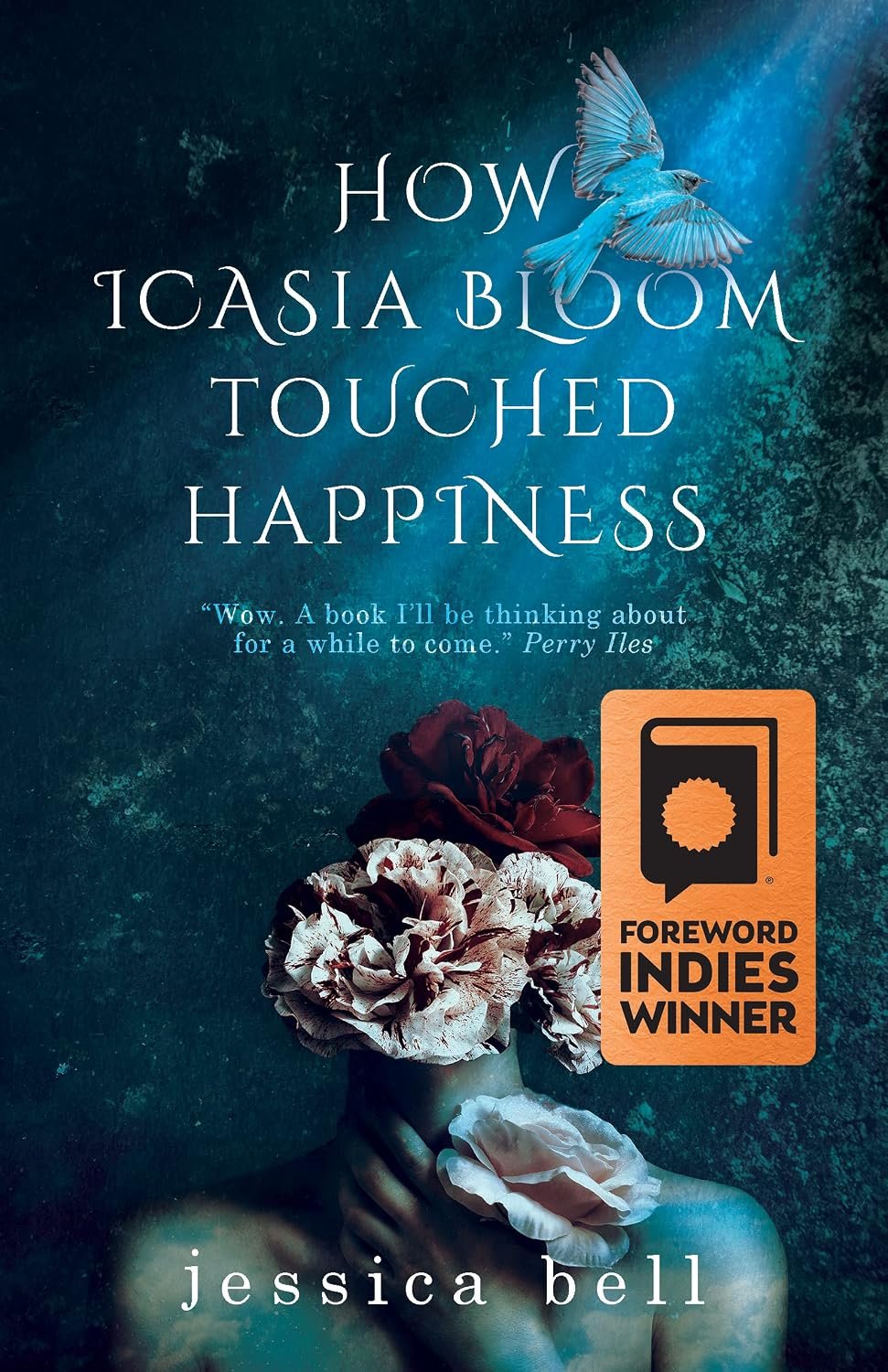
How Icasia Bloom Touched Happiness
Icasia Bloom lives outside a happiness-obsessed society whose rules make unhappiness a matter of life and death.
Books worth discovering. Authors worth knowing.
Jessica Bell imagines happiness as a social requirement rather than a private human experience—and builds a dilemma around that inversion.
S.
When Happiness Becomes a Law
Jessica Bell’s How Icasia Bloom Touched Happiness begins with a chilling reversal: happiness, usually treated as a personal goal, has become an expectation enforced by society. In the Globe, the population lives under the influence of an elusive authority and a governing text called The Book. Citizens are promised extraordinary rewards for following its rules, while those associated with unhappiness face terrible consequences. The publisher’s stark premise is that someone can be put to death because their child has failed to become happy. Bell turns an apparently benevolent ideal into the machinery of control.
Icasia Bloom is not the polished model citizen such a system would prefer. She is a “Tatter” who survives through barter, living near the edges of a social order that defines worth according to compliance. Her situation immediately complicates the idea of happiness as an individual accomplishment. What happens to someone who lacks the material means, status or security that society itself withholds? A demand to be happy can turn cruel when people are punished for circumstances they did not freely choose. This contradiction gives the novel its intellectual engine.
The public synopsis places Icasia near a bakery, where she encounters Selma Beyett, another woman whose life does not fit neatly into approved categories. Selma’s husband Jerome faces a deadline: if he cannot attain the required happiness within six months, he is threatened with death. That urgent, personal dilemma transforms the larger social problem into an immediate decision for two women. Their effort to help Jerome offers a grounded narrative thread through a world that otherwise might seem overwhelmingly abstract.
The Globe and Its Rules of Belonging
Dystopian fiction frequently asks what happens when authorities claim control over a collective good. Security, equality and order can all become excuses for restrictions when their meaning is decided from above. Bell chooses happiness, a word usually associated with warmth rather than punishment. That choice is especially effective because it exposes how difficult happiness is to define. Does it mean a pleasant mood, moral contentment, a life without suffering or the appearance of cheerfulness? A system built on one official definition leaves little room for the many ways people actually live.
The Book, as described by the publisher, functions as an instrument of guidance and judgment. Its title is simple enough to feel almost ordinary, yet its role is enormous. A text that determines who deserves a longer life is no longer just a source of advice. It has become a mechanism that sorts people into categories of worth. Icasia’s discomfort with the system is therefore more than a rebellious personality trait. Her position allows readers to question the legitimacy of standards that society treats as unquestionable.
The contrast between immortality and mortality introduces another puzzle. If a promised second phase of life depends on fulfillment, hope itself becomes conditional. People may be encouraged to pursue happiness not for its human value but to satisfy a test. The moment such a test becomes compulsory, authentic contentment and strategic performance can become indistinguishable from the outside. This is a broader philosophical implication of the premise, not a description of a specific later scene. Bell’s dystopia invites readers to examine what is lost when private emotional life becomes public evidence.
Icasia, Selma and the Power of Solidarity
The relationship between Icasia and Selma stands at the center of the publisher’s description. Their paths cross through an ordinary act of commerce and the daily economics of survival. That small beginning matters. An elaborate social structure can be challenged first by one person paying attention to another’s trouble. Icasia does not initially set out, according to the description, to reorganize the entire Globe. She becomes involved because a particular family is in danger. This allows a large moral question to develop through recognizable human concern.
Jerome’s deadline gives the women something concrete to confront. Six months is short enough to make delay costly, yet long enough for hope, uncertainty and disagreement to accumulate. The synopsis does not disclose the outcome, and there is no need to anticipate it. The compelling question is what rescue would mean under rules that evaluate a person’s emotions. Could another person’s love make someone happy on command? Would changing material circumstances matter more than urging a brighter attitude? These questions follow naturally from the documented premise without inventing the characters’ solutions.
The women’s collaboration also highlights a difference between happiness as achievement and happiness as relationship. A society can measure compliance, but it cannot easily reproduce the freedom of people supporting one another without expecting a public score. Icasia and Selma’s alliance, as advertised, suggests an alternative scale of value. Their concern for Jerome does not have to be justified by universal rules before it becomes meaningful. The story therefore seems positioned to explore solidarity as something that persists even when institutions try to classify everyone.
The Uncomfortable Mirror of a Happy Society
Readers may recognize echoes of contemporary pressure to appear successful, grateful and emotionally well. Social platforms often reward bright narratives, while institutions may prefer people to report that they are coping. Bell’s imagined punishments are much more extreme than ordinary life, and the distinction must remain clear. The novel is not documentary evidence about a current government. Its exaggerated system can nonetheless make a familiar pressure easier to see: the difference between allowing people to seek well-being and demanding that they prove it.
A particularly unsettling aspect is the linking of a parent’s future to a child’s happiness. That relationship turns care into surveillance. A parent may love a child deeply while being unable to control every emotional outcome; the child may experience legitimate sadness for reasons the parent cannot prevent. Treating either person’s dignity as contingent on the child’s mood denies the complexity of growth. Bell’s premise amplifies this problem to dystopian proportions, inviting readers to distinguish nurture from coercion.
The publisher describes the novel as both heartwarming and unsettling, a pairing that makes sense. A dark institutional design can frame a story of compassion without eliminating fear. The possibility of help matters most because the threat is real within the fiction. Likewise, warmth becomes more interesting when it does not erase the structural pressures characters face. Readers looking for speculative writing that offers ethical questions alongside emotional stakes have several reasons to be curious about this combination.
Why the Novel’s Questions Endure
Bell has discussed her interest in stories where protagonists live within distorted social systems rather than simply rejecting them from the beginning. That perspective is useful for understanding Icasia’s predicament. The question may not be whether one dramatic gesture can destroy every rule. It may be whether people can discover humane ways to live while those rules still shape their options. The published premise gives Icasia a concrete problem rather than a fully formed political program, allowing personal change and social criticism to develop alongside one another.
Readers who enjoy philosophical science fiction, morally complicated dystopias and stories of unexpected friendship will find the ingredients explicitly established in publisher material. The novel does not need its society to be technologically elaborate to make its challenge compelling. It needs the rules to matter in intimate lives, and the advertised dilemma involving Jerome supplies exactly that. The mystery is not simply how the Globe works, but how its people can remain recognizably human under demands that deny ordinary human uncertainty.
How Icasia Bloom Touched Happiness draws a powerful line between the right to pursue happiness and the obligation to display it. Through Icasia, Selma and Jerome, Jessica Bell gives that difference personal consequences. This feature leaves the resolution untouched and focuses on what is firmly documented: a woman on society’s margins, a friendship born near a bakery and a world where the search for happiness has become a matter of survival.
About the book.
In the Globe, an unseen authority promises conditional immortality to those who obey The Book. Tatter Icasia survives by barter; meeting Selma Beyett at a bakery involves her in the plight of Selma’s husband Jerome, who has six months to find happiness or face death.
Editorial book feature, not paid sponsorship. Research-based commentary from named public sources, not a first-hand complete-book review. The cover placeholder will be resolved by the owner’s publishing automation.
Found a book worth opening?
Books worth discovering. Authors worth knowing.
Return to the Journal →