
I Am Perfectly Flawsome
Tom Collins and Michele Molitor use the Japanese art of kintsugi to challenge perfectionism without abandoning excellence.
Books worth discovering. Authors worth knowing.
Tom Collins and Michele Molitor use the Japanese art of kintsugi to challenge perfectionism without abandoning excellence.
A review-and-publisher-grounded feature about flawsomism, kintsugi and living with human imperfection.
When the pursuit of perfection becomes the problem
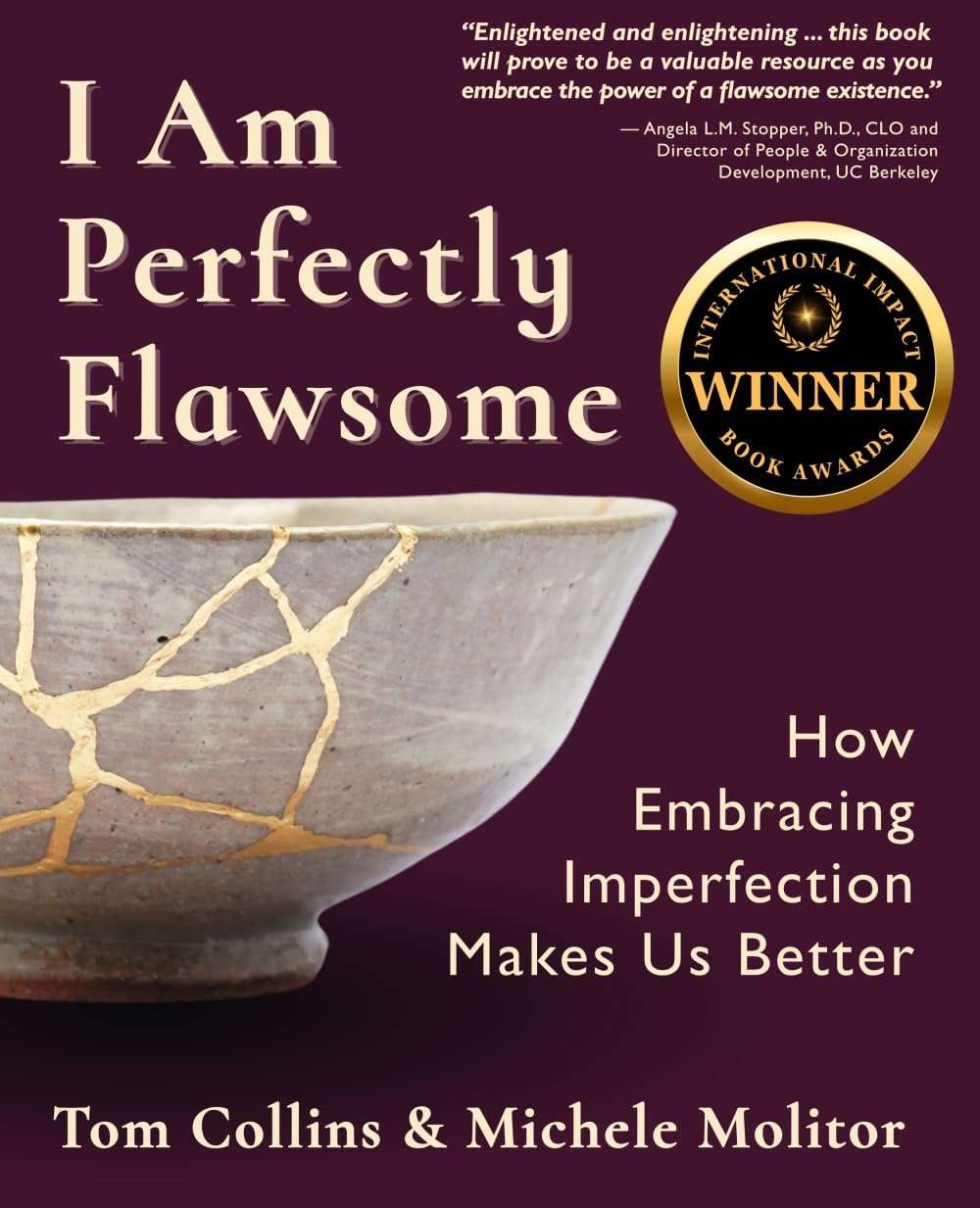
A culture that celebrates flawless outcomes does not always make room for the effort, error and revision needed to reach them. Tom Collins and Michele Molitor take aim at that contradiction in I Am Perfectly Flawsome: How Embracing Imperfection Makes Us Better. The book’s central term joins “flawed” and “awesome” to argue that a person can pursue excellence without treating every mistake as evidence of inadequacy. Publisher and review descriptions identify the Japanese art of kintsugi—the repair of broken pottery using visible lines of lacquer and precious metal—as an important metaphor. Its lesson in this context is not that damage is automatically good, but that repair can become part of how value is recognized.
This is an appealing proposition because perfectionism is often mistaken for ambition. Wanting to do careful work is reasonable. Believing that an outcome must contain no blemish before it deserves recognition can undermine creativity and satisfaction. Collins and Molitor’s promotional materials frame their book as a guide and workbook to noticing these habits and challenging them across personal and professional life. That is their practical argument, not a guarantee that simply adopting a new label will eliminate longstanding psychological difficulties.
Excellence and perfection are not synonyms
The distinction between pursuing excellence and chasing flawlessness is the heart of the book’s premise. Excellence can involve standards, feedback and improvement; perfection demands a finish line that may be impossible to reach. In a workplace, one can responsibly check a document for errors while accepting that every large project involves trade-offs. In a family, one can aim to be attentive and reliable without expecting to respond ideally to every surprise. A useful book on imperfection needs to preserve this tension, because rejecting impossible standards should not become an excuse to ignore genuine responsibility.
The authors explicitly invite readers to remain ambitious while treating human limitations with more proportion. That combination is more challenging than unconditional self-praise. It requires deciding which imperfections matter, which can be corrected and which belong to ordinary variation. The kintsugi metaphor makes that complexity visible. A repair acknowledges a break rather than denying it; it also refuses the assumption that something changed is therefore worthless. Readers can carry this thought into work, relationships and the stories they tell about their own histories.
Why kintsugi is a useful but imperfect metaphor
Kintsugi is often invoked in popular self-help as a shorthand for emotional healing. In the book’s promotional account, it supplies a powerful visual image: cracks are not hidden, and the restored object can be valued anew. The metaphor makes an abstract argument memorable. It is still important to recognize that human experience is not literally pottery. Some hurts require medical care, accountability or changes to external conditions. An editor should not imply that suffering itself is a gift or that everyone must display scars publicly to have learned from them.
A better reading of the analogy is about visibility and respect. People are often encouraged to maintain an image of unbroken success, particularly in professional settings or on social media. A repaired object suggests that a history of difficulty need not disqualify something from appreciation. In practice, that can mean acknowledging an earlier mistake while describing what changed because of it. Readers may find the image helpful precisely because it distinguishes honest repair from the fantasy that the break never occurred.
From individual self-talk to cultural expectations
Professional reviews of I Am Perfectly Flawsome describe applications to leadership, parenting, gendered expectations, work and aging. This breadth matters: perfectionism is not always merely a private personality trait. Institutions and communities can reward impossible availability or punish visible learning. A woman navigating conflicting expectations about work and caregiving may experience those pressures differently from a teenager exposed to social-media comparison. A manager may publicly praise experimentation while privately penalizing every failed attempt. The book’s appeal is its effort to connect inner self-judgment with those wider environments.
Readers should nevertheless examine how much weight any self-help framework places on individual responsibility. Some demands are not solved by changing perspective alone. It is reasonable to ask whether a workplace’s deadlines and incentives allow employees to make mistakes safely, or whether a child’s school treats learning as a process. An imperfection-friendly mindset can influence personal choices, but institutions also have obligations. That critical perspective is consistent with the book’s premise of compassion and accountability rather than a rejection of it.
Failure as information rather than identity
An instructive failure reveals something about a method, assumption or situation. It does not necessarily reveal a permanent truth about the person involved. In the authors’ vocabulary, flawsomism appears to encourage separating what happened from the worth of the person who experienced it. This shift can be difficult when outcomes carry real consequences. A failed exam, project or relationship may be painful and may require serious changes. But it need not justify a sweeping claim that someone is incapable of growth. Holding both truths—responsibility and dignity—is part of the book’s practical appeal.
The idea has a special relevance to creativity. An early draft or prototype is designed to be incomplete. People who cannot bear seeing imperfect work may avoid experimentation altogether. Appreciating revision therefore means appreciating the stage before confidence arrives. Collins has written publicly about discovering typos even after extensive rounds of proofreading his published work; his reflection offers a useful concrete example of the philosophical problem. Serious effort did not produce literal perfection. The right response can be correction and perspective rather than shame.
The social cost of performing flawlessness
Social comparison can make people believe that others move through life with a competence they themselves lack. Digital platforms intensify that impression by rewarding curated outcomes. The promotional discussion of the book raises such issues while encouraging people to recognize ordinary human complexity. A reader may use this perspective to reconsider their own public image: how much time is spent appearing confident rather than learning? How often is help avoided because asking would reveal uncertainty? These are worthwhile questions regardless of whether one adopts the authors’ specific terminology.
There is also a relational cost to perfectionism. If everyone in a friendship or family feels obliged to be admirable at all times, honest conversation becomes risky. An imperfection-friendly approach might allow a person to admit confusion, ask for forgiveness or name a need without expecting immediate rejection. This is a possible application of the authors’ argument rather than a verified outcome of reading the book. People and relationships differ; no single mindset formula can replace mutual respect, safety or clear boundaries.
A workbook invitation, not a therapeutic guarantee
Descriptions of the publication identify practical exercises alongside its central idea. Such activities can help move an insight from the page into everyday attention. But any book making claims about emotional well-being should be understood as offering guidance, not a substitute for psychological or medical assessment. Some people experience perfectionism as part of substantial distress that needs specialist support. A critical reader can appreciate a memorable philosophy while asking what evidence supports its wider recommendations and which circumstances it addresses.
The text’s apparent optimism works best when read as a proposal for more realistic self-evaluation. Human excellence is often collaborative, developmental and unfinished. Declaring oneself “flawsome” can be a friendly reminder to remain engaged with life rather than withdraw until perfect conditions arrive. Its most useful test is whether it encourages accountable action and greater compassion in practice. A slogan alone cannot do that work; reflection and choices have to follow.
Who should read I Am Perfectly Flawsome?
The book will likely suit readers drawn to reflective self-help about perfectionism, people navigating high standards at work, educators or parents considering expectations, and anyone interested in the relationship between mistakes and personal worth. It offers a particularly accessible entry point for readers who respond to memorable metaphors and practical exercises. Those looking for a technical clinical text should assess the book against more specialized resources. Its strengths are its clearly stated premise and humane invitation to reconsider achievement without giving up on improvement.
Tom Collins and Michele Molitor are credited co-authors, and both have spoken publicly about the project’s development. Independent reviews confirm the kintsugi motif and the theme of resisting impossible standards. That combination gives this feature a firm book-specific basis. The title’s central challenge remains worth considering: can people become better at living and working without first demanding that they stop being human?
About the book.
Self-help; perfectionism and personal development. A review-and-publisher-grounded feature about flawsomism, kintsugi and living with human imperfection.
Independent research-based book feature, not a claim of a complete firsthand reading. Cover placeholders await the owner’s Python automation.
Found a book worth opening?
Books worth discovering. Authors worth knowing.
Return to the Journal →