
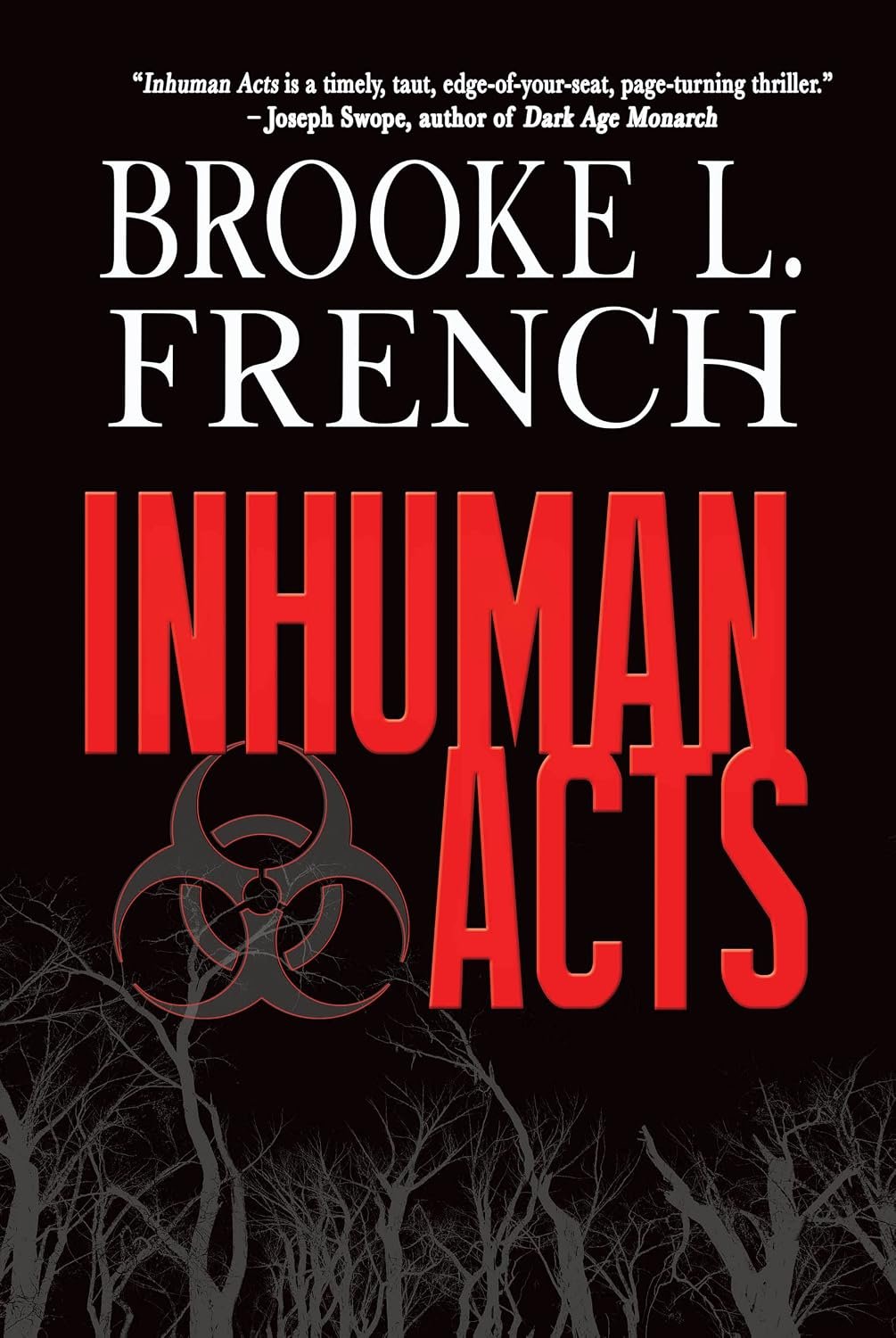
Inhuman Acts
A terrifying outbreak becomes a trail someone wants to erase.
Books worth discovering. Authors worth knowing.
Inhuman Acts — Brooke L. French begins the Letty Duquesne series with unexplained human rabies cases in Chattanooga. Disease ecologist Letty sees a chance to trace the infection, but obstruction and the outbreak’s apparently nonrandom victims turn an investigation of animals and disease into a dangerous human mystery.
An independent MarketAnyBook book feature drawing on public descriptions and verified bibliographic details.
Brooke L. French begins the Letty Duquesne series with unexplained human rabies cases in Chattanooga. Disease ecologist Letty sees a chance to trace the infection, but obstruction and the outbreak’s apparently nonrandom victims turn an investigation of animals and disease into a dangerous human mystery. That starting point gives Inhuman Acts a recognizable identity, but the interest extends beyond the headline situation. The details in its public description introduce choices and pressures that are worth examining before deciding whether the book belongs on a reading list. For a disease ecologist, pattern recognition is more than a puzzle: tracing exposure is potentially the difference between identifying a source and allowing harm to spread.
A useful first question is what happens when the evidence contradicts the easy official explanation? That question connects the significance of an unexpected pattern with an expert who wants the field, bringing the book’s immediate scenario into a broader conversation about decision-making and consequences. The premise supplies a reason to be curious: it creates a situation in which different aims and obligations are likely to pull against one another, even before any outcome is known.
The significance of an unexpected pattern
The publisher synopsis emphasizes that the victims are not random and that the cases involve human rabies. For a disease ecologist, pattern recognition is more than a puzzle: tracing exposure is potentially the difference between identifying a source and allowing harm to spread.
The first element matters because readers need a clear reason to care about what is at stake. What happens when the evidence contradicts the easy official explanation? In this case, the book’s point of departure is grounded in a particular predicament rather than a general promise of excitement or improvement. It also invites a distinction between a person’s outward circumstances and the less visible reasons those circumstances matter. That distinction can help explain the appeal of the setup without demanding a predetermined response to it.
An expert who wants the field
Letty faces an unwanted promotion that could move her away from the investigations she values. That professional conflict gives her reasons to press on even when other authorities prefer a simpler outcome.
Here the picture becomes more complicated. How does scientific fieldwork change the shape of a thriller’s investigation? The contrast with the opening setup makes this strand worth special attention: a goal may remain the same even as the obligations attached to achieving it change. A convincing treatment would need to acknowledge those competing pressures instead of erasing them for a convenient solution. The published premise gives the reader enough material to recognize that tension, while leaving room for the book to define its own answer.
A personal history in the background
The description links Letty’s urgency to earlier animal violence, including the attack that killed her sister. A mystery can gain emotional weight when its professional stakes intersect with unresolved grief, though the book’s full treatment should not be assumed from the synopsis.
This development also reframes the earlier elements. Where does responsible public-health caution end and speculative suspense begin? Set beside the significance of an unexpected pattern, it introduces another perspective on the central concern. The stakes need not be identical for everyone involved, and readers may be interested in the distance between the choices that seem available and those that really are. Such an angle provides a reason to look beneath surface events or slogans without presuming to know the work’s final argument.
A partnership under pressure
Letty works alongside disgraced detective Andrew Marsh while someone monitors her movements. The collaboration creates an intersection between scientific evidence and police procedure, with trust in institutions becoming part of the dramatic question.
Finally, this element changes the scale of the premise. It links a local question to a wider social, personal or speculative world, depending on what sort of book is being offered. The earlier concerns—an expert who wants the field and a personal history in the background—remain relevant when viewed through this final thread. For a reader choosing among many books, that combination of immediate stakes and broader implications is more informative than an unsupported superlative.
Questions that give the book its shape
What happens when the evidence contradicts the easy official explanation? It is a productive question precisely because there is no universal answer. Context, character, experience and competing duties alter what a reasonable choice may look like. In Inhuman Acts, the public premise locates the problem in the significance of an unexpected pattern, then complicates it through an expert who wants the field. These ingredients offer a richer basis for approaching the book than treating it as a single theme with a predictable lesson.
How does scientific fieldwork change the shape of a thriller’s investigation? This invites consideration of the costs that are easier to overlook when a synopsis is compressed to a few dramatic lines. A person may want one thing and need another; a community can reward behavior that strains an individual; a useful method may require trade-offs. The specific details offered for this title make that kind of tension plausible. They do not establish exactly how the author resolves it, and preserving that uncertainty is part of respecting the work.
Where does responsible public-health caution end and speculative suspense begin? Read alongside the other questions, this one widens the scope from events and claims to values. It asks a reader to pay attention to what is being protected, risked or changed. This is the editorial value of looking at a book’s premise closely: patterns become visible without the need to disclose a twist, invent a quotation or pronounce a verdict on pages not yet encountered. The published material is enough to identify the conversation, if not to settle it.
Style, context and reader expectations
The work is presented in the area of disease thriller / ecological suspense. That classification is useful as an initial signal, not a promise that every reader will experience it in the same way. Someone looking for this kind of material may already recognize the combination of subjects and conflicts described here, while another reader may be drawn to one unusual detail instead. In either case, the most meaningful comparison is between the reader’s interests and the actual book description, not an assumption about quality based on the category alone.
A Tennessee outbreak draws a disease ecologist and detective toward an animal source and a human threat. The concrete information matters. It tells a prospective reader where the work begins, what kinds of questions drive it and which elements appear central rather than incidental. Beyond that, judgments about pacing, prose, complete argument or ending require the actual text. A carefully grounded feature can be exploratory and informative without pretending to replace an excerpt or a full review based on firsthand reading.
Who might enjoy Inhuman Acts?
The book is a promising choice for readers who like procedural mysteries grounded in an expert profession, escalating danger and a regional setting. Its rabies premise is fiction; the feature makes no claims about any real outbreak or medical discovery. The details described above give this audience a useful point of comparison with other books on a similar shelf. It is worth asking which element most draws attention: the immediate stakes, the wider setting, the relationship between people, or the central idea being tested. A book is more likely to feel relevant when at least one of those interests genuinely aligns with what the publisher or author says it offers.
For anyone undecided, the practical next step is to check an authorized preview and confirm the available edition. A synopsis can identify promising subject matter but cannot establish whether the voice and execution will suit every reader. Inhuman Acts earns consideration here because the verified premise has several distinct lines of interest, not because an untested claim of excellence should settle the choice. The Journal’s recommendation is therefore focused on fit, curiosity and an informed decision.
A note on the author
Brooke L. French identifies Inhuman Acts as the entry point to her Letty Duquesne thrillers on her author website, which also describes later installments in the series. This concise note uses verifiable author and bibliographic information rather than invented personal details. It places the work within an identifiable publishing or professional context without claiming a private conversation with its creator.
About the book.
A Tennessee outbreak draws a disease ecologist and detective toward an animal source and a human threat.
This independent MarketAnyBook Book Feature draws on public book descriptions and bibliographic information, without claiming firsthand reading or inventing quotations. The book link leads to the owner-provided destination.
Found a book worth opening?
Books worth discovering. Authors worth knowing.
Return to the Journal →