
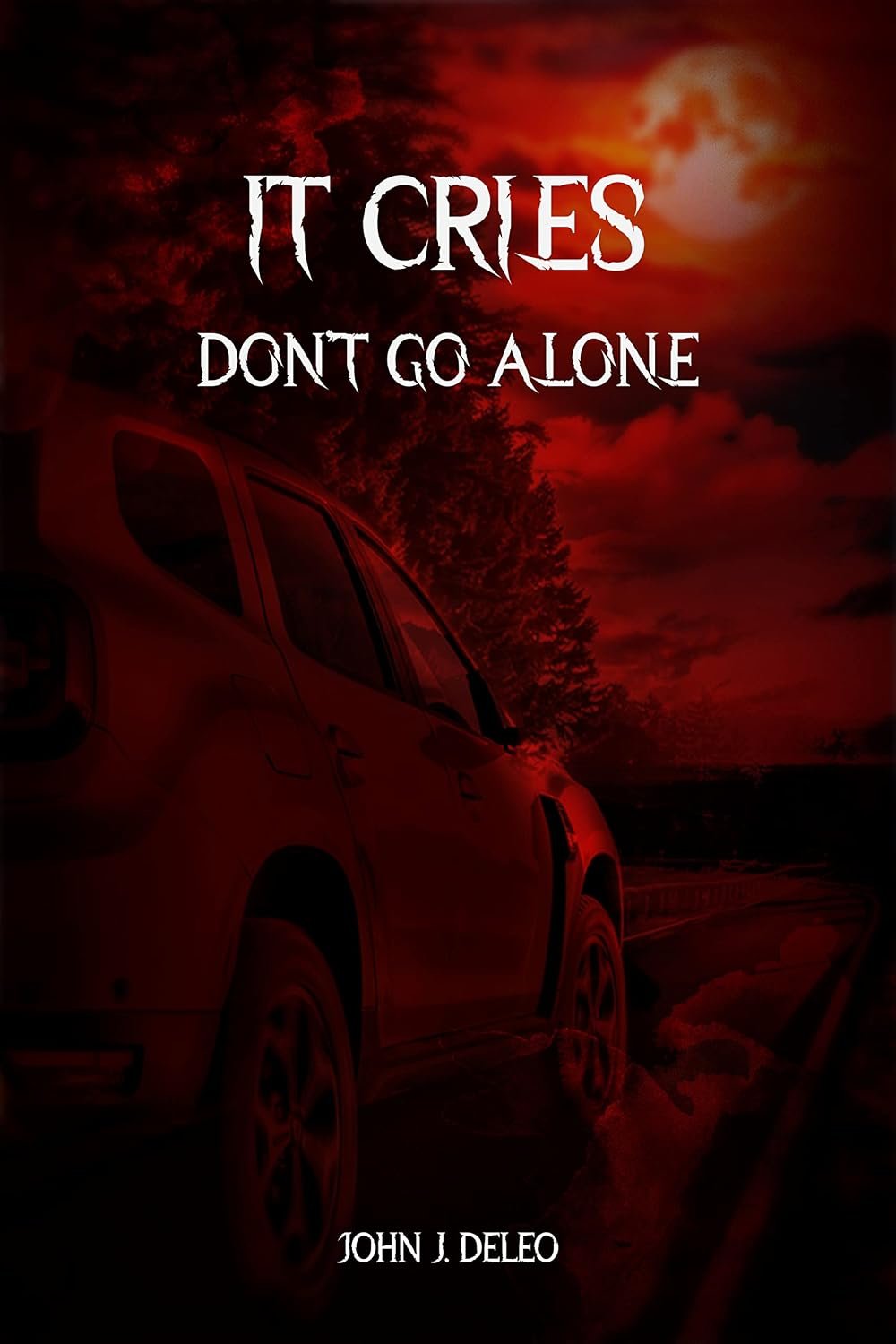
It Cries: Don’t Go Alone
Two friends pursue a haunted-forest mystery and discover a trail of violent history, restless spirits, and escalating danger.
Books worth discovering. Authors worth knowing.
The deepest path into a forest is not always the one that leads home, especially when the landscape seems to remember a crime.
Retail and reader-listing descriptions confirm two friends, a road breakdown, a darkening haunted forest, abandoned buildings, and an old bloodshed.
Curiosity at the edge of a forest
Some horror premises begin with a clear prohibition: do not enter, do not investigate, do not go alone. It Cries: Don’t Go Alone, credited to John J. DeLeo, uses that atmosphere of warning as the doorway to a haunted-forest mystery. Its public description introduces two friends determined to discover what lies behind a local mystery. A lonely road and a malfunctioning vehicle accompany their movement toward an increasingly ominous forest. What starts as a decision to pursue answers leads toward abandoned structures, spirits, and traces of violence that have not stayed buried. The confirmed material provides a recognizable supernatural-horror framework without revealing the story’s resolution.
A setting like this is effective because it turns ordinary choices into moral and practical dilemmas. Curiosity is attractive: perhaps an old rumor has a rational explanation, or someone has been unfairly frightened away from the truth. Yet every new sign of danger also raises the question of when determination becomes recklessness. The synopsis says the friends continue despite warnings built into the environment. Readers can therefore approach the novel as a tension between the desire to know and the instinct to survive, while leaving the precise sequence of discoveries to the book itself.
The forest as a keeper of memory
The announced background of innocent bloodshed gives the haunting more substance than a series of unexplained noises. The promotional synopsis suggests that an old crime has consequences that persist in a form ordinary time cannot easily erase. That idea has a long tradition in ghost stories: a landscape can seem to preserve what a community has failed to acknowledge. The forest is not merely a dark backdrop. It becomes a potential archive of unfinished grief and wrongdoing, with each abandoned place acting as a reminder that disappearance and forgetting are not necessarily the same.
This is an interpretive lens, not a claim that the author reveals a particular historical period, perpetrator, or ritual. None of those details is established by the available synopsis. Its stronger verified elements are the friends, the journey, the spectral presences, and a violent mystery that grows increasingly threatening. By attending to those elements rather than manufacturing lore, a reader can enter the book with curiosity intact. A haunting becomes compelling when the question is not only what is there, but why the dead are unable to rest.
Why companionship matters in a ghost story
The book’s subtitle, Don’t Go Alone, is a provocative instruction for a story whose premise places two friends together. Companionship may offer courage, but it does not guarantee safety. One person can be more cautious, more skeptical, or more insistent than another; the difference in judgment can deepen suspense without the need for a supernatural figure to appear in every scene. The public synopsis does not identify the friends by name or specify their differing personalities. Still, the premise naturally asks readers to watch how trust functions when information is scarce and fear becomes difficult to interpret.
Two people also witness events from different positions. If a sound is heard in the distance or a shape moves among the trees, perception can become uncertain. Horror often tests whether people can communicate clearly when pressure encourages them to react first and investigate later. Here, that question belongs to the genre’s appeal rather than an asserted event in DeLeo’s manuscript. The title’s warning invites readers to wonder whether fear is best managed together, whether loyalty can keep someone in danger too long, and whether there are places where company is simply insufficient.
The pull of abandoned places
Abandoned buildings are among the plot elements specifically identified by the listing. They bring human history into the natural setting: people built something here, used it, and left. Why they left may be more unsettling than the emptiness itself. Horror fiction can draw on that ambiguity to produce tension between recognizable signs of daily life and an atmosphere in which ordinary protection has failed. An old doorway, a dark corridor, or a room with no occupants becomes ominous because it suggests absence with a cause. The source does not describe the architecture or every encounter inside it; those specifics must remain discoveries for the reader.
The sensation of accumulating mysteries is likewise central to the available description. The friends do not simply uncover one clue and receive an answer. The synopsis emphasizes that the questions multiply as they advance. This structure can make a supernatural mystery feel less like a puzzle with a neat solution and more like a confrontation with the limits of what living investigators can understand. For the audience, the pleasure is not limited to guessing the final explanation. It also lies in considering whether each new piece of knowledge makes the next step safer or more dangerous.
Violence, justice, and supernatural consequences
The book’s public copy connects immortality, innocent victims, and an avenging force. That raises an important distinction between a ghost whose presence expresses grief and a force whose actions perpetuate harm. Revenge in a horror story does not necessarily produce justice. Violence may spread beyond its original cause, carrying fear to people who did not participate in the original wrongdoing. Such possibilities are suggested by the synopsis’s broad language, but the precise moral architecture of the novel cannot be asserted without the text. Readers sensitive to violence should know that the listing explicitly promises bloodshed and horrifying consequences.
At its most interesting, haunted-place fiction asks whether naming a crime is enough to end the haunting. The protagonists may seek truth, but truth can impose obligations. Discovering suffering may demand compassion, courage, or restraint rather than a simple victory over an apparition. This perspective keeps the story’s stated history of victims in view without turning those victims into mere atmospheric props. The better question for a reader is how the present confronts a past that has refused to disappear, and what kind of responsibility follows from curiosity once it uncovers something serious.
Listening to the warning
A horror title phrased as advice has a particular power. It suggests someone already knows the danger and wants the next traveler to avoid repeating a mistake. Yet in the announced premise, the friends move toward the forest because they want to understand a mystery. The warning and the desire for answers therefore exist together from the beginning. The reader may ask whether the investigation is an act of courage, an error of judgment, or a mixture that changes as more information appears. A ghost story becomes more unsettling when even a sensible action can have unintended effects. Looking for evidence might disturb what should remain undisturbed; refusing to look might allow an injustice to remain hidden. Those dilemmas give the forest’s unexplained cries a significance beyond their capacity to startle.
Who should read it
It Cries: Don’t Go Alone is a promising choice for readers who enjoy ghost stories with investigative momentum: two companions, remote roads, forests that grow more forbidding, abandoned buildings, and a violent secret with supernatural aftereffects. Its premise offers a mixture of mystery and dread rather than a conventional detective procedural. Readers who prefer minimal violence or purely psychological suspense should check the listing before purchase, because the available description stresses bloodshed and restless spirits. For an audience attracted to questions of buried wrongdoing, the novel’s appeal is the possibility that the forest holds an answer that no living investigator can approach without a cost.
About the book.
Supernatural horror / haunted-forest mystery. Retail and reader-listing descriptions confirm two friends, a road breakdown, a darkening haunted forest, abandoned buildings, and an old bloodshed. Research-based editorial feature, not a claim of firsthand reading.
Sponsored book feature. Research-based commentary using verified public material, not a firsthand review. Cover media fields await the owner’s publishing automation.
Found a book worth opening?
Books worth discovering. Authors worth knowing.
Return to the Journal →