
Light Fright
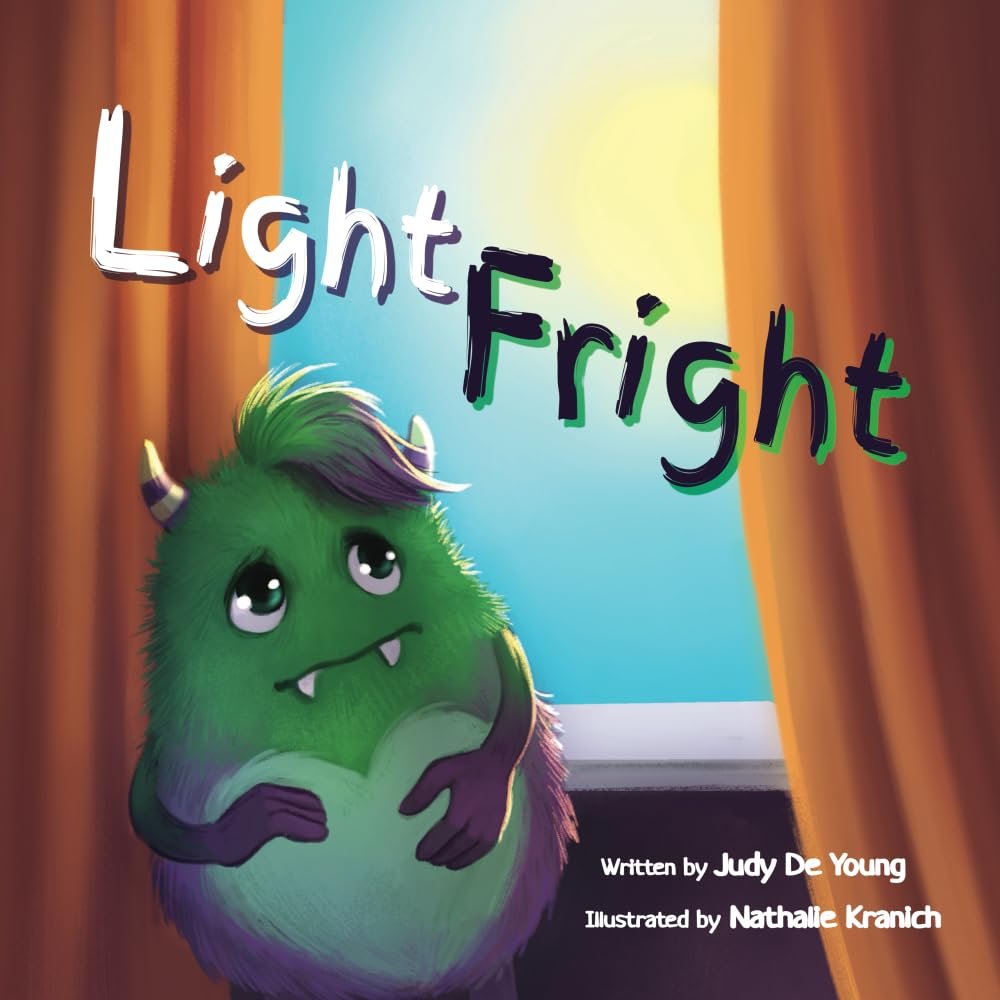
Marley Monster fears children at bedtime in Judy De Young’s playful rhyming picture book, illustrated by Nathalie Kranich.
Books worth discovering. Authors worth knowing.
Marley Monster fears children at bedtime in Judy De Young’s playful rhyming picture book, illustrated by Nathalie Kranich.
Marley Monster fears children at bedtime, while Nathalie Kranich illustrates.
What could be hiding under a monster’s bed? In Judy De Young’s Light Fright, the delightful reversal is that the monster fears children. Public descriptions introduce Marley Monster, whose family sleeps when the sun comes up. Marley cannot settle because he imagines children lurking everywhere. His relatives try to understand what might help him sleep, while Nathalie Kranich’s illustrations accompany the rhyming text. These verified details are more than a novelty twist. They move a familiar bedtime worry to the other side of the bedroom door, allowing young listeners to laugh at a fear they may recognize without having their own feelings dismissed.
A successful bedtime picture book has to balance two competing moods. It can name what frightens a child, but dwelling on danger too intensely may make sleep harder. The premise of Light Fright introduces unease and then softens it through comic distance: the supposedly frightening creature is the nervous one. A child does not have to believe in monsters to enjoy the role reversal. It allows parent and child to speak about fear indirectly, using Marley’s predicament rather than demanding a confession about a real bedtime worry. Whether an individual child finds that approach reassuring will vary, and the book does not promise a universal cure.
The sunlit sleep schedule adds another inventive layer. Children ordinarily associate nighttime with closing their eyes and daylight with exploring. The monster family’s opposite routine changes what appears normal. That perspective shift can encourage a small but worthwhile recognition: an unfamiliar routine is not necessarily wrong, and even an imaginary creature may need support in a vulnerable moment. The publisher confirms that Marley and his creepy kin explore his fears; it does not establish an exact sequence of each family member’s actions. Readers should discover those details in the pages rather than in an invented summary.
A playful reversal of bedtime fear
The question at the center of the story is not simply whether children are dangerous. It is whether Marley can learn to feel safe enough to rest. Parents of young children know that bedtime anxiety often resists a quick explanation. A shadow or sound can become meaningful long after an adult has concluded there is no problem. Putting a monster in that emotional position gives the adult reader a way to approach reassurance with patience. The story’s tone is described as silly, so readers can expect humor to share space with the fear rather than demanding solemnity from beginning to end.
Because Light Fright is a rhyming picture book, sound is part of its encounter with young listeners. Rhyme can create an expectation of return, while rhythm can make a phrase pleasurable to repeat. That is a general observation about read-aloud form, not a quotation or technical analysis of De Young’s unseen lines. The illustrator’s role is similarly essential to the book’s identity. Nathalie Kranich is the credited artist, and illustrations in picture books can carry timing, expression and visual humor beyond what the words alone communicate. Families can linger over each spread to notice how words and pictures work together.
A particularly useful shared-reading strategy is to ask simple, open questions. What does Marley seem to think is nearby? What would you say to someone who could not fall asleep? Would the room look different from a monster’s point of view? These questions are not a hidden test of emotional progress. They invite play and conversation. Adults can also offer the child a choice about whether to discuss their own bedtime or stay in the imaginary world. The story becomes a shared experience rather than a prescribed method for making worries disappear.
Language, pictures and gentle conversation
Official bibliographic information describes the book as a 32-page picture-book title, and the author’s own page highlights its imaginative approach. Short-form storytelling leaves little room for exposition, so visual details and carefully chosen words matter. Children may first enjoy the reversal and only later begin to recognize parallels with their own feelings. Returning to a favorite page can be a form of attention rather than a sign that the lesson was missed. For young readers, repetition is often part of the pleasure of a book, especially one designed to be heard aloud.
The publisher description mentions rich figurative language, and the author makes teaching resources available. Those materials may be useful in a classroom or library setting, but it is important not to turn every reading into an assessment. Teachers can notice opportunities for vocabulary, rhyme and comparing viewpoints while leaving space for simple amusement. Likewise, a family need not attach a formal learning goal to a funny bedtime story. The child’s immediate response may be laughter, surprise, a question or a request to turn back a page; all are worthwhile forms of engagement.
An additional charm of the premise is how it treats a creature that might usually be the villain as a member of a family. Marley has relatives, a sleep routine and a problem he cannot solve alone. Such domestic details can make a fantastic character approachable. It can also encourage adults to avoid teasing a child for a fear that seems irrational from outside. If even a monster can feel uncertain about the dark, the feeling itself need not be shameful. That remains an interpretation of the verified premise, not a claim that the book explicitly teaches a particular therapeutic framework.
There may also be value in letting adults admit their own uncertainty. Bedtime routines sometimes become tense because a caregiver is eager for sleep to happen on a schedule. Light Fright gives the family an imaginary challenge that can be discussed without blaming anyone for not settling quickly. A parent can laugh with the child about the monster’s upside-down day and still take real concerns seriously. The official description says the family searches for what will help Marley; it does not support inventing a single magic solution. Read that way, the picture book may be useful as the beginning of a conversation rather than as the final word on it.
The illustration credit deserves full visibility. A picture-book narrative is often a collaboration in which the artist’s designs determine the humor and emotional accessibility of the setting. A monster can look menacing in one style and vulnerable in another; scale, expression and color can shape how a child experiences a page. Without analyzing unseen individual spreads, readers can still be encouraged to look carefully at Kranich’s credited visual contribution. The pages may offer opportunities to compare what the rhyming text tells and what the pictures suggest. That is one of the pleasures of shared reading: the child can discover visual details the adult initially overlooks.
Who should read it
Light Fright is well suited to families seeking a humorous read-aloud about bedtime worries, and to early-years educators looking for an illustrated story that offers openings for language play and emotional conversation. The familiar topic and picture-book format make it an accessible choice for younger children, although adults should judge readiness and individual sensitivities. Children who dislike scary imagery may prefer to preview the pictures with a caregiver. The joy here is the unusual shift in perspective, not a guarantee that reading one story will settle every bedtime challenge.
Judy De Young identifies herself publicly as a writer with experience creating learning activities for young children, while publisher materials credit Nathalie Kranich as illustrator. Those sources support a book framed around Marley’s bedtime fears and the family’s efforts to help. They do not justify inventing a final solution or claiming clinical benefits. Readers can approach Light Fright as a chance to share a gentle joke about who frightens whom and to open a conversation about the ways reassurance sometimes starts with being understood.
About the book.
Rhyming children’s picture book. Marley Monster fears children at bedtime, while Nathalie Kranich illustrates. Source-based book feature, not a firsthand review.
Independent book feature (not marked sponsored in the Journal Queue) This is source-based commentary, not a claim of firsthand reading or a verified critical evaluation. WordPress cover URL and media ID await publisher automation.
Found a book worth opening?
Books worth discovering. Authors worth knowing.
Return to the Journal →