
Miss Kappa da ridere
A pirate escape room turns into a mystery for Pera, Ely and Kenny.
Books worth discovering. Authors worth knowing.
Miss Kappa da ridere by Pera Toons combines a pirate adventure with riddles and comedy. Its public premise begins with an organised game, then asks what happens when the danger starts to seem real.
An editorial introduction to the book, its premise and the story surrounding it.
An escape room offers a comforting agreement: the danger is imaginary, the clues have been placed on purpose and there is a way out. Miss Kappa da ridere begins by putting that agreement under pressure. What if the game is no longer behaving like a game?
Pirates, puzzles and a changing set of rules
The published synopsis follows Pera, Ely and Kenny into a pirate-themed escape room. Alongside other participants, they encounter riddles and mysteries among inns, caves and ships. Disappearances make the situation harder to dismiss as entertainment, while the enigmatic Miss Kappa raises questions about who is directing events.
That outline offers the shape of the adventure without giving away its solutions. The attraction lies partly in the change of scale: a challenge entered voluntarily begins to demand more than its participants expected. The characters must interpret clues while also deciding how much they understand about the challenge itself.
The joke starts on the cover
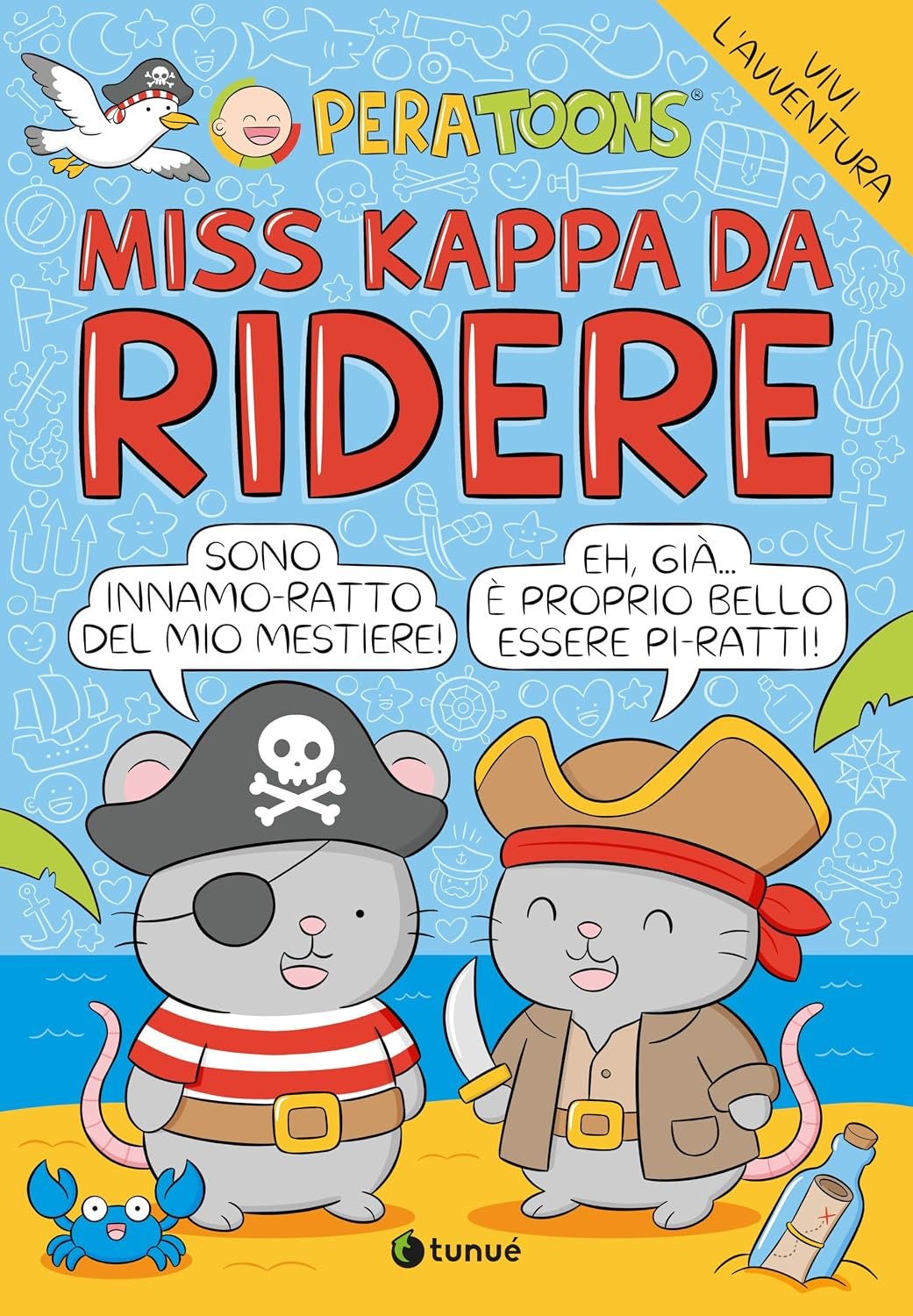
The supplied cover makes comedy visible before the book is opened. Two smiling rats wear pirate costumes on a yellow shore. One has an eye patch and striped shirt; the other wears a broad hat and red bandanna. A crab, a bottle containing a map and a pirate-hatted bird extend the nautical setting.
The speech balloons play with Italian words containing the sound of ratto or ratti. The animals are not merely dressed as pirates: their identity becomes part of the language joke. That is an observable detail of this cover, and a useful indication that the humour depends on both words and pictures.
Why the Italian matters
Wordplay is especially tied to the language in which it appears. A joke can rely on a familiar phrase being divided differently, or on a sound leading the reader towards an unexpected meaning. A literal translation may explain the idea while losing the quick recognition that makes it funny.
Readers selecting this edition should therefore note that it is in Italian. For a child reading with an adult, the cover alone offers a small conversation about how the joke is constructed. For an independent reader, recognising that shift is part of the pleasure. This is not a claim about the difficulty of every joke or puzzle inside the book.
Adventure with room to laugh
A pirate setting provides instantly recognisable objects: hats, maps, ships and hidden destinations. An escape-room premise gives those objects another possible role, as things to inspect rather than scenery to pass by. The reader is invited to wonder what matters and what merely looks important.
Comedy can sit alongside that curiosity. A playful image may slow the rush towards a solution, allowing time to notice how a scene has been arranged. The public description promises a mixture of humour and mystery; this feature has not tested the puzzles or read the complete adventure, so it does not judge their difficulty or explain the ending.
The creator and the edition
Pera Toons is Alessandro Perugini’s pen name. His work is associated with cartoons, verbal jokes and illustrated riddles. The book is published by Tunué in its Tipitondi collection, with a listed release date of 6 October 2026 and a length of 160 pages.
ISBN 9788867908356 identifies the Italian hardcover linked here. Bibliographic details and the public premise can be checked in the Italian bookseller listing and Librerie.coop’s description. A publication announcement supplies creator background. Find more illustrated-book introductions in the MarketAnyBook Journal.
About the book.
Italian hardcover published by Tunué in the Tipitondi collection, dated 6 October 2026. Listed at 160 pages, ISBN 9788867908356, with a suggested reading age of seven and up.
This article is presented as a MarketAnyBook Book Feature based on supplied materials and verified public information. It is not presented as a full-book review.
Found a book worth opening?
Books worth discovering. Authors worth knowing.
Return to the Journal →