
No Books For Benjamin?
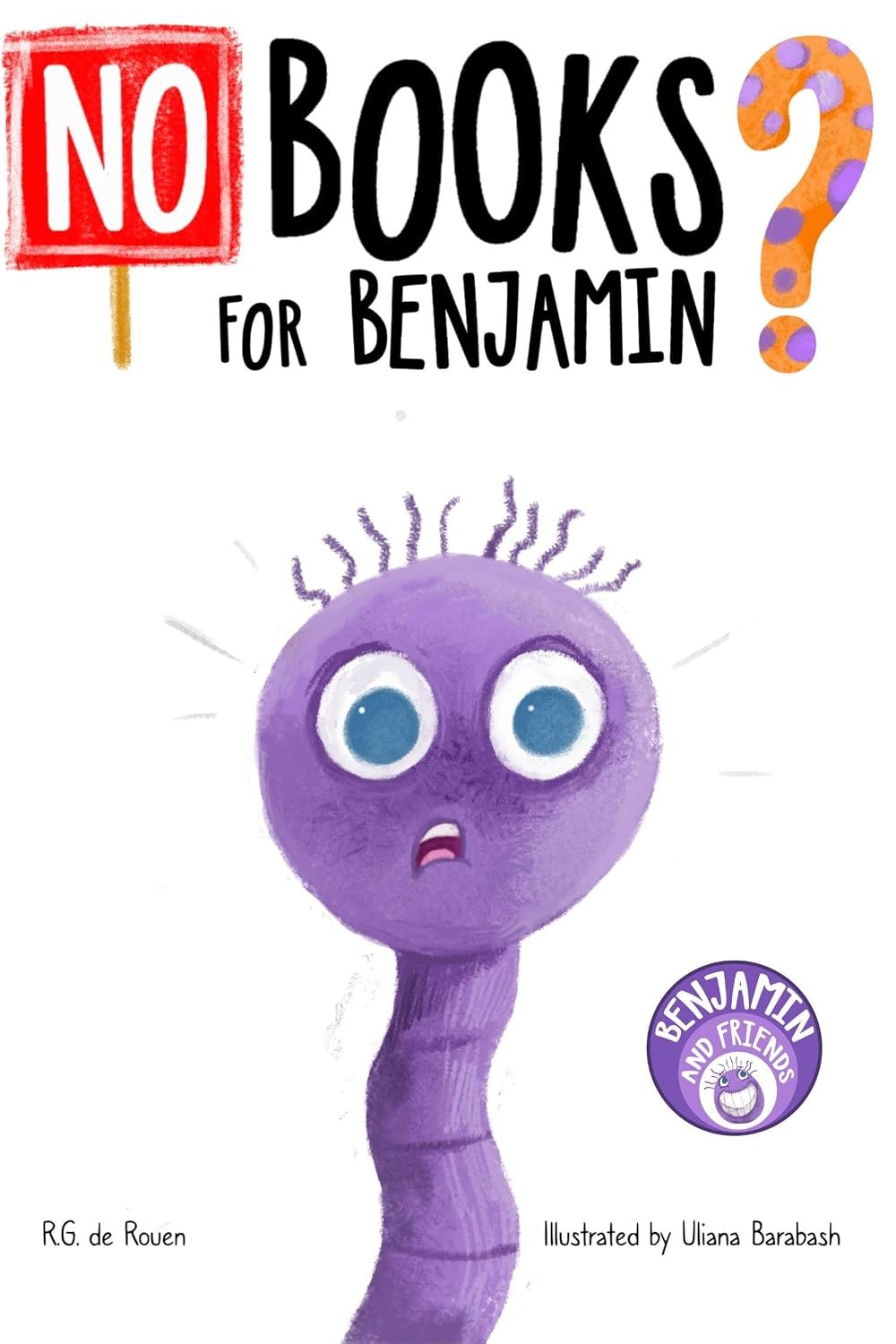
When a strange illness closes the library, Benjamin the bookworm and his friends try to keep stories reaching children.
Books worth discovering. Authors worth knowing.
When a strange illness closes the library, Benjamin the bookworm and his friends try to keep stories reaching children.
R.
When a Library Has to Close
To a dedicated bookworm, an empty library can feel like an impossible catastrophe. That is the dilemma R.G. de Rouen builds into *No Books For Benjamin?*, an illustrated story about a beloved character who has to find a new way to get books into children’s hands. The author’s website explains the cause: a sickness known as the Purple Dots has closed libraries. Benjamin and his friends cannot simply resume ordinary borrowing, so they must think together about how reading can continue. It is an accessible premise for young audiences because it starts with a loss they can understand. A favorite place is suddenly unavailable, and something comforting has become difficult to obtain.
The author connects the story’s inspiration to the disruption experienced by educators during the COVID-19 pandemic. That real-world context matters, but the book makes a deliberate imaginative substitution. It invents a Purple Dots illness, allowing the picture-book world to explore interruption and resourcefulness without requiring a child to revisit a specific medical emergency in documentary detail. Its central question is not how to treat a disease. It is how a community maintains access to stories when ordinary shared spaces have to close. In that form, the challenge becomes a narrative about creativity, cooperation and the value of books as companions.
Benjamin Is a Bookworm With a Mission
Benjamin is a particularly apt hero for the subject. As a bookworm, he embodies both the literal world of insects and the familiar term for a person who cannot stop reading. The title of the second Benjamin story makes that enthusiasm immediately visible: what will become of him if there are no books? He is not presented as a solitary genius solving a problem while everyone else watches. The author’s summary says he works with friends, and public discussion of the book identifies the librarian as part of that effort. Each participant matters because the obstacle is bigger than any one character’s appetite for reading.
For a child listening to the story, this is an invitation to think about solving problems rather than waiting for adults to restore everything exactly as it was. Sometimes a difficulty requires asking for help, dividing the work and noticing which tools remain available. Sometimes it requires adapting a familiar rule. The book’s concept allows families and teachers to explore those strategies without turning the reading session into a lecture. Children can enjoy the ridiculousness of tiny insect characters confronting a very large problem while also recognizing the emotions under the humor: disappointment, confusion and the wish to share something meaningful with others.
An Illustrated Argument for Libraries
Libraries appear in children’s literature as safe, expansive places where new worlds can be reached without paying for each one. Benjamin’s crisis makes their importance more apparent by imagining their absence. When the shelves cannot serve the community in the usual way, what other relationships make reading possible? Librarians possess knowledge of what people need. Readers can encourage one another. Friends may help with practical tasks that no one individual can complete quickly. The story’s framework suggests that a library is not only a building full of objects. It is a network of people and habits that help knowledge circulate.
Illustrator Uliana Barabash is explicitly credited alongside de Rouen in book records. Her role is essential rather than ornamental. In a picture book, illustrations carry motion, comedy, character and explanation that prose alone might struggle to offer to a young audience. Images of Benjamin’s insect world can give children reasons to notice details, predict actions and return to favorite pages. A read-aloud experience often involves two stories at once: the sentences spoken by the adult and the visual discoveries made by the child. Recognizing Barabash’s contribution also respects the collaborative nature of children’s publishing.
A Fictional Problem With Familiar Echoes
Many adults remember the strange feeling of suddenly closed schools and libraries, remote routines, and improvised ways to stay in touch. Children may remember those experiences differently or know them only through family stories. The Purple Dots device makes space for both kinds of reader. A grown-up can recognize the inspiration while a child follows a fictional disruption that has its own playful rules. This can open a conversation about how communities responded to difficulty. It should not be mistaken for a source of current public-health instructions; its primary purpose is narrative and educational, not medical guidance.
The moral possibilities are wider than simple persistence. Cooperation depends on acknowledging that other people have ideas one has not yet considered. It requires patience with mistakes, and sometimes a willingness to let someone else take the lead. Benjamin’s situation is particularly suited to practicing these ideas because the objective is generous: get books to people who want them. The stakes may be modest when compared with an epic adventure, but they are recognizably social. An action helps more than the person performing it. A child can understand why the outcome matters because the pleasure of reading is something meant to be shared.
What Makes a Read-Aloud Work
A picture book is often judged by the conversation it creates as much as by the printed story. The adult can ask what the problem is before revealing the characters’ response. A child can point to the helpers in an illustration or imagine another method for sharing books. Families might connect the story to a visit to their own library, a school book exchange or a shelf at home where titles can be lent to friends. These are suggested ways of using the premise, not claimed exercises printed in the book. They extend the identified values of teamwork, early literacy and curiosity into an ordinary afternoon.
De Rouen’s author site describes his background in education and his interest in encouraging children to love books. It also places Benjamin’s adventures within a broader commitment to imagination and reading. That provides a stronger basis for describing the book’s purpose than an invented scene would. It suggests why a bookworm hero should recur: young readers can come to know a character whose defining enthusiasm is itself one the author wants to foster. Instead of treating books as medicine for a problem, the story makes them desirable objects that inspire the characters to become creative and helpful.
The Joy That Survives Interruption
The title ends with a question mark, and that punctuation captures the energy of the premise. It is not simply a gloomy declaration that stories have disappeared. It asks whether there is a way forward. The excitement lies in watching characters respond when the obvious path is blocked. Parents and educators who remember how much children value stable routines may find this approach sympathetic: acknowledge a disappointing change, then invite imaginative participation in meeting it. The framing also offers a gentle reminder that access to reading should be taken seriously, even when the obstacle is presented in a brightly illustrated imaginary world.
A responsible introduction does not pretend to quote page-by-page dialogue or describe the full resolution without reading and verifying it. Public author material does establish Benjamin, the Purple Dots, closed libraries, the role of friends and the educational inspiration. Those details provide plenty of substance for a feature. For families seeking a book about the pleasure of reading and the resourcefulness of helping one another, *No Books For Benjamin?* offers an appealing invitation. Its small hero faces an enormous inconvenience, and the possibility that books may find their way back to readers becomes an adventure in itself.
About the book.
A disease called Purple Dots closes local libraries, leaving Benjamin the bookworm to solve how children can still receive books with the help of friends and a librarian.
Editorial book feature, not paid sponsorship. Independent research-based commentary using publicly available descriptions and author material, not a claim of first-hand full-text review. The cover placeholder will be resolved by the owner’s publishing automation.
Found a book worth opening?
Books worth discovering. Authors worth knowing.
Return to the Journal →