
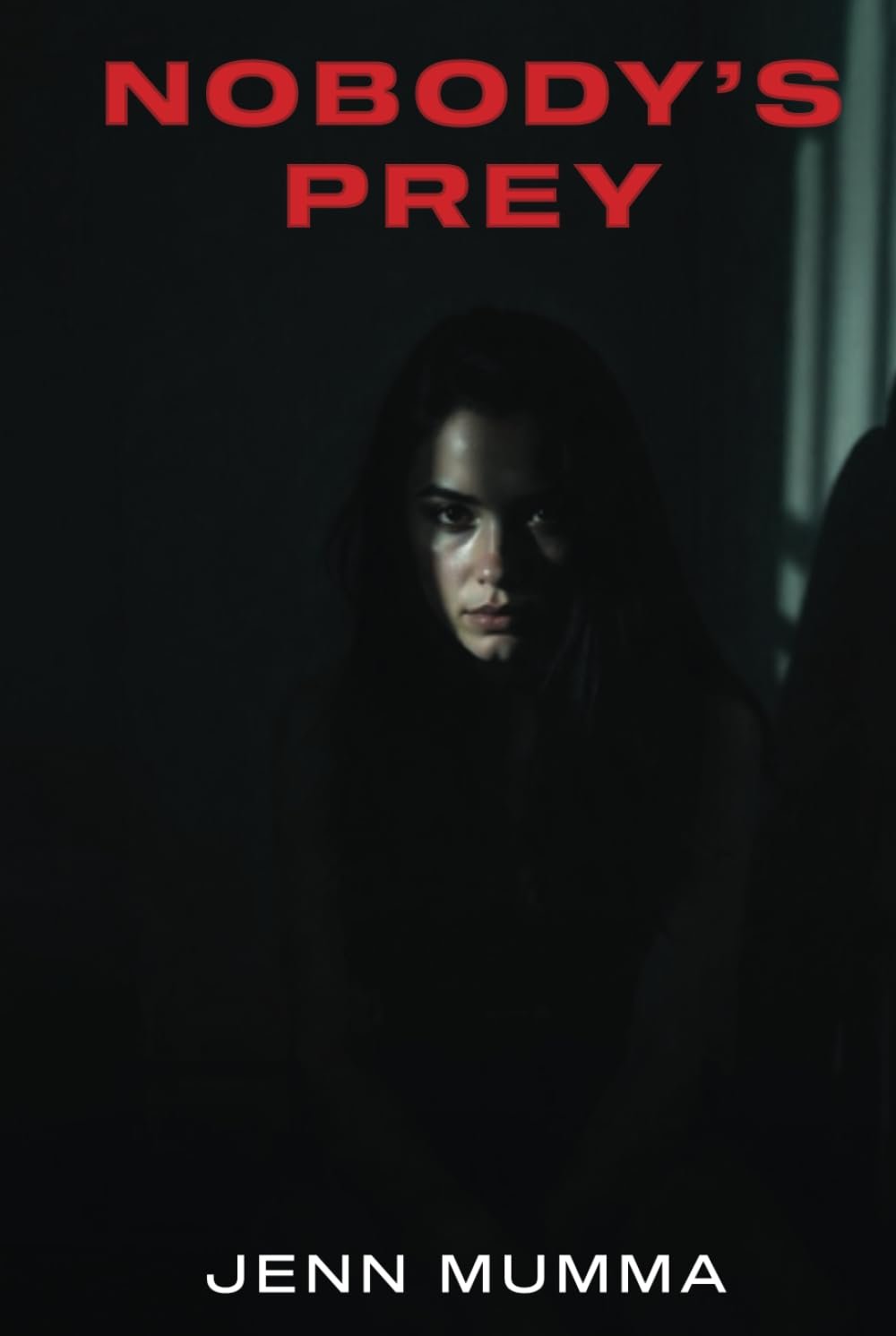
Nobody’s Prey
A survivor-centered book that refuses the identity a stalker imposes.
Books worth discovering. Authors worth knowing.
The strongest verifiable description of Jenn Mumma’s Nobody’s Prey presents a story concerned with stalking survivors and their resistance to intimidation.
An original critical assessment, grounded in verified public book descriptions.
The strongest verifiable description of Jenn Mumma’s Nobody’s Prey presents a story concerned with stalking survivors and their resistance to intimidation.
A survivor is not a role assigned by the offender
The strongest verifiable description of Jenn Mumma’s Nobody’s Prey presents a story concerned with stalking survivors and their resistance to intimidation. Some catalogue records identify the author as Jennifer Mumma, while the MarketAnyBook queue uses Jenn Mumma; the identity of this naming variation should be reconciled against the cover and publisher before publication. The core title, however, is already an argument. “Prey” defines a person from the standpoint of someone exercising predatory power. To reject that label is not to claim that fear or trauma evaporates. It is to insist that a survivor’s life cannot be adequately described by the person who threatens it. That distinction offers the work a serious emotional and social purpose beyond the mechanics of a frightening situation.
Stalking is a pattern, not a single dramatic incident
In popular thrillers, pursuit can be reduced to a convenient series of chase sequences. Stalking often works more insidiously through repetition, intrusion, uncertainty and the destruction of a person’s ordinary sense of freedom. A responsible account needs to make room for those cumulative effects while avoiding the suggestion that a target must act perfectly to deserve safety. The available catalogue copy describes the book as drawing on the author’s life experiences and as a testament to survival. That is enough to identify the intended perspective, but not enough to verify which episodes are autobiographical, exactly how they are narrated, or which institutional responses the text discusses. Those distinctions should remain explicit rather than being filled with plausible-sounding details.
Courage without an unrealistic demand
Books written for or about survivors face a difficult narrative temptation. The author wants to offer hope, and hope is necessary; but if the ending makes recovery look like an act of solitary willpower, a story can inadvertently place responsibility on those already living under threat. The description emphasizes courage and determination. A thoughtful reading should ask whether those qualities are shown alongside support, social context and the unevenness of healing. One form of strength is taking action; another is acknowledging vulnerability and seeking help. Nothing in the available listing establishes how Mumma negotiates these forms of strength, so it would be improper to praise or criticize her handling of particular scenes. The editorial value lies in keeping that question visible.
The difference between testimony and entertainment
A “page-turner” about harassment can attract readers through danger, but the subject resists being treated as pure spectacle. The most compelling work in this area gives the person at the story’s center complexity outside the perpetrator’s attention. Their friendships, work, humor and imperfect decisions need space to exist. In that sense the title promises an important reversal: the threatened individual becomes a person again rather than a narrative object to be chased. Available descriptions do not settle whether the book is best categorized as autobiographical testimony or fictionalized suspense; the safest editorial approach is to describe its survivor-focused framing without inventing a more exact classification. A publishing-quality review should verify the genre and named contributor credit.
An important subject, carefully qualified
Nobody’s Prey is likely to interest readers looking for survivor-centered writing about stalking, personal safety and the refusal to let intimidation define a life. Readers for whom such subject matter is distressing should consider that emphasis before choosing it. Those seeking a legal or safety manual should not assume one is provided; practical support is best obtained from qualified local services. The known premise makes a meaningful promise of agency, but full-text access is needed before the review can speak authoritatively about structure, sensitivity or style. It deserves a serious, non-sensational consideration, and the current draft should be treated as the beginning of that evaluation rather than the final word.
About the book.
This review examines the documented premise and its critical implications; literary execution cannot be completely assessed without a full text.
Non-sponsored editorial review according to the MarketAnyBook queue. Based on publicly accessible descriptions and bibliographic evidence; it is not a claim of full-book firsthand reading. Assessments of unverified interior craft are withheld.
Found a book worth opening?
Books worth discovering. Authors worth knowing.
Return to the Journal →