
Nos Meilleurs Amis – La véritable histoire de Friends
Laurent Hopman and Isaac Jadraque turn to the people and production behind Friends.
Books worth discovering. Authors worth knowing.
Nos Meilleurs Amis – La véritable histoire de Friends follows the making of a television phenomenon through comics. Laurent Hopman supplies the script and Isaac Jadraque the drawings in this account published by Deman Éditions.
An editorial introduction to the book, its premise and the story surrounding it.
A television comedy can make a room feel familiar enough to belong to its audience. The work that creates that familiarity usually remains outside the frame. Nos Meilleurs Amis – La véritable histoire de Friends directs attention toward that other story: the people, decisions and pressures behind the show.
Looking beyond the finished episode
Deman presents the book as a graphic account of the Friends phenomenon, including its production environment and the experiences of the six performers at its centre. Laurent Hopman writes the script, with drawings by Isaac Jadraque. The publisher emphasises the contrast between the programme’s public success and the demands of making it.
That focus distinguishes a production history from an episode guide. The interest lies in how a series comes together and how its participants work within an industry, rather than simply in what happens to fictional characters. Readers can approach the book with affection for the programme while remaining curious about the labour behind the familiar result.
Why tell television history in comics?
A graphic account can place people, rooms and working relationships in a shared visual space. It can make a change of setting immediate and allow a reader to pause over a face or a gesture. Those possibilities are particularly relevant to a subject already associated with a strong visual memory.
The form also asks readers to distinguish documentation from reconstruction. Drawn scenes necessarily involve choices about framing and emphasis. When reading graphic nonfiction, it is useful to consider how the account signals sources, interprets events and gives shape to conversations. This feature introduces the book’s stated approach; it does not claim to have independently audited every scene.
The cover opens the door
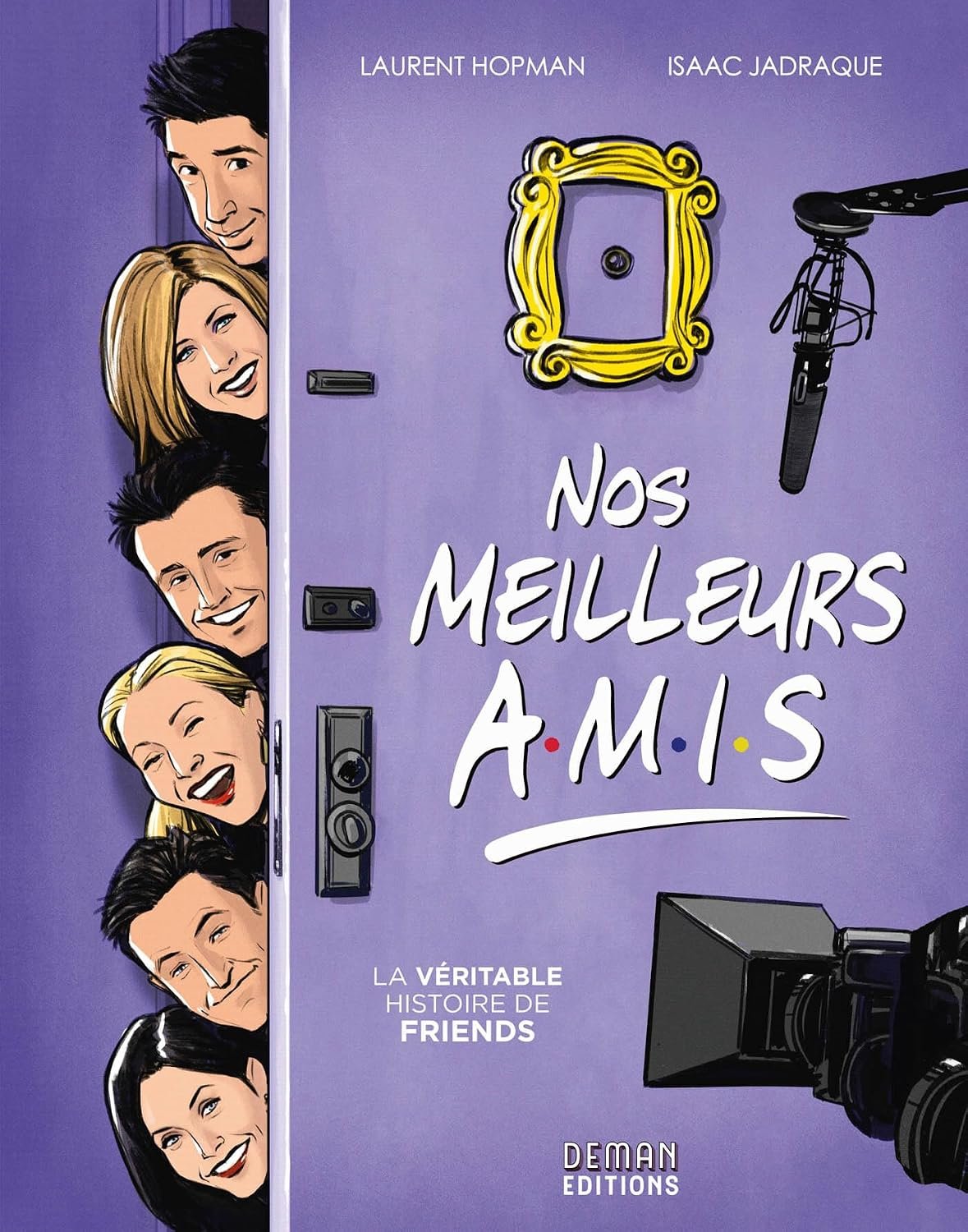
The supplied cover makes the book’s perspective visible. Familiar-looking performers peer around a purple door, while a camera and suspended microphone enter the composition. The door evokes the world the audience sees; the equipment points to the production that makes that world possible.
That combination is a concise invitation to the subject. Recognition provides a way in, but the apparatus around the door encourages a second look. It suggests a book interested in the making of a shared cultural object, not just its most recognisable images.
The creators and the edition
Hopman’s background includes entertainment journalism and the graphic work Les Guerres de Lucas. Jadraque brings experience in illustration and animation character design. The pairing joins a writer concerned with production stories and an artist working in a medium built around expressive characters.
Deman lists publication on 7 October 2026, a length of 180 pages and ISBN 9782493184139. Readers interested in television history or graphic nonfiction can use those details to locate the French edition. This introduction is based on the publisher’s materials and the supplied cover, rather than a full-book review.
For creator biographies and edition information, see Deman’s official book page. The French edition listing confirms the script and drawing credits. Browse further features in the Journal.
About the book.
Deman Éditions, 7 October 2026. 180 pages. ISBN 9782493184139. Script by Laurent Hopman; drawings by Isaac Jadraque.
This article is presented as a MarketAnyBook Book Feature based on supplied materials and verified public information. It is not presented as a full-book review.
Found a book worth opening?
Books worth discovering. Authors worth knowing.
Return to the Journal →