
People's Choice
A society that describes its people as Winners and Losers has already made an argument about whose life is valuable. Litty Williams’s People’s Choice gives that.
Books worth discovering. Authors worth knowing.
A society that describes its people as Winners and Losers has already made an argument about whose life is valuable. Litty Williams’s People’s Choice gives that.
Evidence-conscious literary criticism, not a claim of firsthand full-text reading.
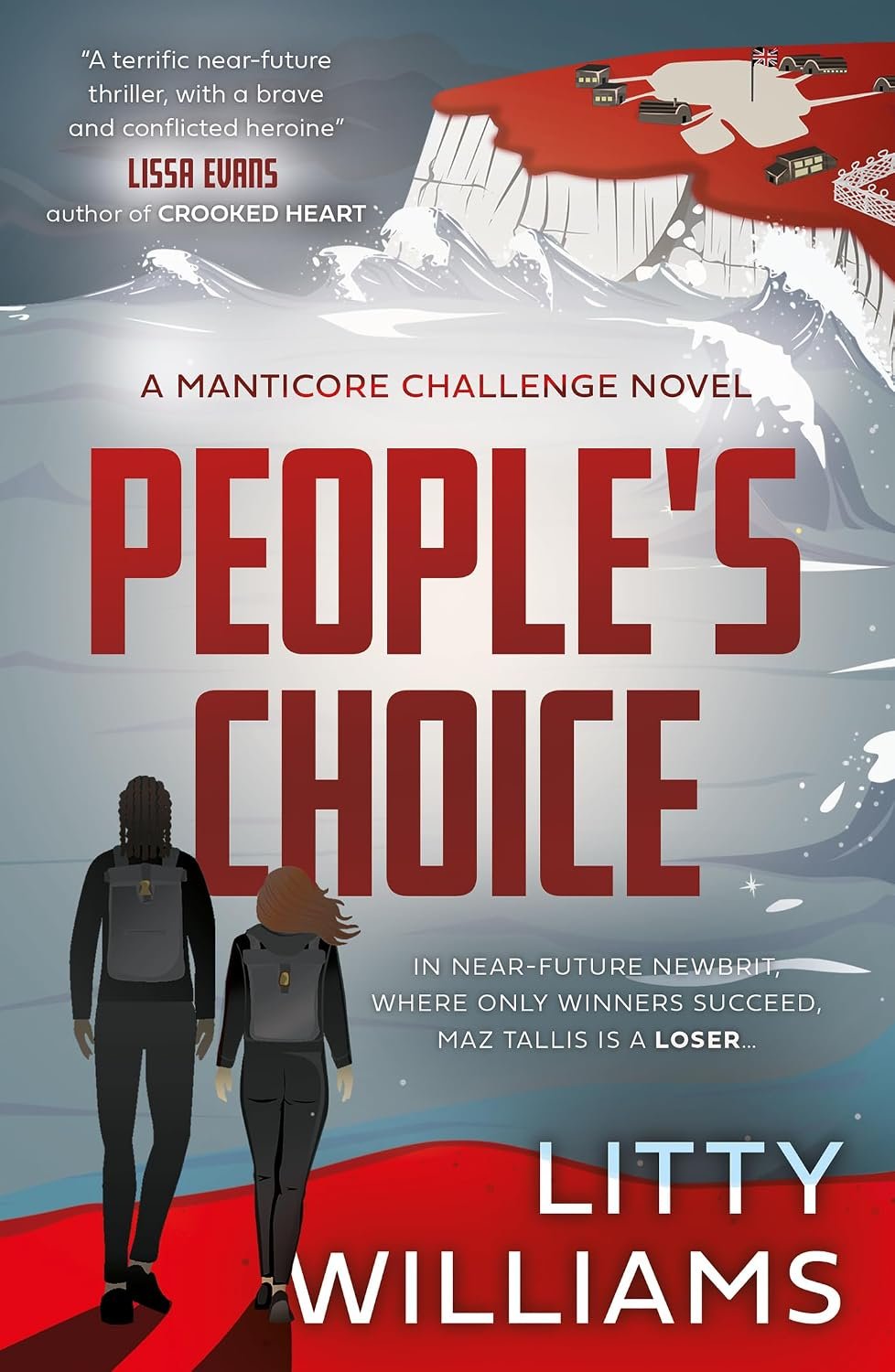
A society that describes its people as Winners and Losers has already made an argument about whose life is valuable. Litty Williams’s People’s Choice gives that argument a frightening institutional form in near-future NewBrit. Maz Tallis, classified as a Loser, needs costly medicine for her half-brother Kyle. The Manticore Challenge offers a possible solution: succeed in a competition and receive a thousand Life Chances, credits exchangeable for essential treatment. The premise turns a young person’s desire to save someone she loves into a contest in which the rules themselves may be unjust.
Survival made competitive The publisher’s synopsis places Maz at Albion House Academy during her final term. She enters the Challenge because the ordinary route to medical care is closed to her family. This is not simply a high-stakes game in the abstract; the prize is tied to a concrete need. The emotional power of the setup comes from that disproportion. Maz is asked to prove herself worthy of the resources that might prevent her brother from suffering. Such a system makes competition feel inevitable, even though the novel’s underlying question is why survival should be rationed through spectacle at all.
The language of Life Chances is particularly unsettling. It reduces biological vulnerability and social opportunity to a transferable currency. Dystopian fiction can use invented terms to make familiar inequities visible at a distance. Readers do not have to believe that a future society will literally create these credits to recognize the pressures that arise whenever health and status are joined. The novel’s social critique is therefore embedded in its rules rather than attached as an afterthought.
Rivalry and stolen agency Maz develops a plan to improve her chances, but Felix, described as a charismatic Winner, steals the idea and becomes a rival. The contrast suggests that even ingenuity cannot escape the stratification of the world. A privileged participant may be able to turn another person’s labour into an advantage. The story has room to examine whether Maz’s determination is enough when the definition of fair play belongs to people who already possess power.
A competition narrative depends on suspense, yet it also needs readers to care about more than who finishes first. The public description makes that possible by tying Maz’s choices to Kyle’s condition and to information she uncovers about the contest. When the threat of illness becomes more urgent, her need for the prize becomes acute. That should intensify the moral pressure without making the brother merely a device to trigger her bravery. The precise balance can only be assessed through the novel itself.
A dilemma larger than one family The publisher identifies a disturbing discovery that forces Maz to consider choosing between protecting her brother and exposing a wider threat. This is the book’s strongest critical hinge. The private obligation is immediate, intimate and emotionally compelling; the public obligation potentially affects many people she may not know. A simplistic story could make one answer obviously noble. A more persuasive one would insist that either decision has a cost, and that institutions which force such choices bear responsibility for the harm.
Young-adult dystopia often follows an individual who learns that personal success cannot be separated from structural injustice. Maz’s situation gives that movement a specific urgency. The Challenge is not simply a backdrop for rebellion; it offers her something she genuinely needs. The seduction of the system is therefore credible. Rejecting it may be morally necessary while remaining practically terrifying.
The work of a series opening This is listed as the first Manticore Challenge volume. A first book must introduce its economy of power, its protagonist’s relationships and the rules of competition clearly enough that readers can make moral judgments without being lost in terminology. It also has to leave meaningful possibilities for subsequent books. The known synopsis supplies strong thematic architecture, though it does not permit a verdict on pacing, characterization beyond the premise or the final handling of the dilemma.
Meritocracy as a story people are forced to believe The terminology of Winners and Losers makes hierarchy seem like the result of individual effort rather than a rule imposed by those with advantages. Maz’s rival Felix is described as a Winner who appropriates her idea. That episode makes the ideology vulnerable to criticism from within: a competitive society may celebrate originality while rewarding the person best placed to claim it. The book has the opportunity to show how apparent talent can depend on resources and access that remain invisible to spectators.
The Manticore Challenge also gives the genre an unsettling spectator dimension. An institution that converts suffering into competition needs participants, rules and some audience willing to call the results fair. Readers may be invited to recognize their own fascination with elimination narratives even as they question what those narratives justify. This creates a useful formal tension for dystopia: the competition must be exciting enough to sustain a novel without making its political cruelty seem admirable merely because it is entertaining.
The burden placed on love Maz’s care for Kyle motivates her entry, but it also makes her vulnerable to manipulation. A system able to price access to essential treatment can exploit the loyalty of family members who would otherwise reject its terms. That is a sharper premise than a generic contest for glory. The most important choice may come when the protagonist begins to see that winning could preserve the system for everyone who follows her. Neither loyalty nor resistance is easy when a sick relative is waiting. The public synopsis confirms the existence of that dilemma but leaves the artistic fairness of its handling for a complete reading.
For readers who want stakes beyond the game <em>People’s Choice</em> looks well suited to readers of socially conscious young-adult dystopia, especially those interested in class, health inequity and competition as an instrument of control. The premise contains illness, exploitation and moral coercion, so it may be heavier than the format of a contest initially suggests. Readers interested only in a neutral tournament story should expect more political and ethical pressure.
The most promising question in Williams’s book is not whether Maz can win a thousand Life Chances, but why a human being has to win the right to save someone in the first place. By making the system attractive to its victim even as she discovers its injustice, the premise creates a genuinely difficult basis for speculative fiction. A full-text reading is needed to judge the execution, but the ethical design is already distinctive.
About the book.
The title, contributors, routing category, original retailer link and unique Drive image file were checked against the live queue. The review is based on publicly available evidence and original editorial analysis.
This is an unsponsored editorial book review. This research-based critical review interprets the verified book listing and available external descriptions; it does not claim a complete reading.
Found a book worth opening?
Books worth discovering. Authors worth knowing.
Return to the Journal →