
Quiet Riot: True Tales of Softly Spoken Superheroes
Forty profiles of quietly influential people challenge the idea that young leaders must always be loud.
Books worth discovering. Authors worth knowing.
Forty profiles of quietly influential people challenge the idea that young leaders must always be loud.
Nadia Finer presents forty role models for quietly inclined young readers, with illustrations by Holly Farndell.
The accomplishment of not being the loudest person in the room
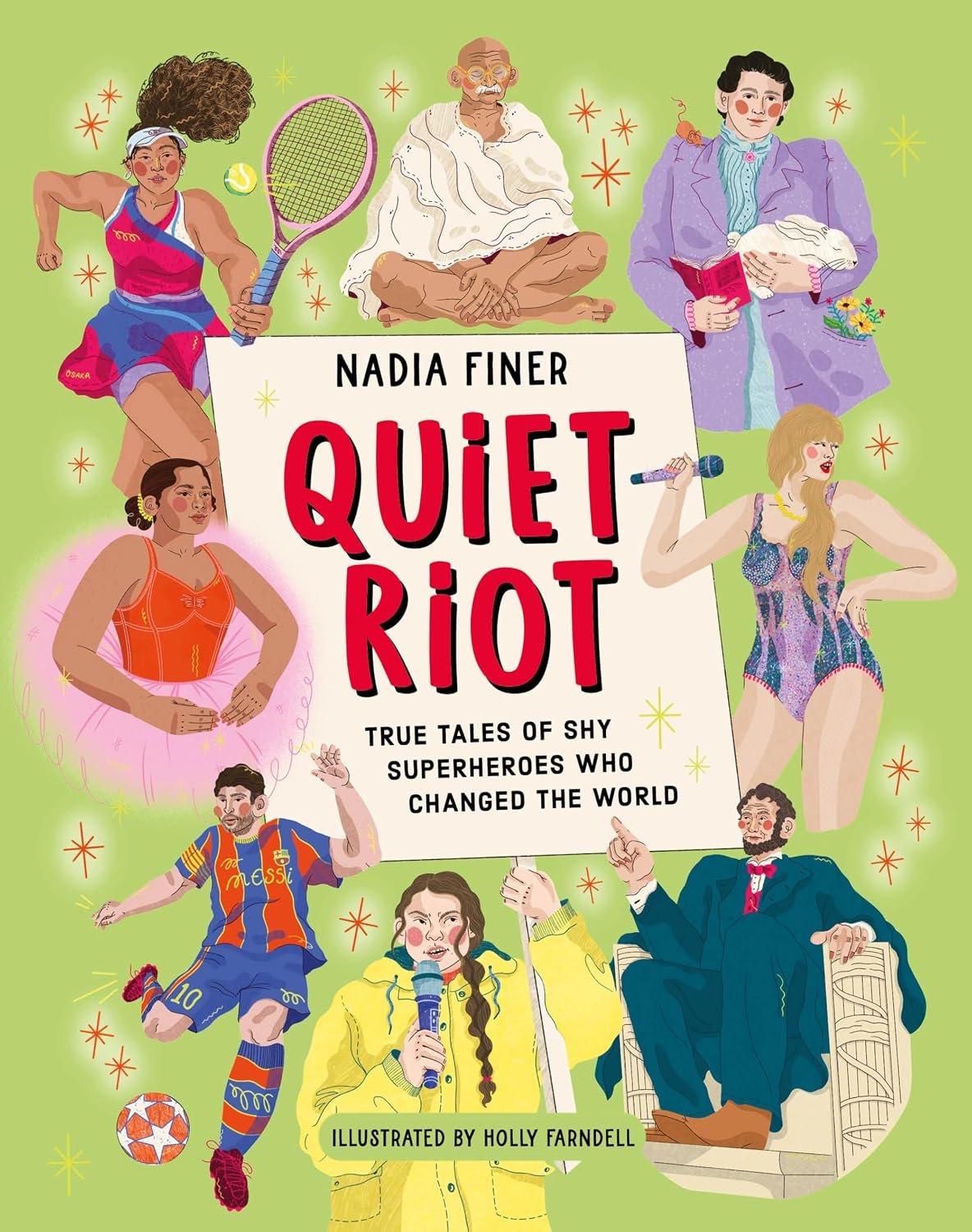
Nadia Finer’s *Quiet Riot* begins from a striking question about public achievement: why do stories of success so often sound like stories about being confident, extroverted and comfortable at the center of attention? The publisher positions the book as an alternative for children who are shy or softly spoken, using forty profiles of people who made a mark in remarkably different fields. Rather than promise that every quiet child will become famous, its more useful proposition is that a quieter temperament need not disqualify someone from taking action. That distinction matters. Children receive social signals about leadership long before they can name them, and many of those signals favor the person who answers first or speaks most forcefully. The book’s subtitle describes “softly spoken superheroes,” but its subject is human rather than supernatural. The featured people are athletes, artists, activists, writers and public figures who provide different points of entry into the same conversation. The publisher names figures including Naomi Osaka, Lionel Messi, Taylor Swift, Billie Eilish, Greta Thunberg, Marcus Rashford, Beatrix Potter and Emily Brontë. This is a deliberately broad range: a child uninterested in sports may connect with a writer, while someone unexcited by literature may look toward performance or activism. The range also invites a healthy question about what we mean by achievement. Making an impact can involve persistence, preparation, attentive listening and commitment, not simply possessing an imposing voice.
Profiles as permission, not as prescriptions
A collection of short biographical examples can offer a different sort of encouragement from a conventional how-to guide. Instead of telling a reader to change personality, it offers instances through which a young person may reconsider assumptions. That approach is especially suitable for children who have experienced shyness as a criticism. The useful editorial conversation is not whether every person profiled identifies with precisely the same temperament; personalities are complicated and public images are incomplete. It is how the stories widen the available picture of people who act courageously. A famous musician’s experience may not resemble an ordinary school day, but the underlying question about finding one’s place is still recognizable. The book’s structure also creates opportunities for selective reading. A teacher or parent could introduce an athlete first, then invite a child to choose a figure in another field. Such use is a suggestion for readers, not a claim about exercises contained in the book. The important movement is from a supposedly fixed label—”I’m the shy one”—toward curiosity about capacities, preferences and goals. Some children will want practice speaking publicly; others will discover that thoughtful preparation, collaboration or one-to-one persuasion is their natural contribution. The achievement is allowing space for more than one kind of participation, while neither romanticizing silence nor treating quietness as a problem awaiting correction.
An illustrated invitation to reconsider confidence
Holly Farndell is credited as the illustrator, a significant part of the identity of this children’s nonfiction title. An illustrated approach can make a large cast of well-known individuals approachable without expecting young readers to process a conventional adult biography. The publisher describes forty stories and a visually engaging presentation for roughly middle-grade readers; the published listing places its principal age range around eight to twelve. Those facts help set expectations about how families and educators might encounter the book. This is not an exhaustive study of fame, nor is it a clinical assessment of anxiety or introversion. It is a library of entry points for conversations about contribution. It is worth distinguishing shyness from introversion, anxiety and simply preferring a smaller social circle. They overlap in everyday speech, but they are not interchangeable experiences. A child who is distressed by overwhelming fear may need thoughtful adult support beyond any encouraging book. A child who prefers observing before speaking may need no correction at all. *Quiet Riot* is best considered as a culturally useful counterweight to the idea that personality is destiny. Its bookish appeal rests in the chance to learn about people and then apply a modest personal insight: perhaps someone can be uncertain, reserved or soft-spoken and nevertheless find an effective way forward.
The challenge of defining a role model
A celebrity biography can inspire, yet celebrity can also make the distance between a reader’s daily life and extraordinary success feel enormous. Here the productive discussion is not “be the next” celebrated figure, but “what action could someone take at their own scale?” A child might admire an athlete’s discipline without wanting a professional sports career, or relate to a writer’s imaginative independence without ever publishing a book. Parents can draw attention to quiet acts that do not become headlines: asking a considered question, working patiently on a difficult skill, helping a classmate, or keeping a promise. These are examples of possible conversations rather than undocumented anecdotes from the profiles. The phrase “changed the world” is intentionally ambitious, and readers can use it to ask what counts as change. Some contributions are obvious to millions; others unfold gradually in small communities. A resilient discussion of the book can make room for both. It also avoids a trap in motivational writing: the suggestion that a child’s worth depends upon achievement. A young person is not valuable because they might later be famous, persuasive or exceptional. The stronger message is that they can belong now, even while growing. The profiles become a set of lenses through which to question arbitrary definitions of leadership rather than a checklist of required success.
Making room for quiet participation at home and school
The book’s range of fields also gives adults a reason to notice how differently achievement is recognized. Schools often celebrate performance that is visible in front of a group, yet a child may contribute quietly by planning a project, writing carefully or noticing that a classmate is left out. A discussion inspired by the profiles can distinguish the act itself from the applause that follows. Quiet children should not have to demonstrate leadership in one approved public style before adults take their judgment or interests seriously. Such a conversation is not a claim that these exact classroom examples occur in Finer’s chapters; it is a practical application of the publisher’s stated mission. The most constructive use of an encouraging book is often ongoing rather than dramatic. A child might return to one profile after a difficult school day, or an adult might ask how a featured person found ways to act despite discomfort. There need not be an immediate breakthrough. Reading about a public figure is a chance to test an assumption, not a contract requiring the reader to imitate that person’s life. This modest approach respects the child and makes more room for the full spectrum of temperament, circumstance and ambition.
Who might find a place in this book
*Quiet Riot* is particularly promising for young readers who shrink from noisy group situations, for families seeking a constructive language around confidence, and for educators looking to diversify the examples of leadership they present. It may work well as a shared read, with adults asking which person surprised the child and which kind of contribution feels personally meaningful. It is less suited to readers expecting a detailed adult psychological manual or a guarantee that shyness will disappear. Readers should also remember that public biographies necessarily simplify complicated lives. Its value is in opening possibilities, not diagnosing a temperament or assigning a path. The book offers an invitation to celebrate attention, tenacity and thoughtfulness alongside more public forms of courage.
Nadia Finer and the team behind the book
Nadia Finer writes and advocates around shyness; the publisher identifies her as the creator of this collection of forty profiles. Holly Farndell provides its illustrations. Their collaboration gives the book both an explicit social purpose and a visual route into the subject. The UK and US publisher listings differ in ISBN and minor subtitle wording, so bibliographic details should be checked against the edition purchased.
About the book.
Illustrated children’s nonfiction about shyness and role models. Nadia Finer presents forty role models for quietly inclined young readers, with illustrations by Holly Farndell. Research-based editorial feature, not a firsthand review.
Sponsored book feature. Research-based commentary using verifiable published sources, not a claim of a complete firsthand reading. Cover placeholders await the owner’s Python automation.
Found a book worth opening?
Books worth discovering. Authors worth knowing.
Return to the Journal →