
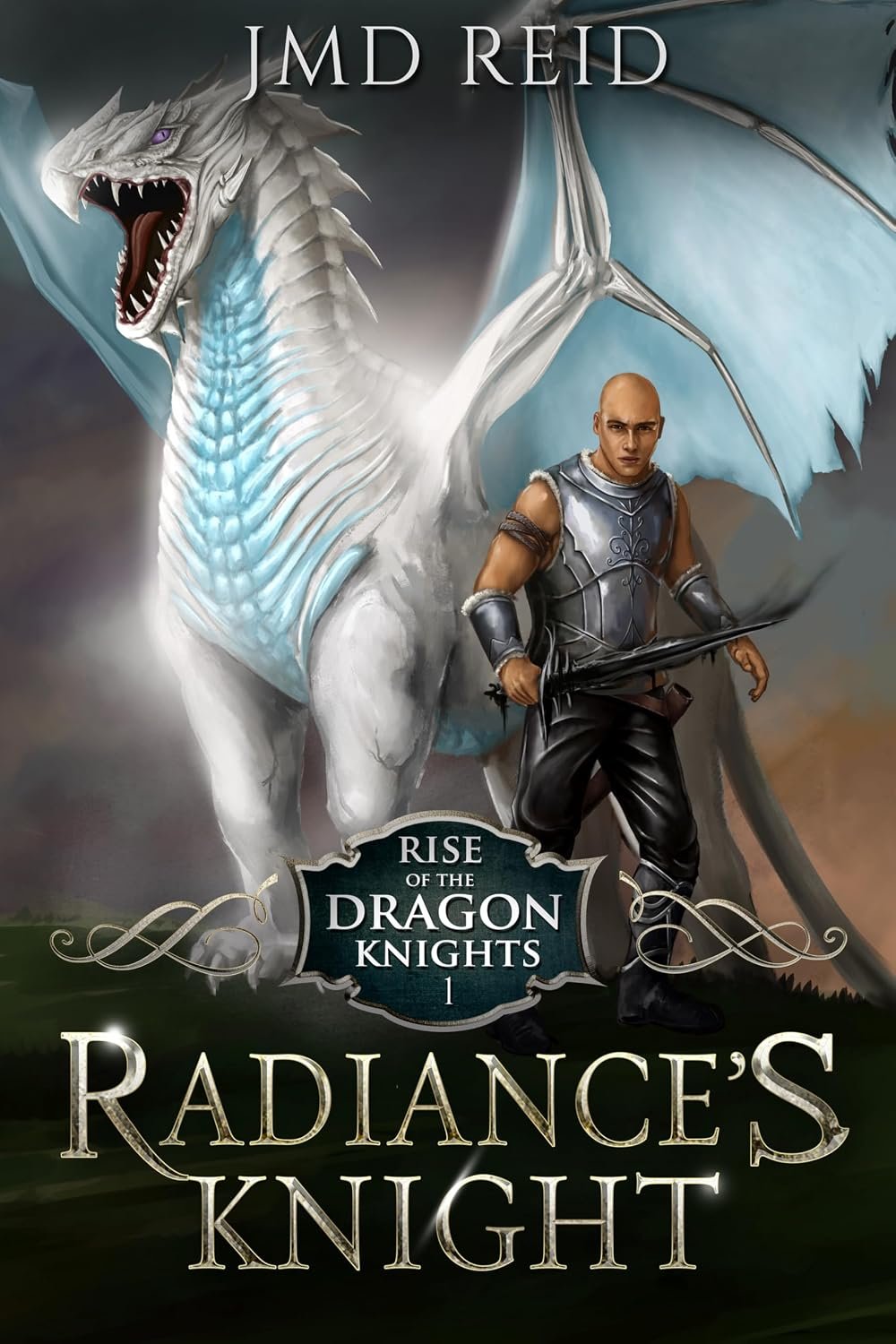
Radiance’s Knight
A desperate demon hunter and an emperor’s defiant daughter converge as the dragon knights’ forgotten legacy begins to awaken.
Books worth discovering. Authors worth knowing.
A desperate demon hunter and an emperor’s defiant daughter converge as the dragon knights’ forgotten legacy begins to awaken.
J.
When the Dragon Knights Are Only a Memory
JMD Reid’s *Radiance’s Knight* begins in a world that has learned to live without its greatest protectors. According to the public synopsis, the last dragon died three centuries earlier. Dragon knights once helped defend the population against rocky, demonic creatures, but that service has passed into history. The demons remain. Fighting them is now dangerous work taken up by desperate people seeking payment. This reversal creates an immediate tension between legend and daily reality. The world remembers a more powerful defense while ordinary individuals accept risks that might once have seemed unnecessary. Its fantasy grandeur begins not in a palace but in the economics of survival.
The young hunter Zhaid is introduced on his first demon hunt. He wants to escape poverty and the guilt he carries about his parents’ deaths. A few successful outings, he hopes, could change his life. The best demon hunters are known as the Craghammers, and he and his best friend must prove themselves. That is a practical, sharply motivated path into an epic setting. Before the story invokes the revival of dragon knights, it establishes a young person trying to earn money by doing something extraordinarily dangerous. The first scale of the conflict is therefore personal: can he risk his life to build a future that seems otherwise unavailable?
A Resource Worth Fighting For
The demons’ cores are valuable because they fuel magical practice and imperial power. This detail makes the creatures more than interchangeable fantasy monsters. The dangerous material they leave behind forms part of the setting’s economy, linking hunters who put their lives on the line to mages and political leaders who may never share those risks. When a resource becomes necessary to warfare, its value rises for reasons far removed from the people who extract it. Reid’s premise creates fertile ground for examining how survival work can serve ambitions that its workers do not control.
Zhaid’s desire for prosperity also carries a moral complication. The same hunts that might free him from poverty can feed an empire preparing for conquest. He need not be aware of every consequence for the system to involve him. Epic fantasy often becomes most interesting where an individual’s modest goal collides with a state-level project. Readers may admire a character’s determination and still worry about what his success makes possible. The public synopsis does not establish exactly when or how Zhaid understands this relationship. It does reveal the machinery that makes such an eventual confrontation plausible.
Princess Yhenli’s Dangerous Refusal
The other confirmed strand of the story concerns Princess Yhenli. Her father, the emperor, intends to conquer the world with military strength strengthened by golem creations and religious guidance from a figure called the Living Goddess. Yhenli is desperate to oppose him. The synopsis says she risks her position and life to protect a stranger connected to the awakening of a dragon. This creates a striking counterpoint to Zhaid. He is trying to gain standing and security from below, while she must decide how much standing and security to sacrifice from above. Their circumstances are unequal, but both are pressed toward decisions that can no longer remain private.
A daughter defying an imperial father is a classic dramatic conflict because political duty and family obligation are entangled. Yhenli’s opposition is not merely a disagreement with public policy. It involves the person who has shaped the court in which she was raised and whose authority determines her place within it. She may know how the machinery of power operates from the inside, yet that knowledge could make resistance more dangerous rather than less. We cannot infer the personal details of their relationship from the summary alone. The confirmed opposition is enough to situate Yhenli as a potentially essential moral force in the story.
The Return of a Forgotten Bond
The most exciting fantasy promise in the published outline is that a dragon is about to awaken and already has a bond with a knight. The emperor dispatches a formidable captain to prevent that knight from reaching the dragon. Here the remembered history of the dragon knights becomes a living threat to present power. Myths that seemed safely dead can reorder political calculations when they return as possible reality. To those who would benefit from dragon protection, the event may represent hope. To a ruler whose conquests depend on an unchallenged military advantage, it may look like catastrophe.
The bond itself offers rich narrative questions, even without inventing answers. Is a knight defined by birth, choice, loyalty or the bond’s own mysterious requirements? Can an unprepared person become a protector while still carrying fear and guilt? How does the return of an old institution change the expectations placed on someone whose original ambition was only to survive? Readers drawn to classic dragon fantasy will recognize familiar ingredients, but Reid’s synopsis places them amid resource extraction, class vulnerability and imperial warfare. That combination gives the revival a social as well as a magical meaning.
What Makes the Stakes Personal
Large-scale fantasy needs readers to care about individual decisions while armies and legends move around them. Zhaid’s poverty and his guilt about his parents provide one clear emotional entry point; Yhenli’s desire to stop her father’s violence provides another. Neither is introduced as someone whose life is uncomplicated. The narrative appears to depend on their willingness to risk what they have in order to pursue what they believe necessary. Their goals could at first seem unrelated, but the dragon-knight threat to the empire establishes why their stories belong in the same book.
The opening also gives readers a useful contrast between courage and desperation. A hunter may take a hazardous job because he has few alternatives; a princess may reject a secure position because she cannot tolerate the harm it enables. Both acts involve bravery, but they arise from different moral and economic pressures. Looking at those differences can deepen the reading experience beyond the spectacle of dragons returning. It encourages attention to the people who pay for a kingdom’s ambitions before heroic language makes the costs disappear.
The Beginning of a Larger Saga
Bibliographic listings identify *Radiance’s Knight* as the first book in *Rise of the Dragon Knights*. Starting a series creates two obligations: a novel should make its own central struggle meaningful, and it must establish a wider world with enough unresolved possibilities to justify another journey. The outline promises both intimate conflict and a revived institution capable of changing history. Readers who enjoy long-form epic fantasy may be especially drawn to that foundation. Someone seeking a standalone conclusion should note the series status before choosing when and how to read.
The research establishes the demons, cores, Craghammers, Zhaid, Yhenli, the imperial threat and the awakening dragon. It does not establish the ending, the precise combat sequence or which characters survive. Those discoveries belong to Reid’s storytelling. The book’s confirmed appeal lies in an ambitious juxtaposition: forgotten guardians, a war-driven empire, a young hunter who cannot afford to fail and a princess who refuses to accept what her father intends. *Radiance’s Knight* invites readers to watch a legend become urgently relevant again—and to consider who must make the difficult choices when old power returns.
About the book.
Zhaid hunts rocky demons hoping to leave poverty and guilt behind. Their cores power mages and the empire, while Princess Yhenli risks her place to prevent her father’s conquest and protect a newly bonded dragon knight.
Sponsored book feature. Independent research-based commentary using publicly available descriptions and author material, not a claim of first-hand full-text review. The cover placeholder will be resolved by the owner’s publishing automation.
Found a book worth opening?
Books worth discovering. Authors worth knowing.
Return to the Journal →